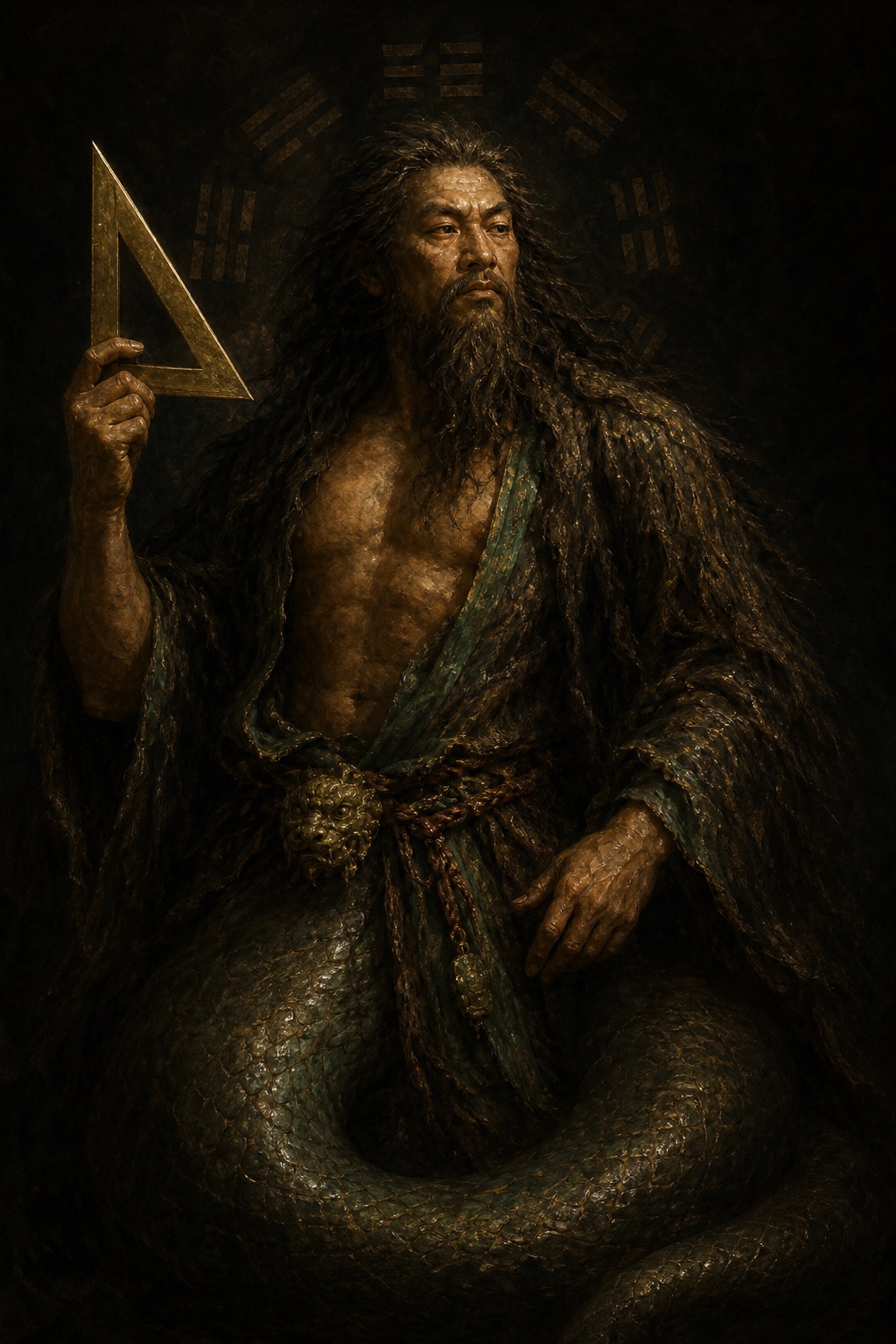
Fu Xi is the first of the Three Sovereigns and the culture-hero the Chinese tradition credits with the shift from mere survival to civilisation. The canonical account of what he did is a single passage in the “Xici”, the Great Commentary appended to the Yijing, and it describes a method rather than a miracle: he looked, and then he abstracted.
古者包犧氏之王天下也,仰則觀象於天,俯則觀法於地,觀鳥獸之文,與地之宜,近取諸身,遠取諸物,於是始作八卦,以通神明之德,以類萬物之情
“Anciently, when Bao-xi had come to the rule of all under heaven, looking up, he contemplated the brilliant forms exhibited in the sky, and looking down he surveyed the patterns shown on the earth. He contemplated the ornamental appearances of birds and beasts and the suitabilities of the soil. Near at hand, in his own person, he found things for consideration, and the same at a distance, in things in general. On this he devised the eight trigrams.” — Yijing, “Xici” II.2, tr. James Legge
The eight trigrams are the basis of the Yijing and, through it, of a great deal of later Chinese cosmology; the same passage goes on to credit him with knotting cords into nets for hunting and fishing. Other texts add the domestication of animals, the institution of marriage with proper surnames, and the replacement of knotted-cord record-keeping with written signs — the whole apparatus by which a population stops being a scatter of families.
He is paired with Nüwa, who is named as both his sister and his wife, and Han-dynasty tomb reliefs show the two of them as human above the waist and serpent below, tails wound around each other, he holding a carpenter’s square and she a compass — the instruments for squaring the earth and rounding the heavens. In the flood myths preserved in later folk tradition the pair are the only survivors, and marry to repopulate the world, with all the hesitation about sibling marriage that the story requires and resolves through omens.
His name is written several ways — 伏羲, 宓羲, and the 包犧 of the passage above — and the Yijing commentary is where the classical tradition anchors him. Sima Qian’s Shiji begins its account of antiquity with the Yellow Emperor rather than with Fu Xi, which is one measure of how the historians and the cosmologists divided the deep past between them.