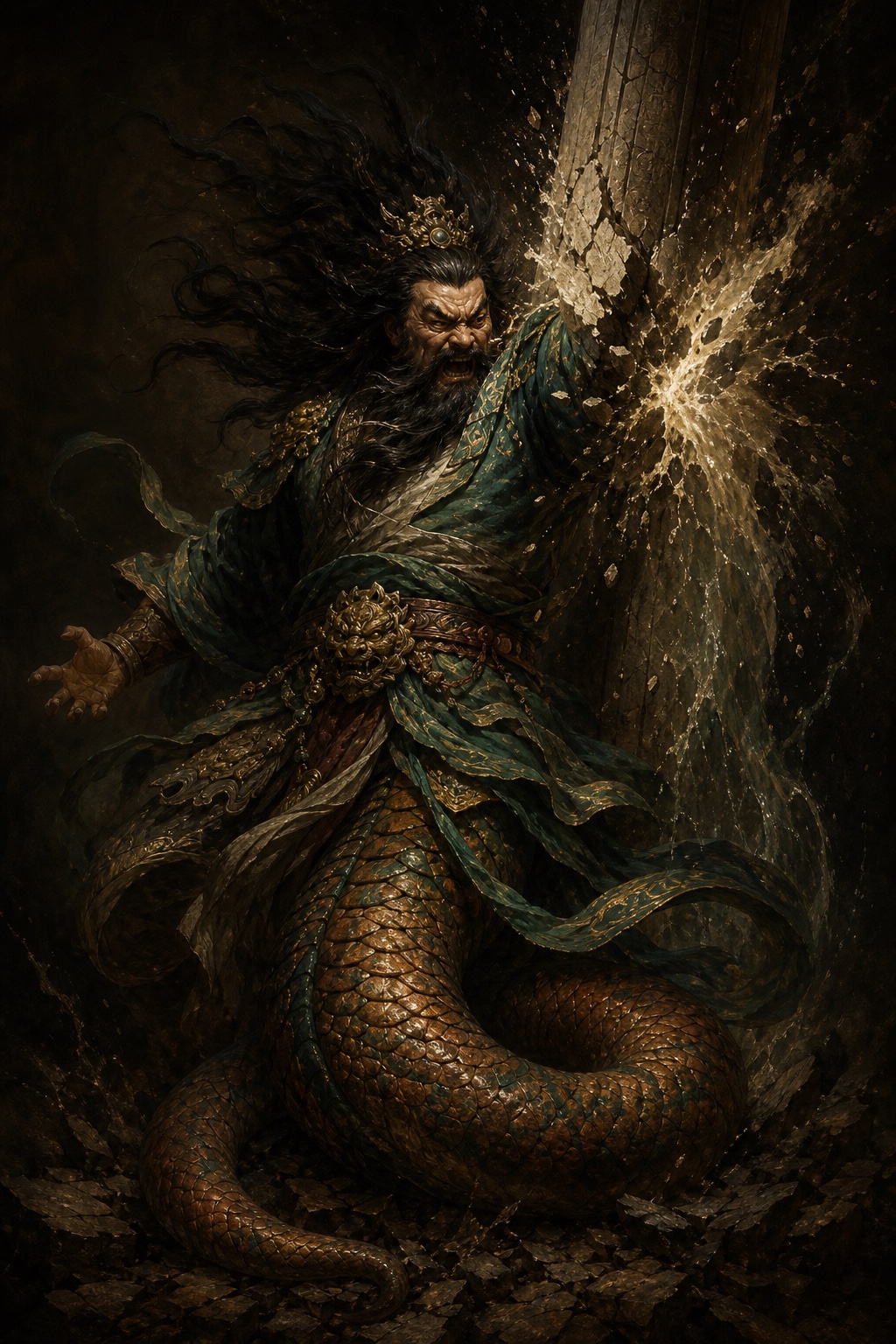
Denied the throne
Gong Gong’s name is also his old job title: 共工, Minister of Works, the office charged with rivers, floods and public works under the sage-kings. In this telling he wants a bigger one. He contends with Zhuanxu — one of the Five Emperors in the traditional chronology — for the throne of supreme sovereign, loses, and cannot let it go.
共工氏與顓頊爭為帝,怒而觸不周之山,折天柱,絕地維,故天傾西北,日月星辰就焉;地不滿東南,故百川水潦歸焉
“Kung Kung fought with Chuan Hsŭ for the throne, and, blundering in his rage against Mount Pu-chou, he snapped the pillar which connects Heaven and earth. That is why Heaven dips downwards to the north-west, so that sun, moon and stars travel towards that quarter. The earth, on the other hand, is now not large enough to fill up the south-east, so that all rivers and streams roll in that direction.” — Liezi, “Tang Wen,” tr. Lionel Giles
It reads less like a battle lost than a tantrum thrown afterward, and the shape of the world is left explaining itself around it: the sky tilts northwest, carrying the sun, moon and stars with it, because a rival who could not be emperor put his head through the mountain that held the sky up. The wreck is also the reason Nüwa has work to do — the sky Gong Gong breaks here is the very sky she has to smelt five-coloured stones to patch, in the fuller version of this same catastrophe that her own entry tells from the repairing side.
The older wreck
The Huainanzi’s own chapter on the heavens, “Tianwen Xun” 天文訓, tells substantially the same story, and it is the older of the two accounts — compiled a century or two before the Liezi passage above reached the form quoted here. The two tellings share the same bones: the same pillar broken, the same cord severed, the same tilted sky carrying sun, moon and stars northwest. They part company only in the last few characters, where the Liezi ends 故百川水潦歸焉 — the ordinary rivers converging on the southeast — and the Huainanzi ends 故水潦塵埃歸焉 — floodwater and dust. Two independent tellings of one wreck, not a copy of each other and not a contradiction: the kind of small variance a story produces once it is old enough to have reached two different books before anyone had written either of them down.
Court and kin
Behind the single famous act is a lineage the Shanhaijing’s “Classic of Regions Within the Seas” 海內經 sets out in one breathless line: Zhurong descends to dwell by the Jiang and fathers Gong Gong; Gong Gong fathers Shuqi, who is born with a flat, square skull and goes on to restore the soil there; Gong Gong also fathers Houtu, who fathers Yeming, who in turn gives rise to the twelve months of the year. It is a genealogy that runs straight from cosmic rebellion into the ordinary business of soil and seasons. Gong Gong’s own court keeps a stranger streak: his minister Xiangliu, remembered elsewhere in the Shanhaijing, is nine-headed and serpent-bodied. The monstrosity in the record belongs to the vassal more than to the master — nothing found here gives Gong Gong himself a body other than a man’s.
Minister of Works
Long before he loses a throne, the record already distrusts him in the job his name describes. In the Shangshu’s “Canon of Yao” 堯典, the minister Huandou recommends Gong Gong’s work on the floods as wide-reaching and accomplished; Yao’s answer is contempt — all talk, the sovereign says, respectful only in appearance, and the waters under his charge keep rising rather than falling.
Whichever reign the record catches him in, Gong Gong never keeps the position he holds.