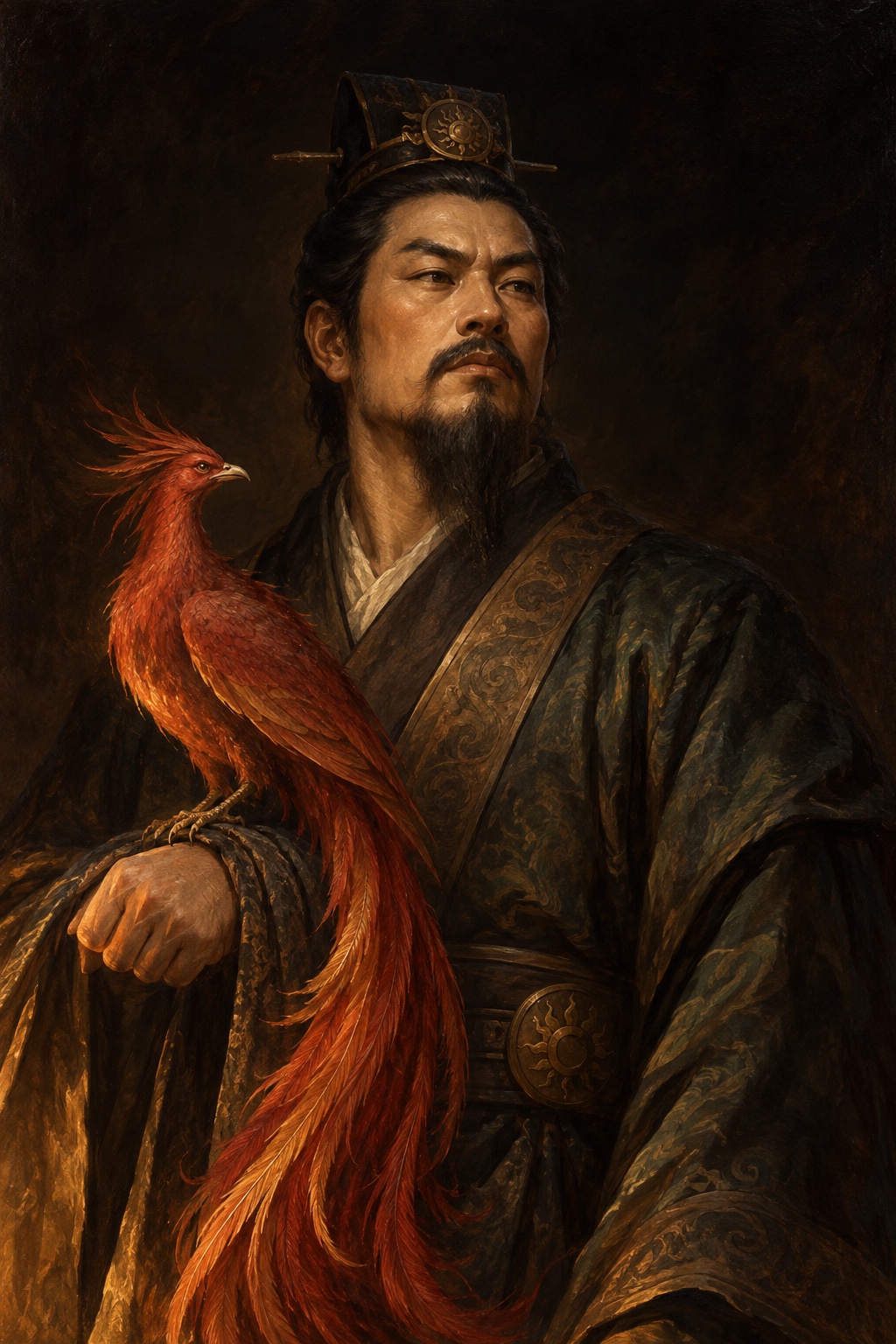
Two sons of one marriage
Yandi’s oldest story is not told for its own sake. It is a step in an argument, and the argument is about a wedding. The Guoyu’s “Discourses of Jin” follow the exiled prince Chong’er of Jin from court to court, and in Qin he is offered Huai Ying as a wife and means to refuse. His adviser Sikong Jizi — Wei Zhao’s commentary identifies him as the Jin officer Xu Chen — talks him round, and the speech opens by fixing its terms: those who share a surname are brothers. Then it goes back to the beginning of surnames.
Long ago, it says, Shaodian took a wife from the Youjiao clan, 有蟜氏, and she bore the Yellow Emperor and Yandi. The Yellow Emperor grew up by the Ji River, 姬水, and Yandi grew up by the Jiang, 姜水. Then comes the sentence the whole genealogy was brought in to support.
成而異德,故黃帝為姬,炎帝為姜,二帝用師以相濟也,異德之故也
“Grown, they were different in virtue, and so the Yellow Emperor became Ji and Yandi became Jiang. That the two emperors used armies to aid each other came of their different virtue.” — Guoyu, “Discourses of Jin IV” 晉語四; tr. Mythos Atlas
The translation follows what the characters say. 濟 is to carry across, to see through, to bring to completion, and 相濟 is the ordinary phrase for two parties who help each other. That is a strange thing to say of two emperors with armies, and stranger as the consequence of a difference in virtue, and the oldest full commentary to survive does not accept it. Wei Zhao, writing in the third century AD, says the character should be read as a different one, which he glosses as destroy: on his reading the two emperors used armies to destroy each other. He backs it with an older text’s statement that the Yellow Emperor fought at Banquan. The Guoyu sentence itself names no battle. The war reading is the commentator’s, and it agrees with the Shiji account below; the plain reading is the text’s, and it does not. This entry records both and does not choose.
What the speaker needs from the sentence is not the war but the surnames. 成而異德 — grown, they differed in virtue — and the surnames follow the virtue, so that one marriage ends in two clans, Ji and Jiang. By his own opening definition, the pair who began as sons of one father finish the sentence as something other than brothers. Wei Zhao loosens the family further. He reads 生, bore, as issued from: Shaodian and the Youjiao woman are the stock the two houses came from, not literally the parents of two men, and he points to the Zuozhuan’s talk of the talented sons of Gaoyang and Gaoxin, where sons means descendants. The Guoyu’s Yandi is a brother in the first clause, the founder of a separate surname by the last, and in the commentary perhaps a lineage rather than a man.
Three battles at Banquan
The Yellow Emperor’s own entry quotes the opening of Sima Qian’s Shiji with a gap in the middle, and most of the gap is Yandi. Between the decline of the house of Shennong and the rising of Chiyou, the “Annals of the Five Emperors” sets a few lines about a third party. They are the only lines in the chapter where Yandi appears.
炎帝欲侵陵諸侯,諸侯咸歸軒轅。軒轅乃修德振兵,治五氣,藝五種,撫萬民,度四方,教熊羆貔貅貙虎,以與炎帝戰於阪泉之野。三戰然後得其志
“Yandi wished to trample the lords, and the lords all went over to Xuanyuan. Xuanyuan then cultivated his virtue and roused his troops. He set the five energies in order, planted the five grains, calmed the myriad people and measured out the four quarters. He trained bears and grizzlies, pi and xiu, chu and tigers, and with them fought Yandi in the wilds of Banquan. Only after three battles did he have his will.” — Sima Qian, Shiji, “Annals of the Five Emperors”; tr. Mythos Atlas
Yandi gets one clause of his own, and it is a motive: 欲侵陵諸侯, he wanted to encroach on the lords and ride over them. He is given no speech, no appearance and no reason. Everything after that clause belongs to Xuanyuan, the name the Yellow Emperor carries until the lords make him Son of Heaven at the end of the same paragraph, and most of it is not fighting. Before a single battle Xuanyuan puts his own virtue in order, then the five energies, the grain, the people and the land. The beasts come last. Whether 熊羆貔貅貙虎 are animals he trained for war or companies named after them the sentence does not say, and the order of the list makes its point either way: the war is won by government before it is fought.
三戰然後得其志 — only after three battles did he get his will. That is the one measure of Yandi’s strength the Shiji gives. He was not beaten at the first meeting, and he was not beaten at the second. The history does not say what happened to him after the third. It does not say he died, fled or submitted; it moves at once to Chiyou, who defies the sovereign’s command and is captured and killed at Zhuolu, and the chapter never names Yandi again.
Nor does it call him the Yellow Emperor’s brother. The Shiji makes the Yellow Emperor a son of Shaodian in the chapter’s first line, but here Yandi arrives with no parentage at all, as a rival among the lords. The Guoyu’s two sons of one marriage and the Shiji’s enemy at Banquan are joined only by Wei Zhao, who read the Guoyu’s 相濟 as a war and pointed to Banquan to prove it. In this atlas the two relations are kept as two. The Yellow Emperor is Yandi’s sibling on the authority of the Guoyu and his rival on the authority of the Shiji.
Emperor of the South
The Huainanzi’s chapter on the patterns of Heaven divides the world and the year among five emperors, one for each quarter and each of the five phases. Zhuanxu has the north and water. Yandi has the south, and the phase of the south is fire.
南方,火也,其帝炎帝,其佐朱明,執衡而治夏。其神為熒惑,其獸朱鳥,其音徵,其日丙丁
“The south is fire. Its emperor is Yandi. His assistant is Zhuming, who holds the balance-beam and governs summer. Its spirit is the planet Yinghuo, its beast the Vermilion Bird, its note zhi, its days bing and ding.” — Huainanzi, “Tianwen” 天文訓; tr. Mythos Atlas
This is the passage that gives him fire, and it is worth being exact about how. The emperor does nothing in it. He is a name in a slot, 其帝炎帝, and the slot would be the same shape with any other name in it. The one active figure is the assistant. The chapter gives every quarter’s assistant a measuring tool — a compass for the east, a square for the west, a weight for the north — and in the south the tool is the balance-beam, 衡, held by Zhuming, who governs the summer with it. The planet Yinghuo, which is Mars, the Vermilion Bird, the note zhi and the days bing and ding are the correspondences of the quarter under the five-phase system. They are the south’s signs rather than anything Yandi wears or carries, and nothing in the chapter describes his person at all.
The ritual calendar keeps him in the same place and changes his attendant. The “Monthly Ordinances” of the Liji repeat the same line for each of the three summer months. This is the first month, in James Legge’s translation of 1885.
其帝炎帝,其神祝融
“Its divine ruler is Yen Tî, and the (attending) spirit is Kû-yung.” — Liji, “Monthly Ordinances” 月令; The Lî Kî, Book IV (“Yüeh Ling”), tr. James Legge (1885), Sacred Books of the East vol. XXVII
Kû-yung is Legge’s spelling of Zhurong, the fire spirit who has his own entry in this atlas. So where the Huainanzi puts Zhuming at Yandi’s side, the calendar puts Zhurong, and the two texts agree only that the south’s emperor is Yandi and that he does not stand alone. The Huainanzi complicates this from inside. Its own seasonal chapter, “Shize”, gives the far south to a Red Emperor and to Zhurong together, and does not say whether the Red Emperor is Yandi. Jingwei’s entry meets the same question from the other side, where one account of her calls her the daughter of the Flame Emperor and another the daughter of the Red Emperor.
The calendar also dresses someone in red for these months, and it is not Yandi. In the summer months the Son of Heaven rides a red carriage behind red horses, flies red banners, wears red and carries red jade. That is the king dressing for the season whose emperor is Yandi, and it is the nearest thing to a costume the early texts attach to his name. The ox-head, the herb held to the lips and the plough that later pictures give the Flame Emperor come from somewhere else, and the next section explains where.
Yandi and Shennong
Later tradition fuses Yandi with Shennong, the divine farmer who hewed the first plough and tasted the hundred plants, and writes the two names as one compound name. The ox-head, the herb and the plough of the later pictures belong to that merged figure, and none of them is in any text this entry quotes. The merger is old, but the objection to it is nearly as old, and it stands in the commentary on the very sentence of the Guoyu that records Yandi’s birth. The Han scholar Jia Kui had glossed the name there flatly: 炎帝,神農也, Yandi is Shennong. Wei Zhao quotes him and, on this point, does not agree, although a few lines later he sides with Jia about Shaodian.
昭謂:神農,三皇也,在黃帝前。黃帝滅炎帝,滅其子孫耳,明非神農可知也
“I, Zhao, hold that Shennong is one of the Three Sovereigns, and came before the Yellow Emperor. When the Yellow Emperor destroyed Yandi, what he destroyed was only his sons and grandsons. Plainly, then, this was not Shennong.” — Wei Zhao, commentary on the Guoyu, “Discourses of Jin IV” 晉語四 (3rd c. AD); tr. Mythos Atlas
The argument is about time. 三皇, the Three Sovereigns, stand before the Yellow Emperor in time, and the Yellow Emperor heads the Five Emperors, so a war between him and Shennong in person would be a war between two ages. Wei Zhao’s answer is that the Yandi the Yellow Emperor destroyed belonged to a later generation: 其子孫, his sons and grandsons. The sentence does not say whose. It may mean that Yandi was the name of Shennong’s house and that the Yellow Emperor fought its heirs, which is close to what the Shiji implies when it says that the house of Shennong had declined for generations, 神農氏世衰. Or it may mean only that he wiped out Yandi’s line. Either way the Yandi of the Guoyu and the Shiji is not the Shennong of the Three Sovereigns. 滅, destroy, is also the word Wei Zhao gives when he rereads the Guoyu’s verb as war.
This atlas takes the same side, for the reason the Shennong entry gives. The Shiji uses both names in one paragraph as though they were separate parties: the declining house of Shennong in one sentence, and Yandi encroaching on the lords a few sentences later. The explicit equation belongs to Sima Zhen’s eighth-century supplement to that history, not to the history itself. The calendar points the same way. In the third month of summer the “Monthly Ordinances” name Yandi as the month’s emperor, and in the ordinances for the same month they warn that no order may interfere with the work of Shennong. The two names stand in the same month’s text, and the text never joins them.
A daughter and a line of fire
The Shanhaijing gives Yandi a family below him in three separate chapters, and the chapters do not overlap. The “Classic of the Northern Mountains” gives him a daughter. The crow-shaped bird Jingwei on Fajiu Mountain was once 炎帝之少女, the young daughter of Yandi, and her name was Nü Wa 女娃. She went out on the Eastern Sea, drowned and did not come back, and as a bird she carries wood and stones in her beak to fill it in. Jingwei’s entry tells her story. Yandi appears in it only as a father’s name, and none of her sources says what he did when she died.
The “Classic of Regions Within the Seas” gives him a wife and a line of descent instead. His wife Tingyao, a daughter of Chishui, the Red Water, bore Yanju. Yanju begot Jiebing, Jiebing begot Xiqi, and Xiqi begot Zhurong. Zhurong came down to live by the Yangzi, 江水 — a different river from the Jiang of Yandi’s boyhood, 姜水, though the two names are spelled the same in romanization — and there he begot Gong Gong. That makes Xiqi the wife’s great-grandson, not her son, and it puts Zhurong four generations below Yandi and Gong Gong five. The same chapter names another grandson, Boling, whose sons are credited with the first bells and the first music. The “Classic of the Great Wilderness: West” names a third grandson, Lingjie, as the father of a people who can go up to heaven and come down again.
The descent does not agree with Zhurong’s other records. The Guoyu’s “Discourses of Zheng” make Zhurong a title that the Fire Minister Li earned in the service of Gaoxin, whose house is not Yandi’s, and the calendar makes Zhurong the spirit who attends Yandi, not his descendant. Zhurong’s entry quotes the first, and the second is quoted above. So the sources give one name three relations to Yandi: descendant, attendant, and officer of another house. Nothing in them reconciles the three. This entry records the descent in its relations because the Shanhaijing is the only text that states a lineage, and it leaves the other two where the texts put them.
His name is fire written twice: 炎 is 火 set on 火. That is the one thing about him that every text keeps. The rest — a brother in a speech about a wedding, an enemy for three battles, a name in the summer’s slot, a father whose daughter drowned, the head of a line that runs down to the Fire Minister and to the one who broke the pillar of heaven — the sources give in pieces, and they do not fit the pieces together.