No figure in this pantheon changed as much as Xiwangmu, and the change is legible if you read her sources in order. Start where she starts, in the Shanhaijing, a catalogue of mountains and the things living on them that reads like a surveyor’s report filed by someone who has seen too much:
又西三百五十里,曰玉山,是西王母所居也。西王母其狀如人,豹尾虎齒而善嘯,蓬髮戴勝,是司天之厲及五殘。
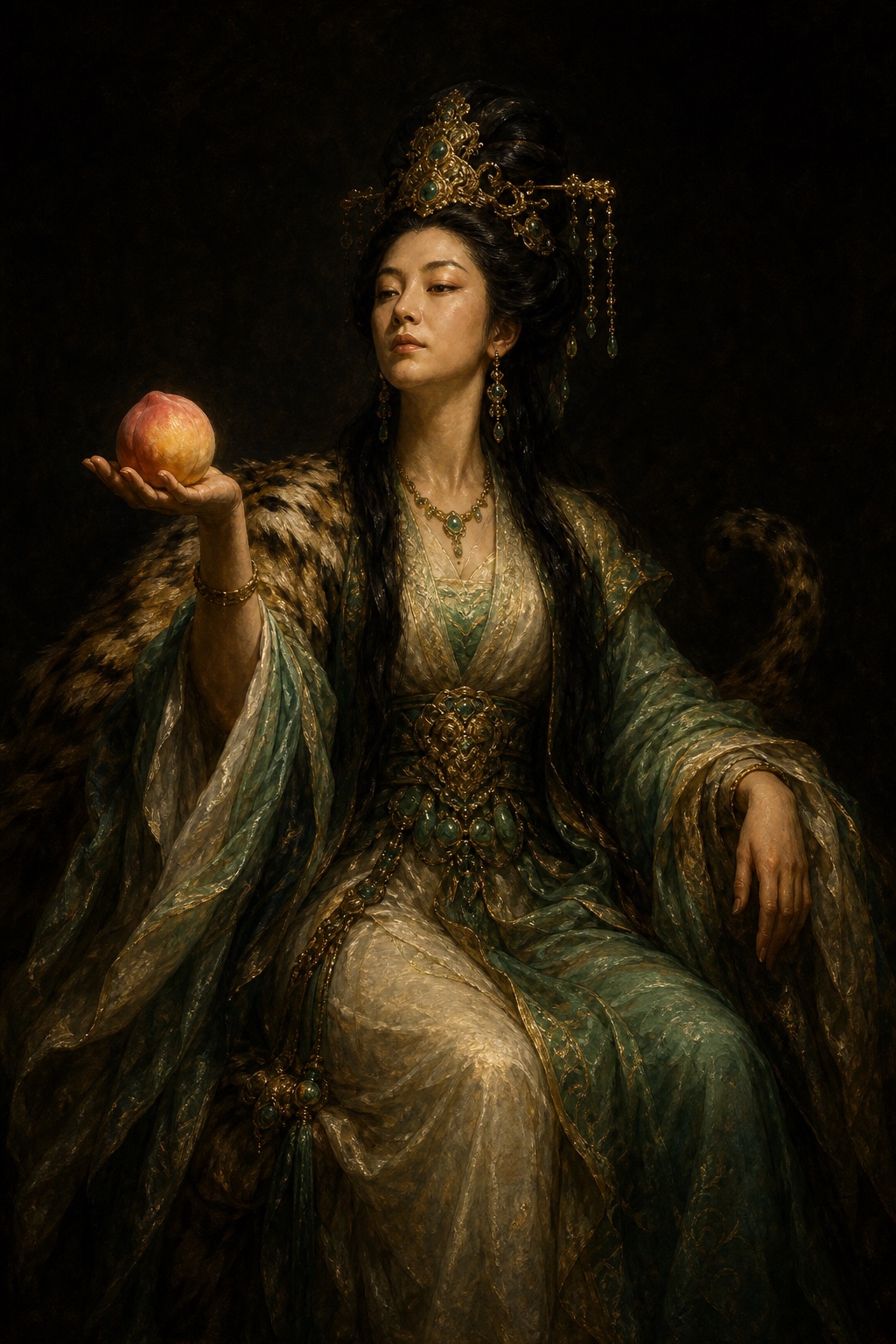
“Three hundred and fifty li further west is the Mountain of Jade, where the Queen Mother of the West dwells. The Queen Mother of the West is shaped like a human, but with a leopard’s tail and tiger’s teeth, and she is good at howling. Her hair is wild and she wears a sheng headdress. She has charge of the plagues of heaven and the Five Destroyers.” — Shanhaijing, “Classic of the Western Mountains”; tr. Mythos Atlas
That is not a hostess. That is a plague deity with an animal’s tail, howling on a mountain at the western edge of the known world, and the text lists her the way it lists the other hazards of the terrain. Her office is calamity: 司天之厲 — she administers what heaven sends down when it means harm.
By the Warring States she is being cited as something else entirely. The Zhuangzi runs through a roll-call of beings who attained the Way — the Yellow Emperor, Zhuanxu, the sun and moon themselves — and puts her among them:
西王母得之,坐乎少廣,莫知其始,莫知其終。
“Xi Wang-mu got It, and by It had her seat in (the palace of) Shao-guang. No one knows Its beginning; no one knows Its end.” — Zhuangzi, “The Great and Most Honoured Master”, tr. James Legge (via ctext.org)
The tiger’s teeth are gone without comment. She has become an adept, seated in a palace, beyond origin and end. By the Han she has a jade court on Kunlun, a consort in Dongwanggong as the yin to his yang, three blue birds running her errands, and a clientele of emperors.
What survives every revision is the orchard. Her authority is not administrative — she signs nothing, appoints no one — and it does not need to be, because she holds the only thing the celestial bureaucracy cannot issue. When the Huainanzi wants to name the source of deathlessness in a single clause, it writes 羿請不死之藥於西王母, “Yi begged the drug of no-dying from the Queen Mother of the West.” She is where the archer has to go. There is nowhere else.
That makes her the pantheon’s real gatekeeper, and the guest list at her banquet beside the Lake of Gems is the closest thing Chinese heaven has to a doctrine of election. The Jade Emperor can grant you office; Xiwangmu decides whether you die. Which is precisely why the most famous act of rebellion in the whole tradition is a monkey eating his way through her peach garden without an invitation — and why the earliest layer of her, the one with the tiger’s teeth, is worth keeping in view. The gentle Queen Mother handing out fruit is a late redaction of something that started out presiding over pestilence.