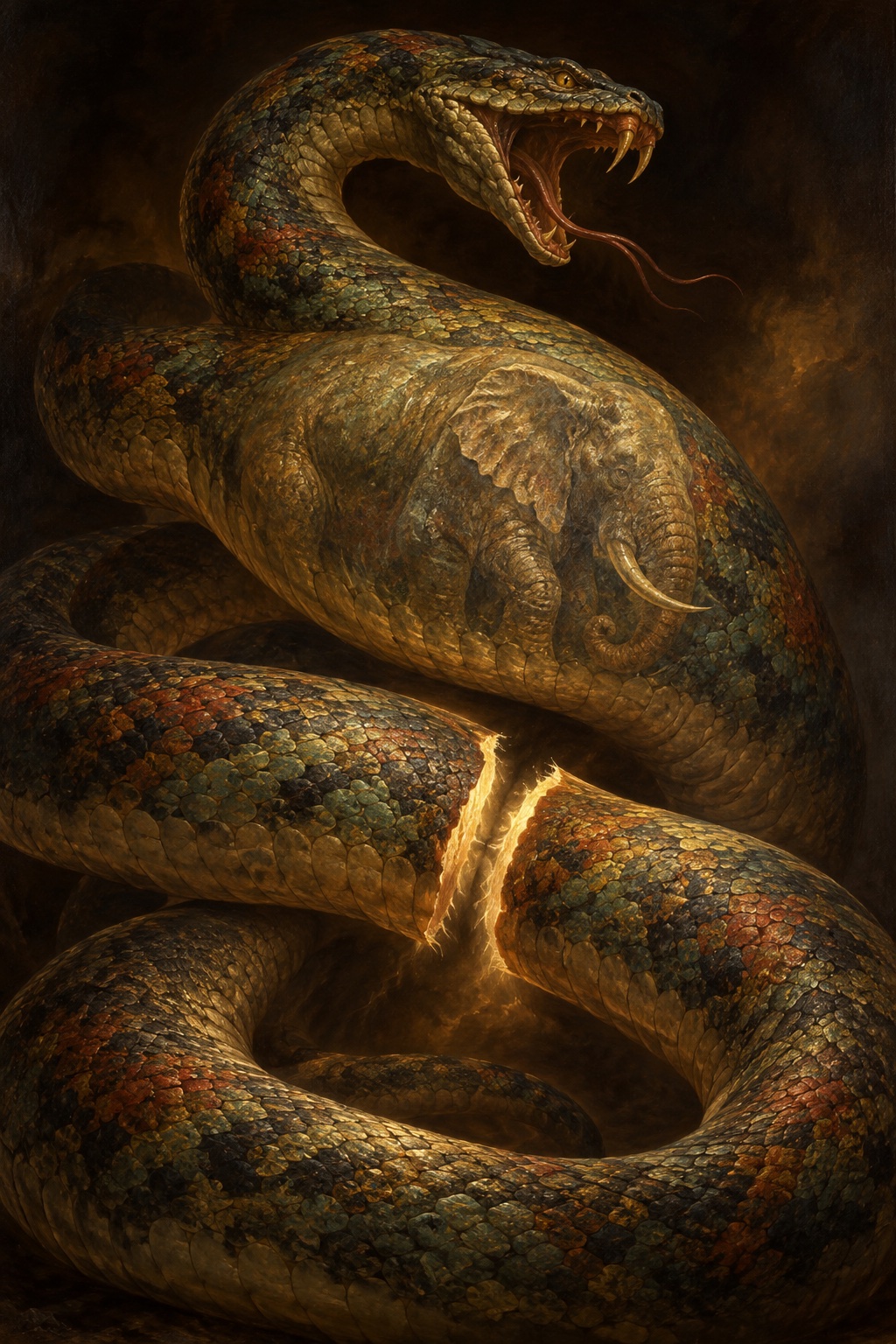
Cut apart at Dongting
The Huainanzi sets Xiushe in the reign of Yao. Ten suns have come out together, the crops are scorched, and the people have nothing to eat. Then the passage names six harms and brings one charge against all of them. Xiushe’s name comes last in the list.
猰貐、鑿齒、九嬰、大風、封豨、修蛇皆為民害。堯乃使羿誅鑿齒于疇華之野,殺九嬰于凶水之上,繳大風於青丘之澤,上射十日而下殺猰貐,斷修蛇於洞庭
“Yayu, Zaochi, Jiuying, Dafeng, Fengxi and Xiushe all preyed upon the people. So Yao sent Yi to execute Zaochi in the wilds of Chouhua, to kill Jiuying on the banks of the Xiong River, to net Dafeng in the marsh of Qingqiu, to shoot the ten suns above and slay Yayu below, and to cut Xiushe in two at Dongting.” — Huainanzi, “Benjing”; tr. Mythos Atlas
The charge is the same for all six, 皆為民害: each of them was a harm to the people. The list does not say what harm any of them did, and it gives none of them a shape. For Xiushe the name is all there is. 修 means long, so the name reads as the long snake, and that is a reading of the name only. The passage says nothing of the snake’s body, its size or its home.
Yao then sends Yi, 堯乃使羿, the archer filed here as Hou Yi, and the commission takes the six one clause at a time. Xiushe’s clause comes fifth: after the shot at the ten suns and the killing of Yayu, and before the capture of Fengxi, which closes the commission. The verb is 斷, to cut through or sever. This entry renders it as cut in two, as the other entries on the six harms do, but the passage does not count the pieces. It does not say how the cut was made. It names no sword and no blade, and in this clause it gives Yi no bow. In the clause just before, the same passage has him shoot the ten suns; it does not say that he shot the snake.
The place is 洞庭, Dongting, and the passage gives it no description. After the clause the Huainanzi says nothing more about the snake. Fengxi is taken in the Mulberry Forest, 萬民皆喜, all the people rejoice, and they set up Yao as Son of Heaven. In the Huainanzi, Xiushe is a name in a list, a place and a single verb.
A great snake
The Huainanzi has come down with the commentary of the Han scholar Gao You, and the Siku quanshu edition of the Huainan honglie jie prints his notes inside the text. He glosses the six harms in a single note, set straight after the charge that all of them were a harm to the people, and he gives each name a few words. This edition writes the snake’s name 脩蛇, where the Huainanzi text quoted above has 修蛇.
脩蛇大蛇也吞象三年而出其骨之類
“Xiushe is a great snake, of the kind that swallows an elephant and after three years passes its bones.” — Gao You, Huainan honglie jie, “Benjing”; tr. Mythos Atlas
The note is unpunctuated in this edition, and it says two things. The first is 大蛇也: Xiushe is a great snake. Of the texts quoted in this entry, this is the first to say anything about the snake’s body, and what it gives is size. The second is a comparison, 吞象三年而出其骨之類: of the kind that swallows an elephant and passes its bones after three years. 之類, of the kind, puts Xiushe in a class. Gao You does not say that Xiushe swallowed an elephant, and he tells no story about it. He says what sort of snake it was.
He does not name any other snake. The words he uses for the sort are close to the words the Shanhaijing uses for a snake with another name, the Ba snake, in the next section, but the Ba snake is not in his note. Nothing in the note says that Xiushe and the Ba snake are one creature. The tie between them, in Gao You, is a matter of wording only.
Another note on the same page glosses Dongting together with the Mulberry Forest, and it makes Dongting the name of a marsh in the south. That is the commentator’s word for the place. The Huainanzi itself gives Dongting no description.
The Ba snake
Gao You’s words echo a notice in the Shanhaijing, in the “Classic of Regions Within the Seas: South”. The notice is not about Xiushe. Its snake is the Ba snake, 巴蛇.
巴蛇食象,三歲而出其骨,君子服之,無心腹之疾。其為蛇青黃赤黑。一曰黑蛇青首,在犀牛西
“The Ba snake eats elephants, and after three years it passes the bones. A gentleman who takes it has no ailment of the heart or the belly. As a snake it is blue-green, yellow, red and black. One version says it is a black snake with a blue-green head. It is west of the rhinoceros.” — Shanhaijing, “Classic of Regions Within the Seas: South”; tr. Mythos Atlas
Beside Gao You’s note, the first clause of the notice is a near match. The Shanhaijing has 食象, eats an elephant, where Gao You has 吞象, swallows an elephant. It has 三歲而出其骨, where Gao You has 三年而出其骨: both say that the bones come out after three years, with a different word for the year. Only the verb and the word for year differ.
The notice then gives the Ba snake what the Huainanzi never gives Xiushe. It gives a use: 君子服之,無心腹之疾, a gentleman who takes it has no ailment of the heart or the belly. The notice does not say whether the thing taken is the snake or the bones that it passes. It gives colours: 其為蛇青黃赤黑, as a snake it is blue-green, yellow, red and black. Then, after 一曰, one version, it gives a second account, a black snake with a blue-green head. The notice keeps both accounts and does not choose between them. Last, it places the snake on the chapter’s map, west of the rhinoceros, 犀牛, a beast that an earlier notice in the same chapter describes as shaped like an ox, but black.
All of this belongs to the Ba snake. The Shanhaijing does not name Xiushe here, and Gao You does not name the Ba snake. The cure, the colours and the place west of the rhinoceros are the Ba snake’s, and this entry does not give them to Xiushe. What Gao You’s note shares with this notice is an elephant and three years.
The hill of bones at Baling
The Ba snake has a death of its own, and a place for it. The Song encyclopedia Taiping yulan, under the prefecture of Yuezhou, quotes a work it calls the Xun Jiang ji on how Baling got its name. Then it quotes the Huainanzi.
《尋江記》曰:羿屠巴蛇於洞庭,其骨若陵,故曰巴陵。《淮南子》曰:斬修蛇于洞庭
“The Xun Jiang ji says: Yi butchered the Ba snake at Dongting, and its bones were like a hill, and so the place is called Baling. The Huainanzi says: he cut down Xiushe at Dongting.” — Taiping yulan, juan 171; tr. Mythos Atlas
In the first sentence the archer is Yi and the place is Dongting, as in the Huainanzi. But the snake is the Ba snake, and the verb is 屠, to butcher or slaughter. The sentence also goes on past the killing, where the Huainanzi stops. 其骨若陵: the snake’s bones lay like a hill, and the hill gave Baling its name. Then 故曰巴陵, and so it is called Baling: the sentence reads the place name as the Ba snake’s hill, 陵.
The second sentence is the Huainanzi, but not in the words of the text quoted at the head of this entry. The encyclopedia writes 斬修蛇于洞庭, with the verb 斬, to cut down, where the Huainanzi text quoted above has 斷. Neither verb comes with a weapon.
The encyclopedia does not say that the Ba snake and Xiushe are one snake. It sets a sentence about each under the same place, one after the other, and leaves the reader to join them. The pairing is the whole of its claim.
Two works of geography also tell the story of the hill. The Tang Yuanhe junxian tuzhi gives the Ba snake’s half only, with Yi, Dongting and the bones like a hill, and does not cite the Huainanzi. The Song Yueyang fengtu ji of Fan Zhiming makes the same pairing as the encyclopedia. It quotes the Jiang ji, as it names the work, on the bones heaped into a hill, and it quotes the Huainanzi on a snake cut down at Dongting, without the snake’s name. It adds that in its own day the Ba snake’s mound still stood beside the hall of the prefectural office, tall and towering. Neither work says that the Ba snake is Xiushe.
Two snakes in one poem
In the Tang, Li Bai wrote the two stories as one. His poem “Jingzhou zei ping lin Dongting yan huai zuo”, written on looking out over Dongting after rebels in Jingzhou had been put down, has two couplets about the snake.
修蛇橫洞庭,吞象臨江島。積骨成巴陵,遺言聞楚老
“Xiushe lay athwart Dongting and swallowed elephants by the river’s islands. Its heaped bones became Baling: a tale handed down, which I heard from the old men of Chu.” — Li Bai, “Jingzhou zei ping lin Dongting yan huai zuo”; tr. Mythos Atlas
The first line takes the Huainanzi’s name, 修蛇, and the Huainanzi’s place, Dongting. The second gives the snake the elephant, 吞象, in the same two characters as Gao You’s note. The third gives it the hill of bones, 積骨成巴陵, which the texts on Baling gave to the Ba snake. Of the texts quoted in this entry, the poem is the only one in which Xiushe, by name, swallows elephants and leaves its bones at Baling. Gao You put Xiushe in the elephant-swallowing kind; Li Bai makes it do the swallowing.
The couplets make the link on the word of others. The last line hands the story to the old men of Chu, 楚老: it is a tale handed down, which the poet says he heard. The couplets also leave out the killing. They have no Yi, no Yao and no verb of cutting. The snake lies across Dongting, it eats, and its bones become a hill. Where the Huainanzi gives Xiushe a death and little else, these couplets give it everything except the death.
So the texts build Xiushe up in layers. The Huainanzi gives a name, a place and a single cut. Gao You calls it a great snake of the elephant-swallowing kind. The Shanhaijing tells of a Ba snake that eats elephants, and the texts on Baling give that snake a death at Dongting and a hill of bones, and two of them set the Huainanzi’s snake beside it. Li Bai gives the elephant and the hill to Xiushe by name, in a single poem. Each link is the work of the text that makes it, and no text quoted here says, in plain words, that Xiushe is the Ba snake.