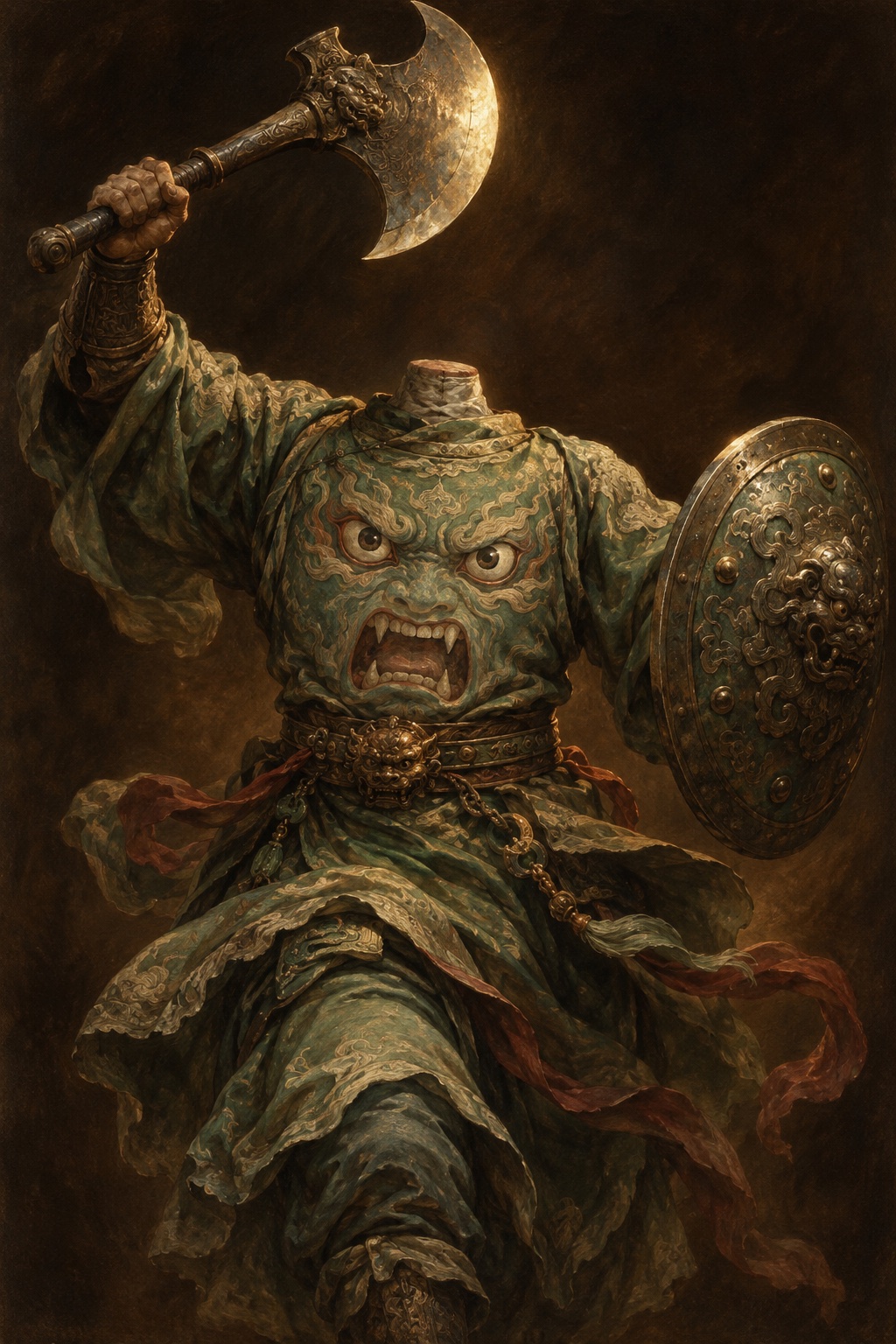
A quarrel over godhead
The Shanhaijing’s book of the regions beyond the western sea walks north through a run of bodies built on other plans: a country whose people have one head and three bodies, a country of one arm, one eye and one nostril, a people with one arm and three eyes who ride patterned horses, and a bird with two heads beside them. Those notices locate each country by the one before it and then count its parts. Xingtian’s notice carries no such location. It opens with his name and a quarrel, and the only place it names is the mountain where his head is buried.
The quarrel takes one clause: Xingtian contended with the Emperor for godhead. The text calls his opponent 帝, the Emperor, and names him no further, so this entry does not name him either. It does not say how the contest was fought, or whether any blow fell before the Emperor’s; there is no weapon in the notice until the head is gone. The wikisource edition this atlas quotes also prints two notes on variant readings inside that opening clause, one of them in the middle of the name itself, so the quotation below begins where the notes stop, with the Emperor’s stroke.
帝斷其首,葬之常羊之山,乃以乳為目,以臍為口,操干戚以舞。
“The Emperor cut off his head and buried it on Mount Changyang. Then he took his nipples for eyes and his navel for a mouth, and, gripping shield and axe, he danced.” — Shanhaijing, “Classic of Regions Beyond the Seas: West”; tr. Mythos Atlas
Two verbs belong to the Emperor, 斷 and 葬: he cuts, and he buries. 葬 is the ordinary word for burying the dead, so the head gets a burial, and a named place for it, Mount Changyang, 常羊之山. 葬之 says only that he buries “it”, and the nearest thing for 之 to point back to is the head. What becomes of the rest of the body, and where it stands afterwards, the notice does not say.
Then comes 乃, “and then”, and the sentence changes subject without naming the new one. Nothing marks the moment the Emperor stops acting. Only the sense decides it: what follows needs a trunk with nipples and a navel, and the only body in the sentence that could supply them is the one that has just lost its head.
Nipples for eyes, a navel for a mouth
乃以乳為目,以臍為口: two clauses in the same shape. The construction takes one thing as another. The notice does not say that eyes grow on his chest or that a mouth opens in his belly. It says the parts his trunk already has are taken for eyes and for a mouth, so the face comes down onto the body: the eyes where the nipples are, the mouth at the navel. The bodies in the notices before his are only described, one head on three bodies, one arm and three eyes. His is the only one of them that the text shows being remade, and it is remade after the Emperor’s stroke rather than born that way.
操干戚以舞: he grips 干 and 戚, a shield and an axe, and with them he dances. The weapons arrive only now, after the contest has been decided, and the verb they serve is 舞, to dance, not to strike. The notice does not say whom the dance is aimed at, or that he goes on contending with the Emperor, or that the Emperor answers.
It does not say for how long, either. The same classic, describing Jingwei, says she constantly carries wood and stone to the sea; nothing of that kind stands in his notice. It gives the dance, and it stops. 舞 is its last word, and the next notice moves on to other figures. Whatever the dance meant, and whether it ever ended, the Shanhaijing leaves to its readers, and its readers have not left it alone.
A couplet beside Jingwei
Tao Yuanming wrote a cycle of thirteen poems on reading the Shanhaijing. The tenth gives its first couplet to Jingwei, carrying a twig in her beak to fill the sea, and its second to Xingtian.
刑天舞干戚,猛志故常在。
“Xingtian dances with shield and axe; his fierce will, as of old, is always there.” — Tao Yuanming, “Reading the Shanhaijing” X; tr. Mythos Atlas
Five characters stand in for the whole notice. The Emperor is gone from the line, and the beheading, and the burial on Mount Changyang, and the nipples and the navel. What stays is the name, the weapons, 干戚, and the verb, 舞, which Tao takes straight from the classic. The second line then adds what the classic never said. 猛志, a fierce will, gives the dance a reason, and 常在, always there, gives that will a length. The classic gave the dance no length at all; Tao supplies one, but he gives it to the will behind the dance, not to the dance itself. It is what the first couplet does to Jingwei as well: the survey reports an act, and the poem credits the one who acts with an intent.
The last four lines of the stanza name neither figure. They speak of beings that have been changed and are gone and do not regret it, and they close on a question, whether a good morning can still be waited for. The poem before this one in the cycle is Kuafu’s race with the sun. The one after it turns to figures who did violence and went against the Emperor’s decree, and it carries a warning: bright heaven sees, and evil is not a road to walk. Tao did not put Xingtian in that poem, although his quarrel in the classic is with an Emperor too. He put him beside Jingwei.