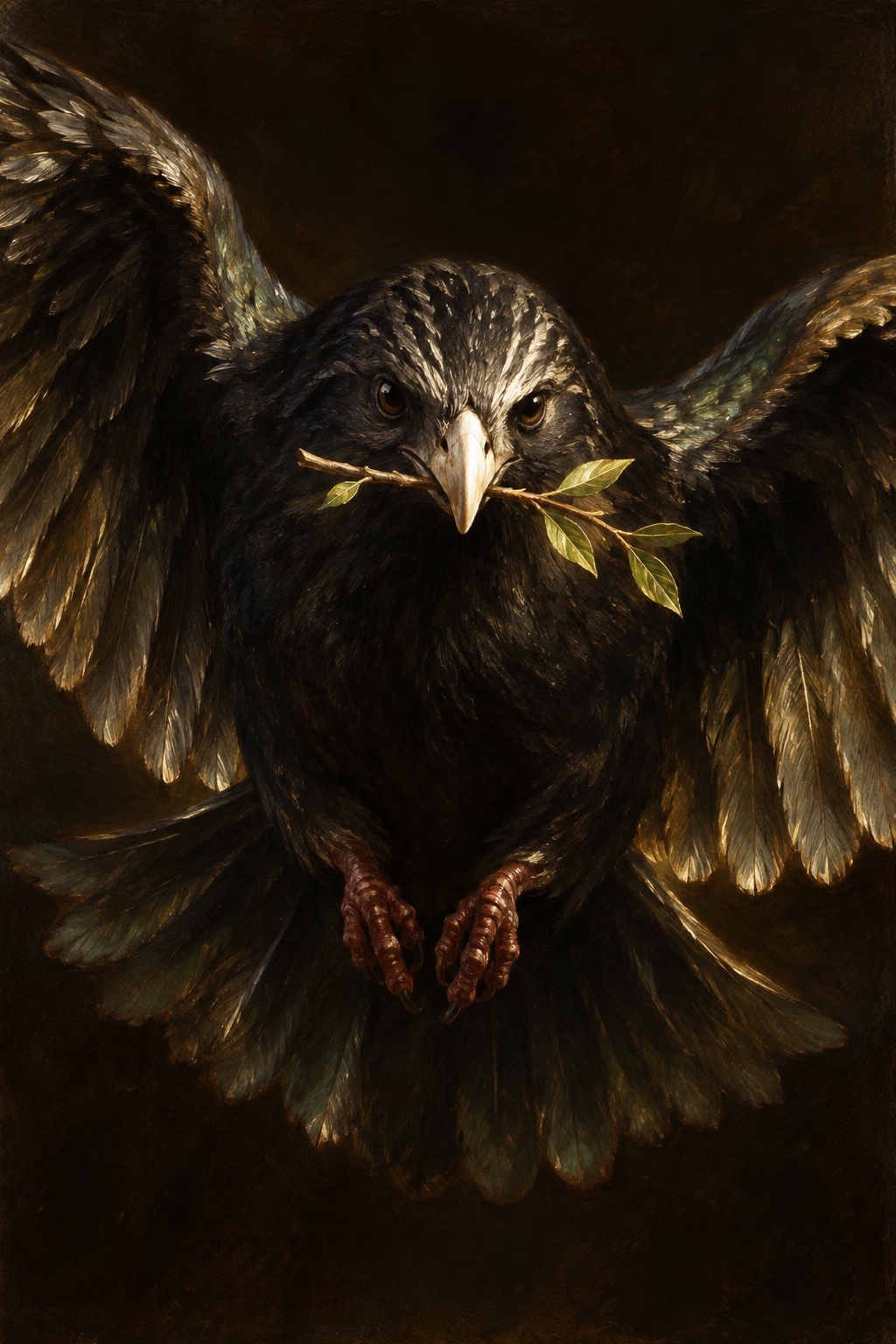
Eighty-eight characters on Fajiu Mountain
The Classic of the Northern Mountains is a survey, not a storybook. It walks north from peak to peak in a fixed formula — so many li further on, a mountain called such-and-such, what grows on it, what lives on it, which river rises there and where that river goes — and it does this eighty-seven times in one chapter without pausing for a narrative. Her entire existence is one stop on that itinerary.
又北二百里,曰發鳩之山,其上多柘木。有鳥焉,其狀如烏,文首、白喙、赤足,名曰精衛,其鳴自詨。是炎帝之少女,名曰女娃,女娃游于東海,溺而不返,故為精衛,常銜西山之木石,以堙于東海
“Two hundred li further north is the mountain called Fajiu, and on its heights there is much zhe wood. There is a bird there. It is shaped like a crow, with a patterned head, a white beak and red feet, and its name is Jingwei; its cry calls out its own name. She is the young daughter of Yandi, and her name was Nü Wa. Nü Wa went roaming on the Eastern Sea, drowned, and did not come back, and so became Jingwei. She constantly carries wood and stones from the western mountains in her beak, to fill in the Eastern Sea.” — Shanhaijing, “Classic of the Northern Mountains”; tr. Mythos Atlas
Eighty-eight characters, and the whole figure is in them. The description is unusually exact for this book, which more often gives a beast four legs too many and moves on. 其狀如烏 — shaped like a crow. Not a phoenix, not an ornamental bird of any kind; crow-sized, crow-silhouetted, the commonest black bird in the northern sky. 文首 gives the head a pattern or a streaking without naming a colour, and the beak and the feet get one word each: white, red. That is the entire body, and every later picture that makes her bright and long-tailed is arguing with the text.
Then 其鳴自詨, her cry calls out its own name. This is a formula the chapter uses for several birds and it is doing something specific: the bird is called Jingwei because “jingwei” is the noise she makes. Her name is not a title anybody conferred. It is a transcription.
The pivot is the word 是 — “she is” — and it turns a field note into an obituary. The bird on this mountain used to be a girl, and 北山經 tells the death in eleven characters with no scene and no witness: 女娃游于東海,溺而不返. 游 is the wide classical verb for roaming, drifting, swimming; the text does not say whether she was playing or travelling, and it does not say she was rescued, mourned or buried. It says she did not come back.
What she does instead of coming back occupies the last clause, and it is in the present tense of a gazetteer describing local wildlife. 常銜西山之木石 — she constantly carries, in her beak, wood and stone from the western mountains. 銜 is precise: to hold crosswise in the bill, the way a bird carries nesting material. 以堙于東海, in order to fill in the Eastern Sea. 常, constantly, is the load-bearing word. The sentence is not about a thing she once did. It is about what is going on up there now.
The twig and the wide green sea
Four centuries after the gazetteer filed her under a mountain, Tao Yuanming read the same book through and wrote a cycle of poems out of it. The tenth opens with her, and it opens without introduction, because by then none was needed. Eighty-eight characters of field notes had become a byword, and two lines were enough to invoke it.
精衛銜微木,將以填滄海
“Jingwei carries a tiny twig in her beak, meaning to fill the blue-green sea with it.” — Tao Yuanming, “Reading the Shanhaijing” X; tr. Mythos Atlas
Everything in the couplet came out of the classic, and almost nothing in it is the same size. 北山經 gives her 木石, wood and stone, a load she can carry only because a survey entry does not stop to picture it. Tao writes 微木, and 微 is small in the sense of slight, faint, barely there — a twig. He has taken the stone out. At the other end of the line he does the opposite. The classic’s target is 東海, the Eastern Sea, a named body of water at the edge of a mapped world; Tao’s is 滄海, where 滄 is the cold blue-green of deep water. The sea stops being one more place on the itinerary and becomes simply the sea. The distance between what she carries and what she is filling opens as far as eleven characters can open it.
The verb moves as well. 北山經 has 堙, to block up, to bury; Tao has 填, to fill in, which is the word the later retellings settle on. The real change is 將以 — going to, in order to, by means of this. 常 in the classic reports a habit, the thing an observer would see her doing on any day he happened to look. 將以 credits her with a plan. The survey records what she does; the poem is the first witness here to say that she means it.
The poem does not stay with her: its next couplet turns to Xingtian 刑天, and Tao sets the two side by side as one kind of figure. The pairing is his, and the tradition afterwards took it from him and kept it.
Four more names, and a vow
The Shuyiji, compiled by Ren Fang under the Liang, tells the story again with a hundred and twelve characters instead of eighty-eight, and every one of the extra characters is something the classic would not say. The Song encyclopedists put it in the Taiping Yulan’s chapter on birds, in a section headed with her name, and that is where it survives.
昔炎帝女溺死東海中,化為精衛。其鳴自呼。每銜西山木石,以填東海,怨溺死故也。海畔俗說:精衛無雄,耦海燕而生,生雌狀如精衛,生雄狀如海燕。今東海畔精衛誓水處猶存,溺死此川,誓不飲其水。一名誓鳥,一名怨禽,又名志鳥,俗名為帝女雀
“Long ago the daughter of Yandi drowned in the Eastern Sea and turned into Jingwei. Her cry calls out her own name. She carries wood and stone from the western mountains in her beak, every time, to fill in the Eastern Sea, and the reason is her grievance at having drowned. By the shore they say: Jingwei has no male of her own kind. She pairs with the sea-swallow and breeds, and the females she bears are shaped like Jingwei and the males like the sea-swallow. On the shore of the Eastern Sea the place where Jingwei swore against the water is still there today; she drowned in this stream, and she swore that she would not drink its water. One name for her is the oath-bird 誓鳥, one is the grievance-fowl 怨禽, another is the will-bird 志鳥, and the common name is the emperor’s-daughter sparrow 帝女雀.” — Ren Fang, Shuyiji, in Taiping Yulan 925; tr. Mythos Atlas
The first thing this text does is answer the question 北山經 refused to ask. The classic states the drowning and moves to the next mountain; it never gives her a reason for what she does afterwards. The Shuyiji gives one in five characters — 怨溺死故也, because she resents the drowning — and the whole figure tilts. 怨 is grievance held rather than anger spent, the word for a wrong that is not going to be settled. Everything else in the passage grows out of that word, including two of her names.
Small things have shifted underneath as well. 其鳴自呼 stands where the classic had 其鳴自詨: the same claim about her cry, made with the ordinary verb for calling out instead of the classic’s rarer one. 每銜 replaces 常銜, each time for constantly. 以填東海 uses Tao Yuanming’s 填. Nobody is quoting anybody exactly, which is how a gazetteer note behaves once it has been retold for five hundred years.
Then the passage does something the classic never does: it goes to look. 海畔俗說 — by the shore they say. What follows is folk natural history, not myth. Jingwei has no male, 精衛無雄; she takes a 海燕, a sea-swallow, for a mate, and the brood sorts itself by sex, the daughters coming out as Jingwei and the sons as sea-swallows. This is what people say about a bird they believe is on the coast now, and it makes her a species rather than a ghost. On the same shore there is a place, 精衛誓水處, where she swore at the water, and the text insists it 猶存, is still there — the flat present tense of somebody who could take you to it.
The vow itself is the hardest line in her whole record. 溺死此川,誓不飲其水: she drowned in this stream, and swore she would not drink its water. Filling the sea is an act against it. Refusing to drink is something else — a thirst she keeps, forever, rather than take one mouthful from what killed her. The four names in the closing clause divide neatly between the two impulses. 誓 is the oath and 志 is the fixed will; 怨 is the grievance. Only the last name, 帝女雀, the one the text marks as 俗名, the common one people actually use, looks past the act to the girl: it says nothing about the sea, and calls her somebody’s daughter.
Three witnesses, two emperors
Three witnesses put an emperor behind her, and between them they use two names and three formulas. 北山經 says 是炎帝之少女: she is the young daughter of 炎帝, the Flame Emperor, and it follows that with a name of her own, 名曰女娃. The Shuyiji opens 昔炎帝女, the daughter of Yandi long ago, keeping the father’s name and dropping both the 少 and the girl’s. And directly beside it on the same page of the Taiping Yulan, the compilers set a clause from the Bowuzhi that tells the story a third time — the crow-shaped bird, the marked head, the white beak, the red feet, the drowning in the eastern water — and this one reads 昔赤帝之女, the daughter of the Red Emperor.
The encyclopedia files all three under one heading, her own, so whoever assembled that page took them for accounts of a single bird. It does not say whether the Flame Emperor and the Red Emperor are a single figure, and this entry does not settle it either. What can be said is what the three clauses have in common: a girl who is somebody’s daughter before anything happens to her, and an emperor the record cannot name the same way twice.
None of the three says Shennong. Later tradition merges the Flame Emperor with him and treats 炎帝神農氏 as one name, and once that merger is taken for granted the drowned girl becomes the daughter of the divine farmer — the figure who tasted every plant in China to learn what it would do, which makes a tidy pairing and is not what any of her sources claim. The Shennong entry in this atlas sets out why the merger will not bear the weight: the Shiji uses the two names in a single paragraph as though they belonged to separate parties, and the explicit equation is Sima Zhen’s eighth-century supplement to that history rather than the history itself. So the father recorded here is the one the passages record, 炎帝, with the identification left where the sources leave it.
That leaves the household around her empty. 少女 ranks her among daughters the classic never lists; nothing in any of the three texts names a mother, a sister or a brother, and the eleven characters that kill her mention no one who might have missed her. She is the daughter of a father the sources name two ways, and the rest of the household exists only in the grammar.