神農氏作 — the one who arose next
The “Xici”, the Great Commentary to the Yijing, tells the history of civilisation as a list of inventions, each one credited to a sovereign and each one matched to a hexagram. Fu Xi’s entry in that list is already in this wiki. Shennong’s is the clause immediately after it, and it opens with a death.
包犧氏沒,神農氏作,斲木為耜,揉木為耒,耒耨之利,以教天下
“On the death of Bao-xi, there arose Shen-nong (in his place). He fashioned wood to form the share, and bent wood to make the plough-handle. The advantages of ploughing and weeding were then taught to all under heaven.” — Yijing, “Xici” II.2, tr. James Legge
斲 and 揉 are the two verbs: to hew and to bend. The share is cut from wood, the handle is steamed and bent from it, and that is the entire technology. What Fu Xi gave the world was a way of thinking — the trigrams, an abstraction of everything he had looked at. What Shennong gives it is a tool, and then the instruction in how to use it, 以教天下, taught to all under heaven. The commentary does not treat the second as a lesser gift than the first.
His name says the same thing twice over: 神 divine, 農 the farmer.
日中為市 — the invention of the afternoon
The next clause of the same passage credits him with a second thing, and it is not a tool at all.
日中為市,致天下之民,聚天下之貨,交易而退,各得其所
“He caused markets to be held at midday, thus bringing together all the people, and assembling in one place all their wares. They made their exchanges and retired, every one having got what he wanted.” — Yijing, “Xici” II.2, tr. James Legge
The invention here is a scheduled hour and a shared place. 日中, midday, is the whole mechanism — an agreed time when everyone is in the same spot with everything they have, so that exchange can happen without anyone having to search for anyone. 各得其所, everyone got what he wanted, is the commentary’s flat verdict on it, and the hexagram it assigns is Shi He, biting through.
Read together with the plough, the two clauses are one argument: he makes surplus possible, and then he makes it circulate. Agriculture and commerce arrive in the same paragraph and are given to the same man.
一日而遇七十毒 — seventy poisons before nightfall
The “Xici” is a sober text and gives him no episode. The one everybody remembers is in the Huainanzi, in an essay arguing that even sages had to work.
於是神農乃始教民播種五穀,相土地宜,燥濕肥墝高下,嘗百草之滋味,水泉之甘苦,令民知所辟就。當此之時,一日而遇七十毒
“thus Shennong began to teach the people how to cultivate the five grains, according to the suitability of the land—whether dry or wet, fertile or barren, high or low. He tasted the flavors of a hundred herbs, the sweetness and bitterness of water sources, so that the people would know what to avoid and what to seek. At this time, he encountered seventy poisons in a single day.” — Huainanzi, “Xiuwu”; tr. Chinese Text Project
嘗 is the verb, and it means to taste, with the mouth. Before this, the passage says, people ate grass, drank standing water and chewed whatever they could pick or catch, and were constantly sick and poisoned. The remedy Shennong finds is not a herb; it is a method, and the method is to run the experiment on himself. 令民知所辟就 — so the people would know what to avoid and what to approach — makes the transaction explicit. Seventy poisons in one day is his working conditions.
The Huainanzi is making a philosophical point with this, and it is worth noticing which one. Its opponents claim the sage acts by 無為, by doing nothing. The essay’s answer is to name five sages and show them exhausted: Shennong haggard, Yao gaunt, Shun blackened, Yu with hands and feet calloused. The founder of Chinese medicine is offered as evidence that nobody ever civilised anything by sitting still.
神農 and 炎帝
Later tradition merges Shennong with 炎帝, the Flame Emperor, and treats “Yandi Shennong” as one name; the Shanhaijing lineage this wiki quotes on Zhurong’s page traces a household down from Yandi. The oldest historical source disagrees with itself about this, and the disagreement is worth preserving rather than resolving.
:::variant{source=“Sima Qian, Shiji, “Annals of the Five Emperors” 五帝本紀”} The Shiji passage already quoted on the Yellow Emperor’s page uses both names in a single paragraph as though they were two different parties. The house of 神農 has declined and cannot discipline the nobles; separately, 炎帝 wants to encroach on them, and the Yellow Emperor fights 炎帝 at the field of Banquan through three battles. At the end the nobles honour Xuanyuan as Son of Heaven 代神農氏, in place of the house of Shennong. Sima Qian never says the two are the same, and the explicit equation 炎帝神農氏 belongs to Sima Zhen’s eighth-century supplement, not to the Shiji itself. :::
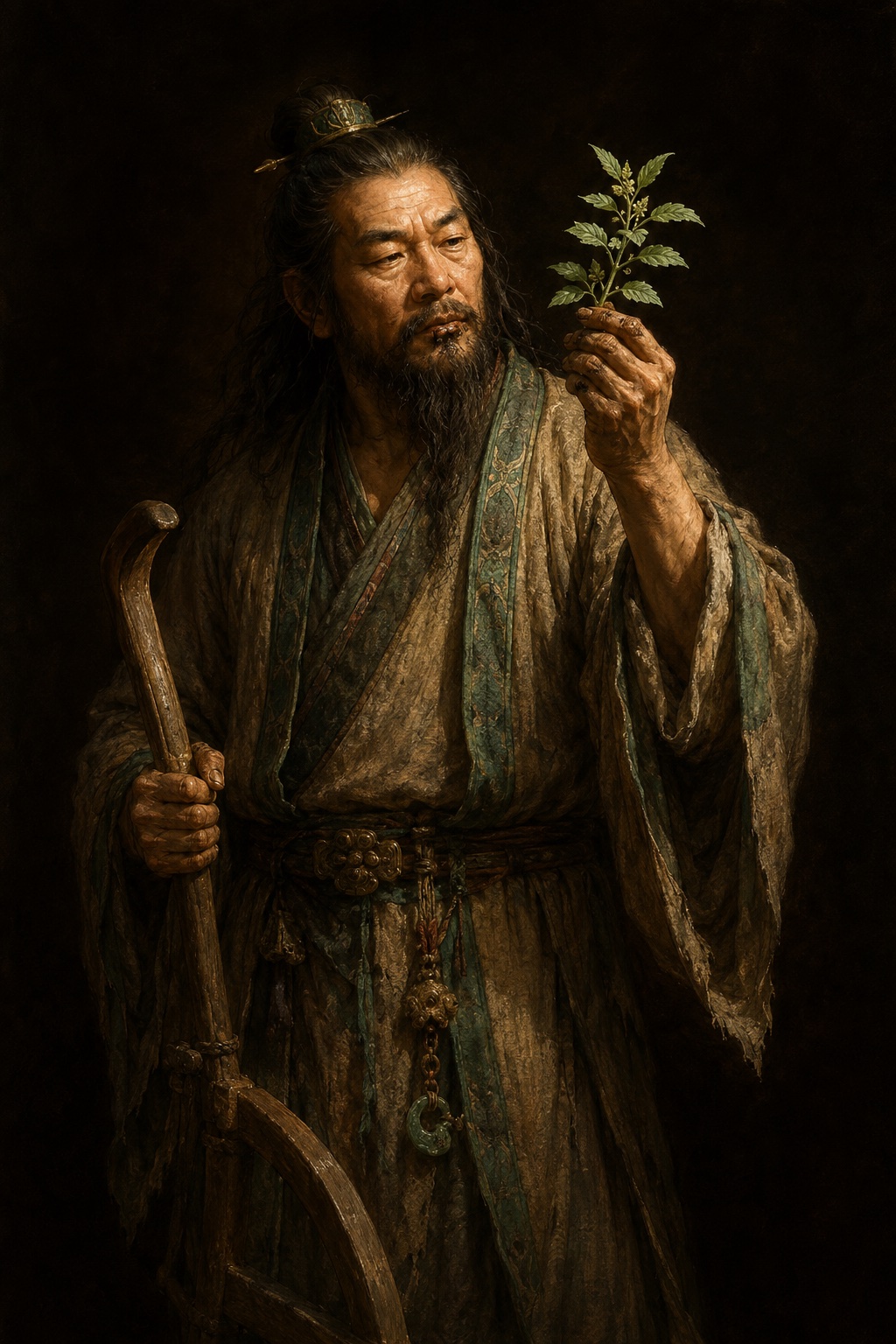
The ox-head, the green robe and the sprig of herb held to the lips all belong to the later, merged figure. What the earliest texts give is narrower and stranger: a man who hewed a plough, fixed an hour for the market, and ate everything growing in China to find out what it would do.