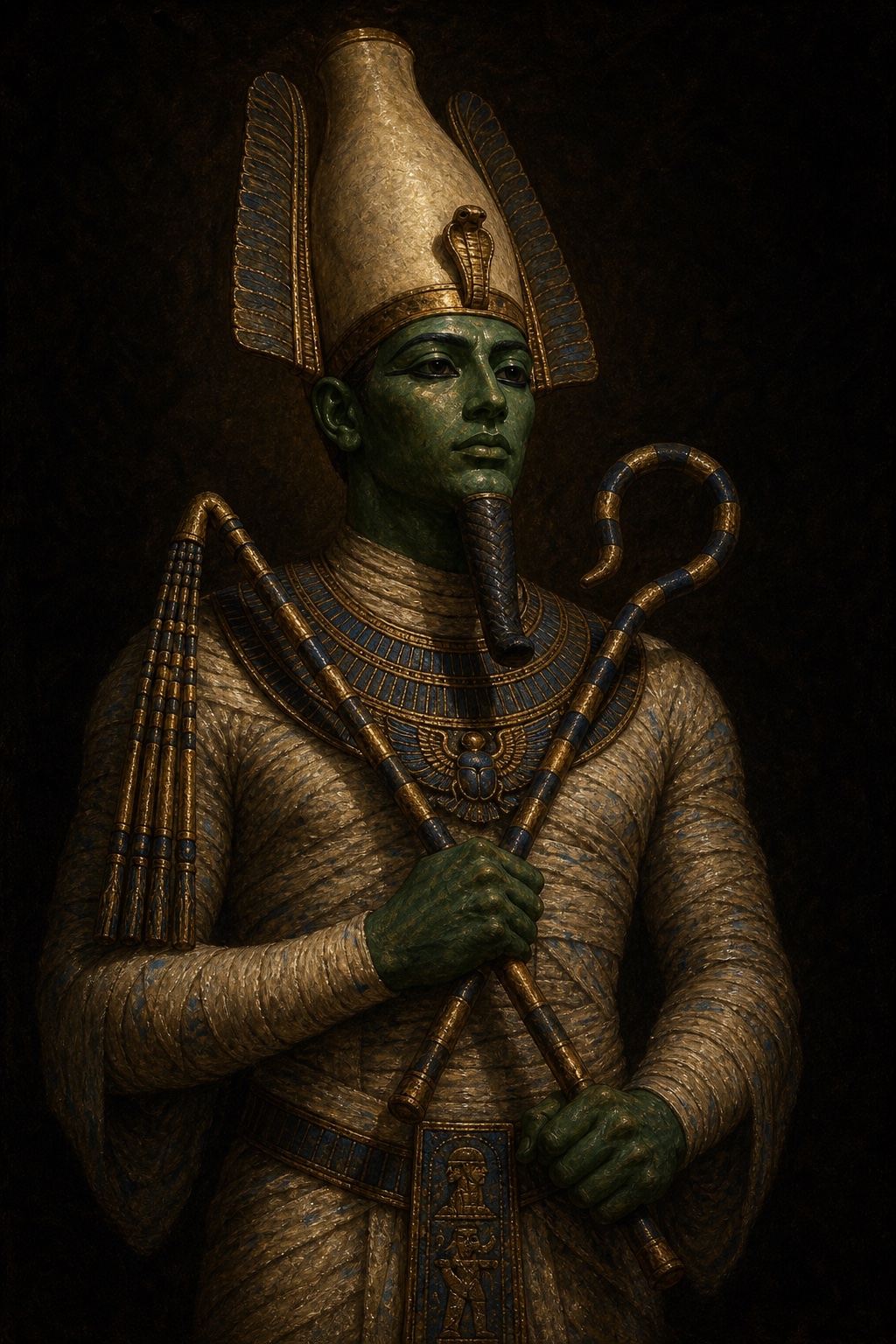
Osiris once ruled Egypt as a living king, teaching agriculture and law before his jealous brother Set murdered him — sealing him into a coffin built to his exact measurements and, in the fuller version of the story preserved by Plutarch, later cutting the body apart and scattering the pieces across Egypt. His sister-wife Isis searches out every piece, restores him through ritual magic, and their brief reunion is enough to conceive their son Horus. Osiris does not return to rule the living; instead he descends to become king and judge of the dead, presiding over the hall where every heart is weighed against the feather of Maat.
That death-and-return became the central promise of Egyptian funerary religion. From the Middle Kingdom onward, every deceased person hoped to “become an Osiris,” undergoing the same mummification, judgment, and rebirth the god himself received. His skin painted green or black marks him as lord of the fertile black soil and sprouting grain as much as lord of the tomb — in his cult, death and harvest are the same idea seen from two directions.
“Homage to thee, Osiris, Lord of eternity, King of the gods, whose names are manifold, whose transformations are sublime, whose form is hidden in the temples.” — Legends of the Gods (1912), “A Hymn to Osiris”, tr. E. A. Wallis Budge