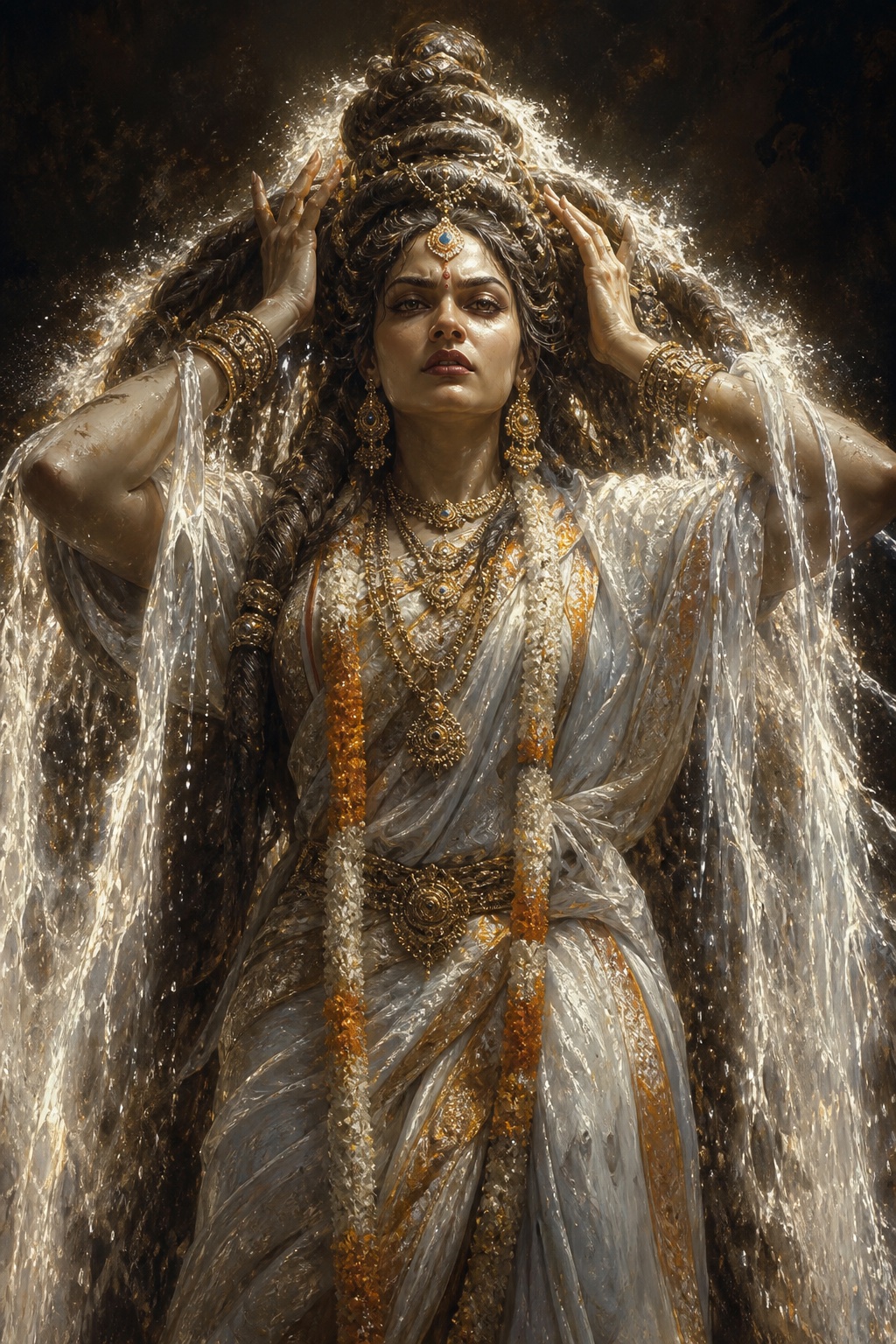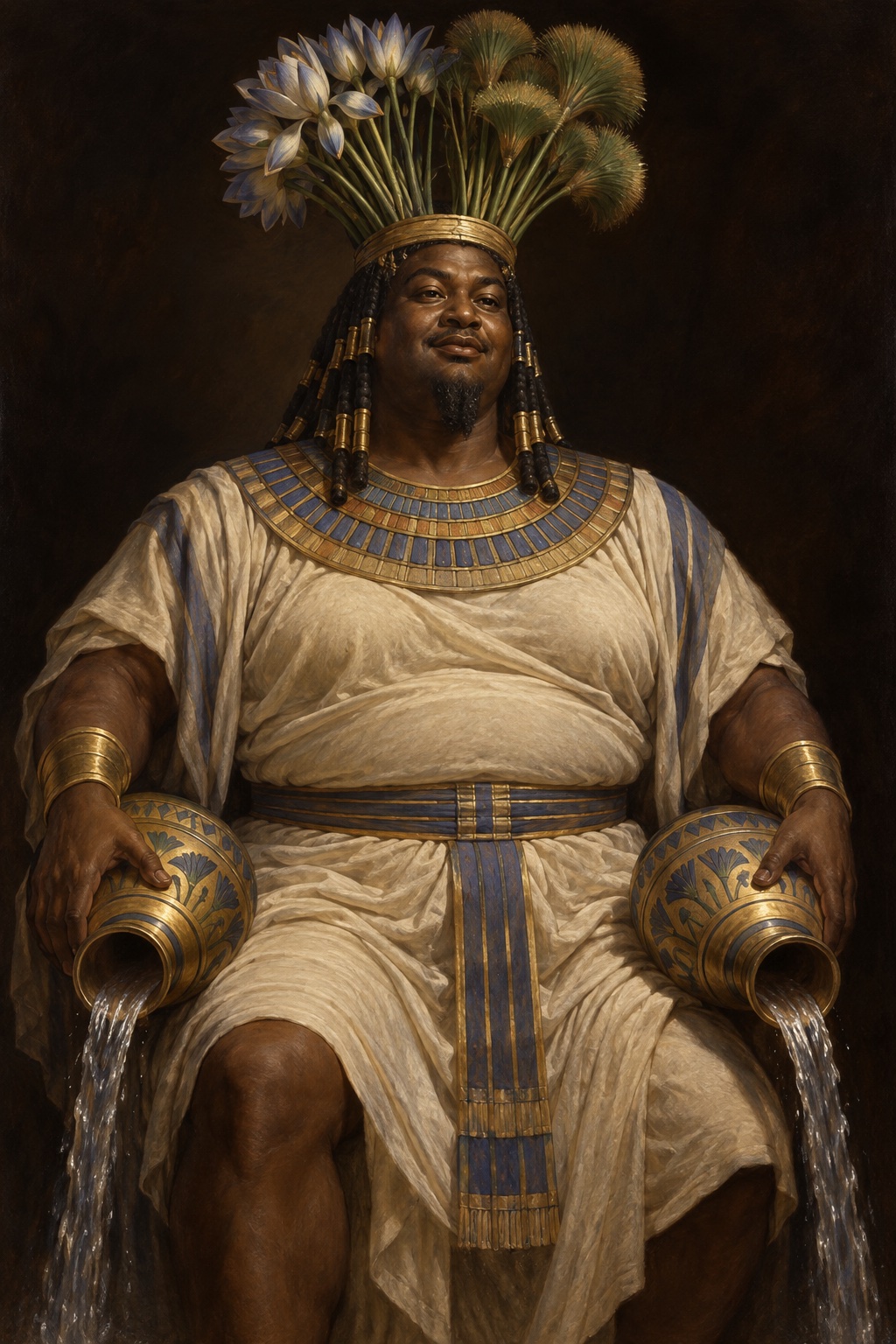
Budge writes Hep, or Hap
The head of this entry uses the commonest of the god’s spellings, and the source it quotes throughout uses three. Budge opens his chapter on the Nile-god with a sentence that puts two of them side by side and then describes a body no reader expects.
Hep, or Hapi, is always depicted in the form of a man, but his breasts are those of a woman, and they are intended to indicate the powers of fertility and of nourishment possessed by the god — E. A. Wallis Budge, The Gods of the Egyptians (1904), vol. 2, p. 43
Hep is the older form, Hap the shortest, Hapi the one his chapter settles into and the one modern writing has kept. Unlike Khepri, Neith, Amun and Nun, whose entries here carry a modern head name against Budge’s Khepera, Net, Amen and Nu, nothing has to be overridden: Hapi is both his usual spelling and the standard one.
The hazard is not the spelling. It is that three separate gods answer to it, and Budge keeps them apart only in his index, where Hap the Nile-god, Hap the Apis bull and Hap the son of Horus each get their own line with their own page numbers. The second of those is the sacred bull of Memphis, who joins with Osiris to make the compound god Asar-Hapi, the Serapis of the Greeks. The third is one of the Four Children of Horus, the ape-headed guardian of a canopic jar, whom Nephthys protects and who takes the north and the small viscera; modern Egyptology spells him Hapy to keep him distinct, though Budge never writes that form once in either volume. Nothing in this entry is that god, and nothing in it is the bull. Everything here is the river in flood.
The two Niles
One god, but counted twice. Egypt divided its river the way it divided itself, into a South and a North, and gave each half its own Hapi with its own plant bound on his head.
The god of the South Nile has upon his head a cluster of lotus plants, whilst he of the North Nile has a cluster of papyrus plants — E. A. Wallis Budge, The Gods of the Egyptians (1904), vol. 2, p. 43
The two are also drawn as one, and the fusion is the more famous image of the pair.
When the two forms of Hep or Hapi are indicated in a single figure, the god holds in his hands the two plants, papyrus and lotus, or two vases, from which he was believed to pour out the two Niles — E. A. Wallis Budge, The Gods of the Egyptians (1904), vol. 2, p. 43
Two vases, two rivers, one pair of hands. In the other standard scene the two Nile-gods stand facing each other and tie the stems of lotus and papyrus into a knot — the binding of Upper and Lower Egypt performed by the water that runs through both, which is as close as the iconography comes to a political argument. Budge’s chapter describes the man, the breasts, the plants and the vases, and stops there. The blue or green skin, the heavy belly and the loaded offering table that a modern reader expects are conventional; no sentence in reach here says any of them.
The bed of Hapi
The Egyptian flood is not weather. It is a god arriving, on a schedule, in a place the texts can name. The legend of the seven years’ famine describes the source itself, and describes it as furniture.
Here is the bed of Hapi (the Nile), wherein he reneweth his youth [in his season], wherein he causeth the flooding of the land — E. A. Wallis Budge, Legends of the Gods (1912), “The Legend of Khnemu and of a Seven Years’ Famine”
He renews his youth every year, in his season, and Budge’s rendering of what follows makes the inundation a union: the god comes and has union as he journeys, as a man has union with a woman, and plays the husband again, and satisfies his desire. The text then gives figures — he rises to the height of twenty-eight cubits at Abu, and drops at Sma-Behutet to seven. The sentence immediately after belongs to Khnemu, not to the river: it is Khnemu who smites the ground with his sandals, draws the bolt and throws open the double door through which the water comes.
What arrived on that schedule was the entire economy, and the arrival was met as such.
the festival of the annual rise of the Nile was celebrated throughout Egypt with very great solemnity, and statues of the Nile-god were carried about through the towns and villages that men might honour him and pray to him — E. A. Wallis Budge, The Gods of the Egyptians (1904), vol. 2, p. 47
Note which way the prayer runs. The statues go out to the villages while the water is rising, not to summon it.
The seven years he did not come
Then there is the year he does not arrive, and the six after it. In the legend Budge translates from the stele on the island of Sehel, a king writes to his governor because Hapi, meaning the Nile, has not come forth. What that failure did to the country is set out in one flat inventory.
in my time to the [proper] height for seven years. Grain is very scarce, vegetables are lacking altogether, every kind of thing which men eat for their food hath ceased — E. A. Wallis Budge, Legends of the Gods (1912), “The Legend of Khnemu and of a Seven Years’ Famine”
The list runs on past the quoted end into men plundering their neighbours. This is the only Egyptian text in reach that states the negative case plainly: the god here is not a symbol of abundance but the mechanism of it, and when the mechanism stops the state starves. What ends it is not a sacrifice to Hapi. The god who answers is Khnemu, the ram-headed potter of Elephantine, near whose island the sources of the river were believed to lie, and he answers in a dream.
I will make Hap (i.e., the Nile) rise for thee, and [in] no year shall [he] fail, and he shall spread himself out in rest upon every land — E. A. Wallis Budge, Legends of the Gods (1912), “The Legend of Khnemu and of a Seven Years’ Famine”
The king wakes when he hears the god mention crops, and pays for it: the decree he issues endows Khnemu with twenty schoinoi of land on each side of the river, with gardens. The famine ends in a land grant to somebody else. Khnemu can make the promise at all because of what he has already claimed to be, earlier in the same speech.
I am [he] who created himself, Nu, the Great [God], who came into being at the beginning, [and] Hapi, who riseth according to his will — E. A. Wallis Budge, Legends of the Gods (1912), “The Legend of Khnemu and of a Seven Years’ Famine”
Three gods claimed in one sentence by the potter of Elephantine. Nun’s entry in this atlas already reports that declaration without quoting it; this is the sentence it reports. Read from Hapi’s side it is not a borrowing but an absorption, and it is not the only one. Budge’s second volume makes the same equation from the other direction.
But Hapi was also identified with Nu, the great primeval water abyss from which all things sprang — E. A. Wallis Budge, The Gods of the Egyptians (1904), vol. 2, p. 47
The third identification is with Osiris, whom Budge takes for a river-god in predynastic times before he was anything else, and who became identified with Hapi in course of time. That equation drags a household in behind it: because Osiris was identified with Hapi, Budge reasons, Isis was regarded as the female counterpart of Hapi — while other goddesses had been assigned to him earlier as wives or sisters, Nekhebet for the Nile of the South among them. None of that is a marriage this atlas records, and no consort is claimed here. It is a chain of inferences about who a river is, and it is Budge’s chain.
The god who cannot be figured in stone
The strangest thing said about Hapi is said in a hymn, and what it says is that he cannot be depicted at all — which is a remarkable position for a god whose two-vase figure is everywhere on the monuments. Budge finds in it some of the chief attributes of God ascribed to the power that causes the Inundation, and paraphrases the passage in his first volume.
cannot be figured in stone, he is not to be seen in the images on which are set the crowns of the south and the north with their uraei, offerings cannot be made to him, he cannot be brought forth from his secret places — E. A. Wallis Budge, The Gods of the Egyptians (1904), vol. 1, p. 147
he is not to be found in the shrines which are inscribed with texts, there is no habitation which is sufficiently large for him to dwell in, and the heart [of man] is unable to depict him — E. A. Wallis Budge, The Gods of the Egyptians (1904), vol. 1, p. 147
No stone, no image, no offering, no shrine, no house big enough, and no picture even in the mind. Every one of those denials is aimed at something the Egyptians demonstrably did for him — the statues carried through the towns and villages are recorded two sections above — which is why the hymn matters. It is a text arguing against its own religion’s practice, and it does it about the Nile rather than about the sun.
The last place he turns up is stranger still. In the hymn to Aten that Budge prints from Akhenaten’s Amarna, where the disk has displaced almost every other god, Hapi survives twice: once at home, coming up out of the underworld, and once relocated to the sky for the benefit of foreigners who have no river.
Hapi (i.e., the Nile) cometh from the Tuat to Egypt — E. A. Wallis Budge, The Gods of the Egyptians (1904), vol. 2, “Hymn to Aten”
Thou makest Hapi in heaven to come down to them — E. A. Wallis Budge, The Gods of the Egyptians (1904), vol. 2, “Hymn to Aten”
A Nile in heaven that falls on other countries is rain, explained by a people for whom rain was the foreign version of the only water that mattered. Even the reform that abolished the gods kept this one, demoted from a god who arrives to a thing the disk makes arrive — which is the whole of Hapi’s history in a single line, since the same shift is already there in the seven years’ famine, where the river fails and the promise to restore it is made by somebody else.