Budge writes Nu
The name at the head of this entry is not the name in its source. Budge, whose two volumes are the fullest public-domain account of these gods in English, never writes Nun: the string does not occur once in the whole of The Gods of the Egyptians, vol. 1, and its single appearance in vol. 2 is an index line for an unrelated word. He writes Nu, always, and so does every entry in this atlas at the moment it quotes him — Atum’s, Ament’s, Neith’s, Serqet’s all say Nu inside a Budge sentence. Ra’s entry, which is quoting nobody, says Nun. Both name the same god, and this entry keeps the modern form for the reason Khepri, Neith and Amun keep theirs: Budge’s Khepera, Net and Amen belong inside his own sentences, and the head of an entry belongs to the reader who arrives at it.
The short form carries a hazard worth stating once. Vol. 1 prints the word Nu a hundred and twenty-three times, and several of those name a man rather than an abyss — the scribe Nu, who owned a Book of the Dead papyrus and has nothing to do with any of this. Budge’s own index in the second volume keeps the two apart with separate lines, and so must anyone counting mentions.
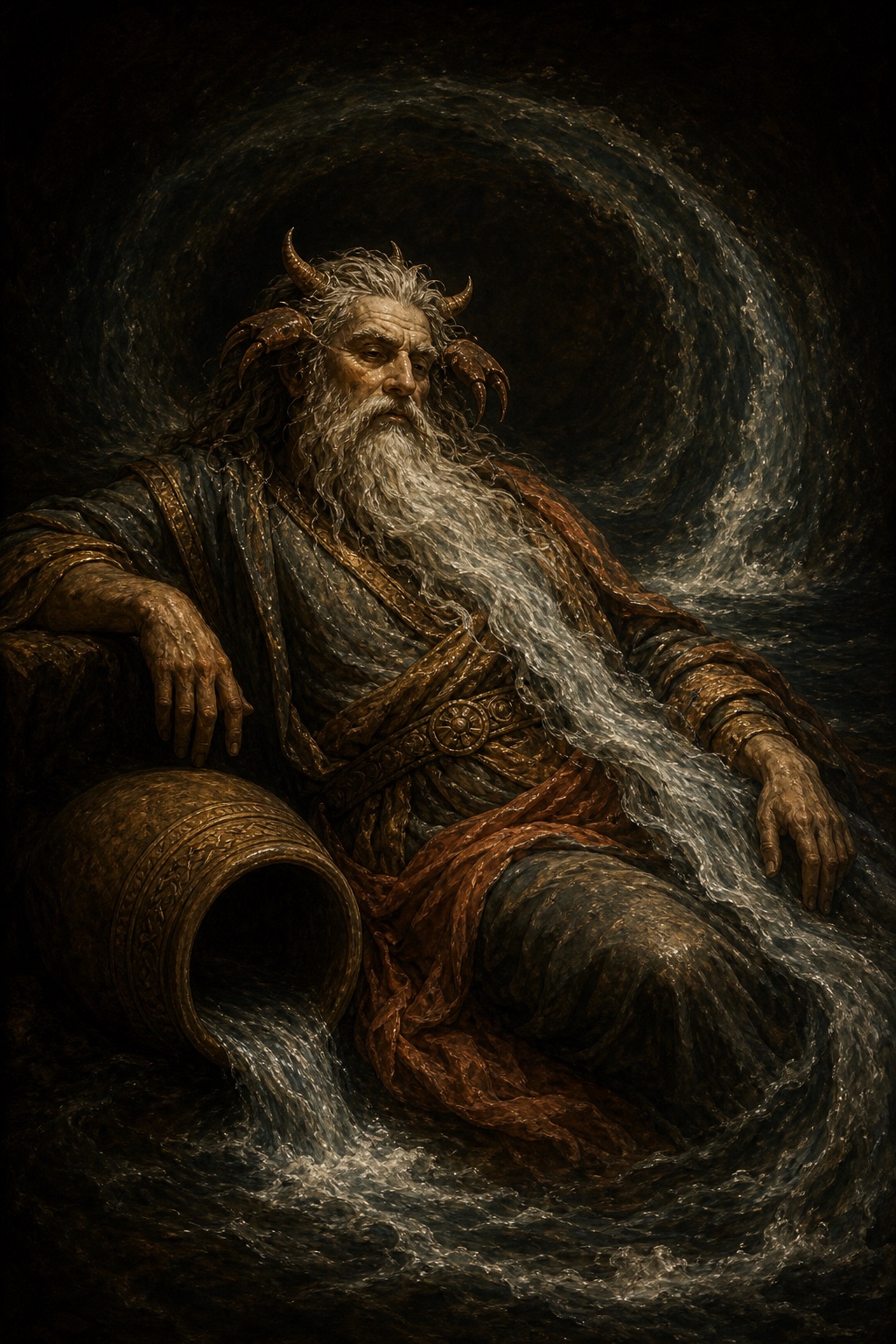
What the god is, is water. Budge describes a deep and boundless watery mass out of which the heavens and the earth and everything in them came into being, with the germs of every kind of life already in it from the beginning; he finds both the ocean and the Nile identified with it, and finds it identified in later times with the sky and with the heaven above the sky, though strictly it is the water lying between the two. For the name itself he prefers a play on two Egyptian words — nu, the watery mass, and nen, inactivity — which makes this god the inert water the world was raised out of rather than anything that acts. That is why the atlas files him under the first generation, the category kept for the beings who are there before the gods who do things. He is the first Egyptian figure in it: Atum, Ptah and Geb are gods here, Nut is a goddess, and not one of them is what was there first.
The forms in which Nu is depicted vary. Thus he is represented in human form holding a sceptre when he forms one of the company of the gods of Amen, but he is also represented with the head of a frog, which is surmounted by a beetle — E. A. Wallis Budge, The Gods of the Egyptians (1904), vol. 1, p. 284
The sentence runs on past the quoted end to a third form, the head of a snake. The beetle sitting on the frog’s head is the scarab, which belongs to Khepri and to the sun at dawn, and it is the only thing in this god’s iconography pointing anywhere but at water; even the writing of his name is three vases of water for the sound, with the sign of outstretched heaven and the water determinative after them. Budge reads that spelling as placing him in the sky rather than in the sea, which is the opposite of where a modern reader puts an ocean.
The first-born god from whom Ra came into being
The Legend of the Destruction of Mankind opens with Ra grown old. His bones have turned to silver, his limbs to gold and his hair to lapis lazuli, and men and women are saying so where he can hear them. He calls for his Eye, and for Shu and Tefnut, and for Geb and Nut, and for the father-gods and mother-gods who were with him when he was still inside the water — and then, with the whole company bowed down on either side of him, he speaks past all of them to one god in particular. The text names the addressee outright before the speech begins: Ra spake unto Nu.
O thou first-born god from whom I came into being, O ye gods of ancient time, my ancestors, take ye heed to what men and women [are doing]; for behold, those who were created by my Eye are uttering words of complaint against me. Tell me what ye would do in the matter, and consider this thing for me, and seek out [a plan] for me, for I will not slay them until I have heard what ye shall say to me concerning it — E. A. Wallis Budge, Legends of the Gods (1912), “The Destruction of Mankind”
That is the strongest statement of the relation anywhere in reach, and Budge’s footnote on the same page confirms who is being addressed. It is the sun-god of Egypt telling a room full of gods that he came out of somebody, and it is not a single witness: Budge’s own rendering of the same scene in his other book, eight years earlier, has Ra say almost exactly the same thing.
It does not survive the next sentence unchallenged. The frame Budge prints for the reply that follows makes Nun the son of Ra, and it does so in both books — the 1912 transcription and the 1904 volume word that frame differently and agree about its direction, two sentences after Ra has called him the god he came into being from. This entry records the contradiction rather than settling it. It is Budge’s text and not a scanning fault, it survives two books and two separate transcriptions, and nothing else in reach decides which way the descent runs.
The counsel against mankind
Nun answers. What he says is four clauses long, and every death in the rest of the legend follows from it.
Thou art the god who art greater than he who made thee, thou art the sovereign of those who were created with thee, thy throne is set, and the fear of thee is great; let thine Eye go against those who have uttered blasphemies against thee — E. A. Wallis Budge, Legends of the Gods (1912), “The Destruction of Mankind”
The quotation begins inside the speech because the sentence introducing it is the disputed one described above; the speaker is Nun and the text says so, in a clause this entry declines to quote. Read the advice on its own and it is not what a father of the gods might be expected to say. It grants first that Ra had a maker and has outgrown him — which is the descent puzzle stated by the one god best placed to know the answer — and then it tells him to send the Eye. The assembled gods second the plan immediately, the Eye goes out in the form of Hathor, and this atlas already tells the rest twice over: Hathor’s entry follows her into the desert, and Sekhmet’s follows what she becomes once she has tasted blood and has to be stopped with seven thousand jars of beer mixed with blood. All of it is downstream of these four clauses.
Nothing in the legend punishes him for them, and nothing in it thanks him either. The counsel is taken, the massacre happens, Ra regrets it, and the god who proposed it is not mentioned again until the sun-god needs another favour.
The gods who call him father
Three speakers in the same book call him father, in three different scenes, and none of the three is the frame that makes him a son. The first is Ra again, later in the same legend, giving Thoth an order to summon Geb — Budge spells him Seb — and then sending Geb on an errand.
Do thou go to the place where my father Nu is, and say thou unto him, ‘Keep ward over the worms (or, serpents) which are in the earth and water’ — E. A. Wallis Budge, Legends of the Gods (1912), “The Destruction of Mankind”
This is the one passage anywhere that hands him a duty rather than an opinion: the watch over the serpents of the earth and the water, given to the god who is the water. Budge’s parenthesis is his own hedge between two readings of one Egyptian word, and it stays where he put it.
The second and third are the same speaker twice. In the History of Creation the god Neb-er-tcher, who says he came into being in the form of Khepri — Khepera, in Budge’s spelling — tells his own beginning in the first person and twice breaks off to quote his father.
My father Nu saith:— They covered up (or, concealed) my Eye with the plant-like clouds which were behind them (i.e., Shu and Tefnut) for very many hen periods — E. A. Wallis Budge, Legends of the Gods (1912), “The History of Creation”
The other version of the speech, a page earlier in the same text, has the same clause with the three-gods sequence attached: from being one god the creator became three, and Shu and Tefnut rose out of the inert watery mass they had been lying in. Both versions have the Eye hidden behind the first two children and both put the words in the mouth of a father who is the water they came out of.
The last scene is the one this entry cannot quote. Near the end of the Destruction legend Ra tells Nun that his limbs are weak and that he will not let it happen twice, and Nun gives two orders in reply: he calls Shu son and tells him to be the Eye for his father, and he tells the goddess Nut to lift him. Nut asks how that can be done, calling Nun her father as she asks, and then becomes the cow that carries Ra away on her back. The transcription of those lines is broken — whole clauses are printed as rows of dots — so the wording is not quotable and is given here without quotation marks. What it says is nevertheless plain, and it is not what this atlas says elsewhere: Nut’s entry gives Shu as her father and Tefnut as her mother, and Shu’s entry gives Ra as his. The relation field on this page therefore names only Ra, the one claim three separate passages support, and the other two children stay here in prose where the disagreement is visible.
The Eight, and the four round his throne
Budge spells the name of this god’s female counterpart exactly the way he spells the name of the sky-goddess Nut, and the two are not the same goddess. The counterpart of the abyss is its female half, the primeval mother, of whom he says almost nothing except that later goddesses — Hathor, Mut and Neith among them — were identified with her and took over her attributes. Holding the sky off the earth is somebody else’s work entirely. Because the two names are written identically, this entry carries no consort field at all: the value would resolve to the wrong page in all six languages and nothing would warn anyone. The pair stands at the head of the company of eight primeval gods of Hermopolis, four male and four female, a roster that was never fixed — Ament’s entry records the same lists from the other side, where some authorities put Amun and Ament into these two places instead.
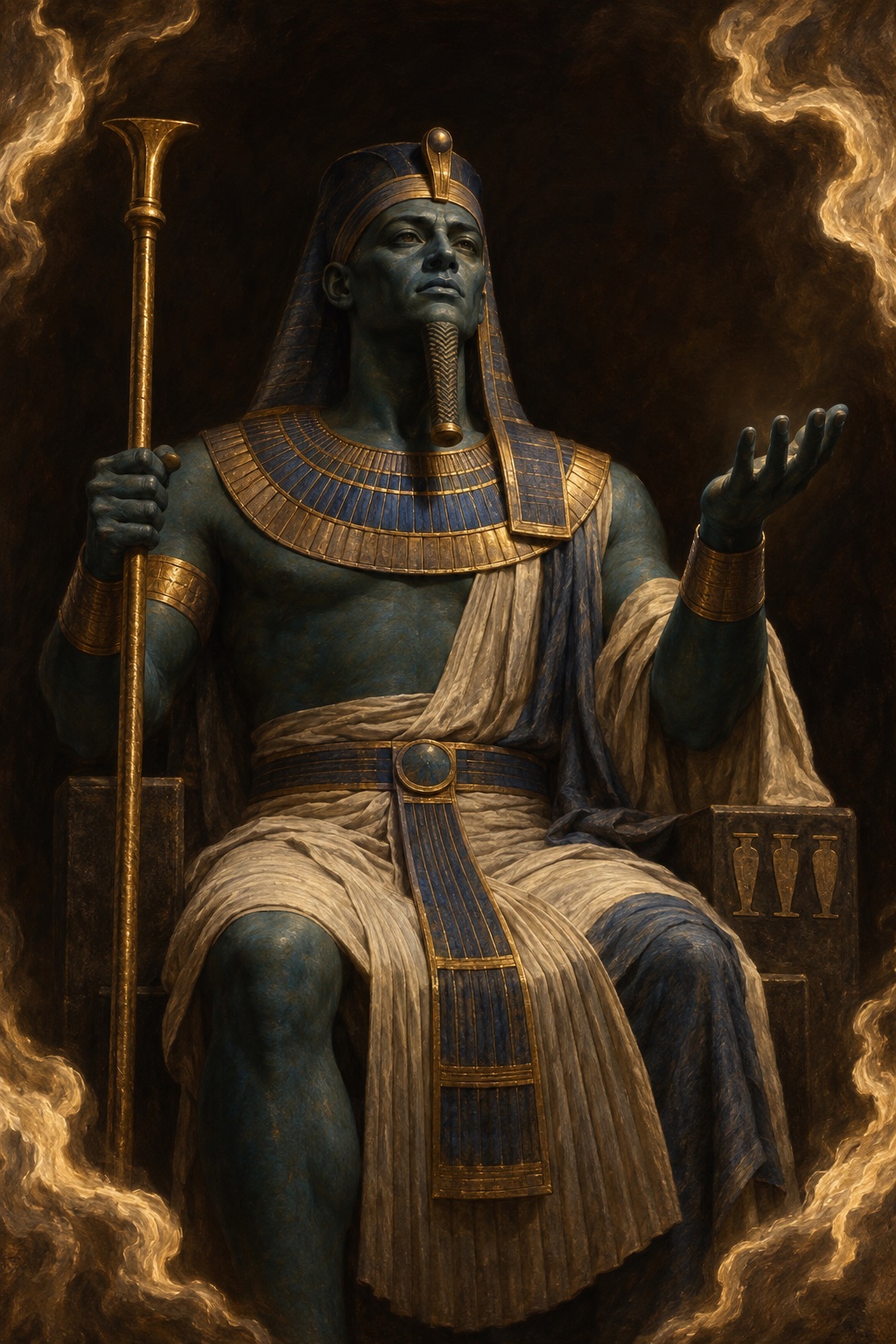
The other group he stands in the middle of is smaller and better attested. In the Pyramid Texts of Teta, Budge finds four goddesses who shot forth flame and worked protection on behalf of the god Nu while he was seated on his throne: Isis, Nephthys, Neith and Serqet, the same four who guard the Four Children of Horus and the organs in the canopic jars. Neith’s entry and Serqet’s both already record the grouping from their own side. Note what the sentence does and does not say. The protection is worked around him, by others, while he sits; he is the object of the ritual and not a participant in it, which is the shape of nearly everything told about him.
Three gods are said outright to be him. Ptah takes him as a form, Ptah-Nu, which Budge reads as the union of the great celestial workman and architect with the primeval element of water. Khnemu, in the legend of the seven years’ famine, declares himself to be Nu the Great God who came into being at the beginning, and Hapi who rises according to his will — three gods claimed in one sentence by the potter of Elephantine. And Hapi, the Nile in flood, is identified with Nu in Budge’s second volume as the primeval water abyss all things sprang from. Budge adds a fourth case as an argument rather than a title: that the attributes of Nu were transferred wholesale to Ra, until Ra was identified with him absolutely, which would make the sun-god’s rise from the water a takeover as much as a birth.
Lay the whole record end to end and one thing stands out. He is addressed, quoted, obeyed, protected and absorbed; he acts exactly once, when Ra asks him a question and he answers it. The answer kills most of mankind. For a god whose name means the inert water, that is a surprisingly large mark to have left.