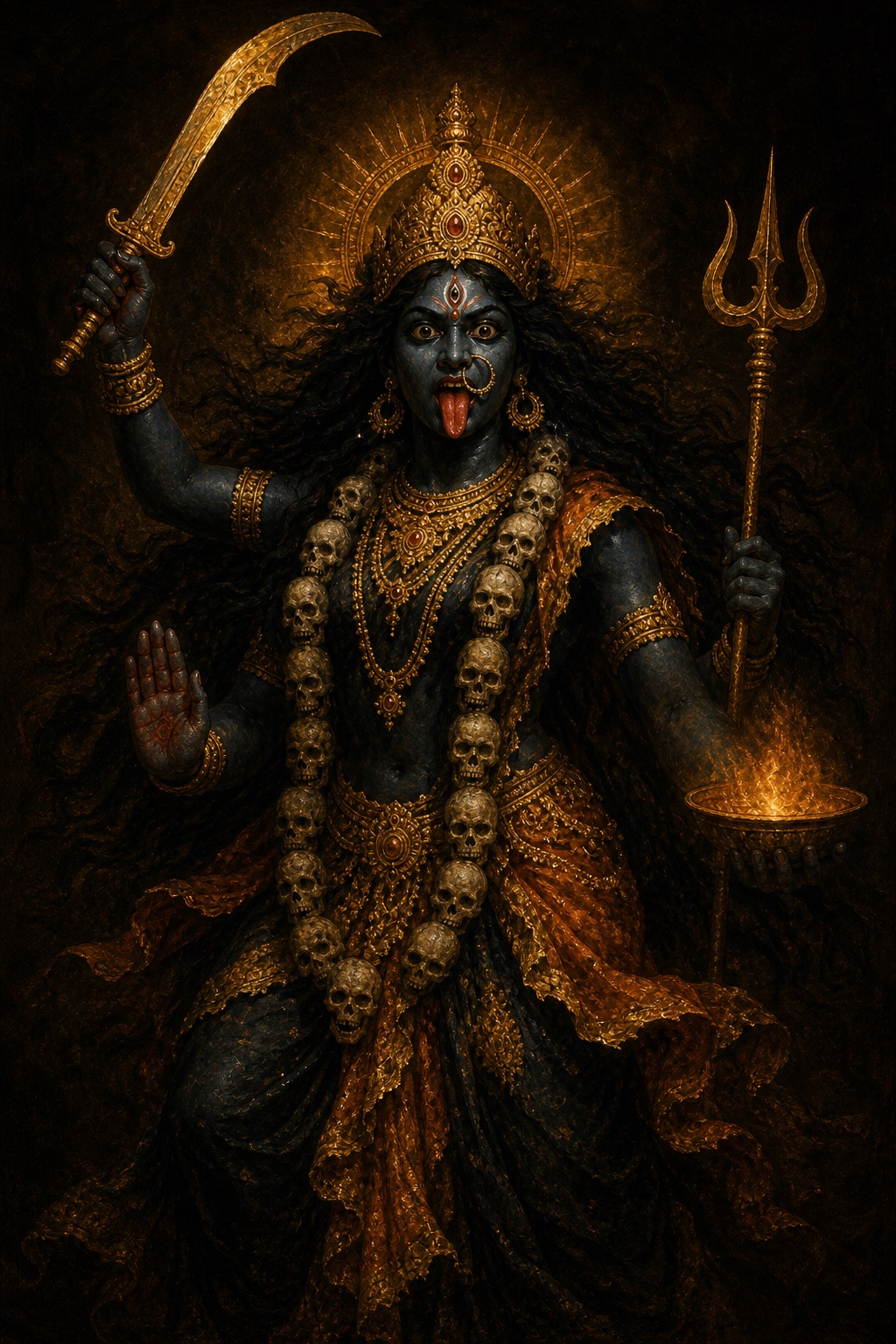
Wading in blood at Suten-henen
Hathor’s own entry already carries the opening of this episode: Ra, mocked by an aging mankind, sends his Eye against the rebels in the form of Hathor, and she returns to report that the slaughter “was sweet to my heart.” Three sentences later, in Budge’s own translation and with no explanation offered, the narrative simply stops calling her Hathor. The goddess is renamed Sekhet — Budge’s spelling of Sekhmet — and the same action continues under the new name:
And it came to pass that Sekhet of the offerings waded about in the night season in their blood, beginning at Suten- henen. — E. A. Wallis Budge, Legends of the Gods (1912), “The Destruction of Mankind”
(The space inside “Suten- henen” is a line-wrap artifact of the 1912 transcription, not an error introduced here; the same place-name appears without it elsewhere in Budge’s text.) That silent substitution — not a genealogy, not a formal gloss, just the same sentence carrying on under a new name — is the plainest evidence in the whole episode that Hathor and Sekhmet were, in this telling, understood as one destructive force wearing two faces. It is also the reason for the spelling gap between the goddess named on this page and the goddess named in Budge’s prose: Sekhmet is the modern rendering used throughout this wiki; Sekhet is what the 1912 translation actually prints, and the quotation above reproduces it exactly.
The beer that stopped her
Ra cannot simply recall his own weapon; he has to trick her. Mandrakes are brought and crushed — handed, oddly, to “Sekhet, the goddess who dwelleth in Annu (Heliopolis),” a second invocation of the same name within a few lines of the raging Sekhet who is the subject of the whole episode. Budge’s text never says whether this is the same goddess under a cult epithet or a distinct Heliopolitan figure folded into her, and nothing here resolves it either. The crushed mandrakes go into the brewing vats together with some of the blood of the men and women already slain — real blood, not a dye standing in for it; the detail in popular retellings where Ra stains the beer red with ochre is not in this text. Seven thousand jars of the doctored beer are carried downriver and poured across the meadows overnight, and the rampage outruns even Ra’s own intent: seeing the beer prepared, Budge has him say, “it is good, it is good, nevertheless I must protect men and women against her” — the god who unleashed her moving to contain her before she can finish the task he gave her. At dawn she finds the flood:
she found these [Heavens] flooded [with beer], and she was pleased thereat; and she drank [of the beer and blood], and her heart rejoiced, and she became drunk, and she gave no further attention to men and women — E. A. Wallis Budge, Legends of the Gods (1912), “The Destruction of Mankind”
She is not defeated. She is fed exactly what she has already been drinking, until she forgets why she began.
Sekhmet and Hathor
The mid-episode renaming is why this entry’s relations carry Hathor as identified-with, and why Hathor’s own entry carries the identical relation pointed back. It is not a scholarly gloss layered onto the story afterward; it is Budge’s text doing it, mid-sentence, without comment, in the middle of the single episode both entries draw on. Read together, the two pages tell one story from its two names: Hathor sent forth and pleased with the killing, Sekhmet wading through the blood that killing leaves behind and drinking herself insensible once it is mixed into the beer that finally stops her.
Lioness of war, plague, and the physicians who served her
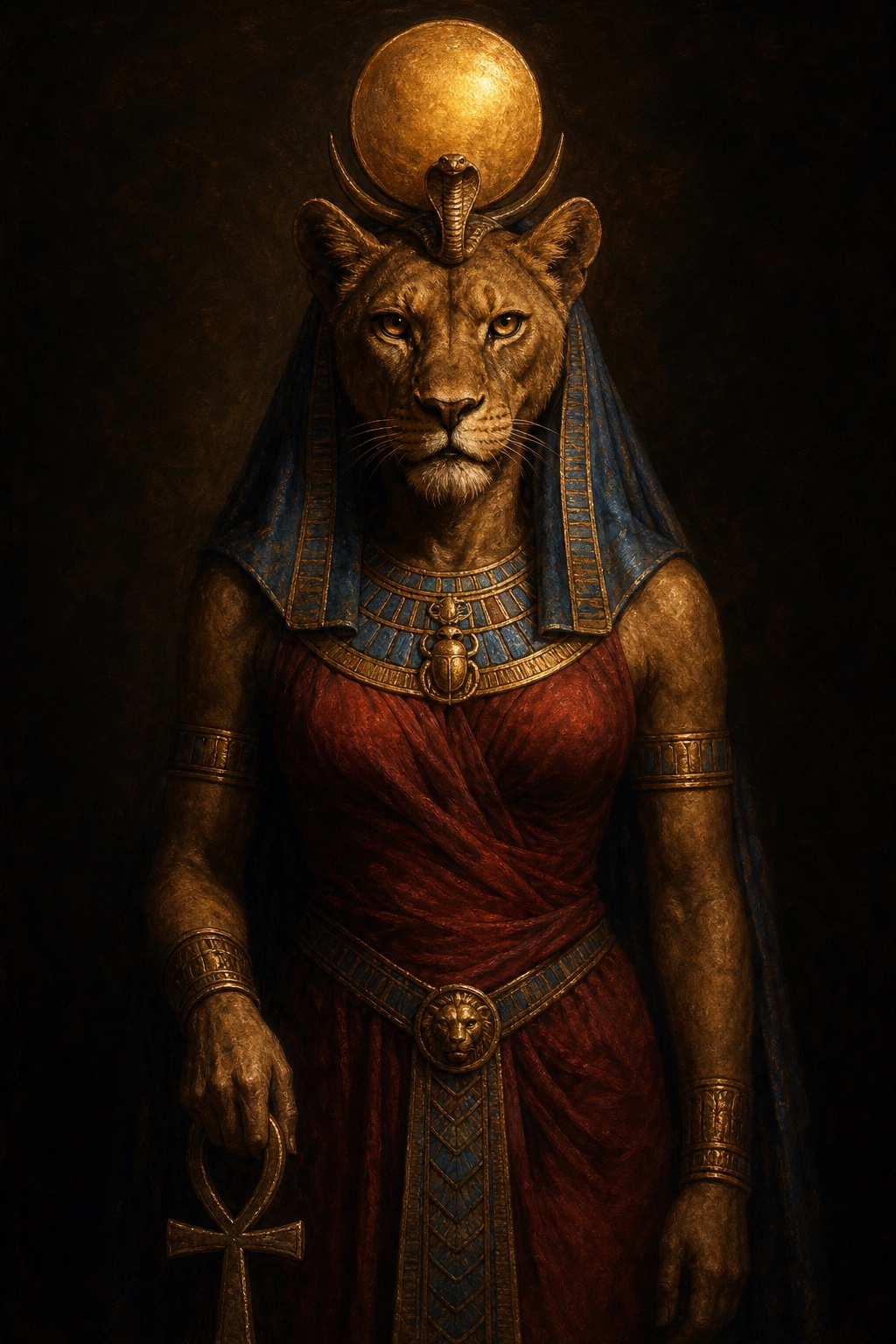
Nothing in the Destruction narrative itself calls her a lioness outright. Her signature image — a woman’s body under a lioness’s head, crowned with the solar disk and uraeus — is attested in this corpus not from a Sekhmet-specific passage but at one remove, through Tefnut’s entry, which names Sekhmet among the feline goddesses Budge lists Tefnut as identified with in various cities. Later cult tradition, well outside anything the Destruction narrative describes, made her doubly dangerous and doubly needed: the goddess whose breath could carry plague across the land, and the patron of the physician-priests who treated it in her name. That is the same double edge that runs through her one surviving myth, where the force nearly ending mankind is checked not by opposition but by careful management — but it belongs to later practice, not to anything Budge’s quoted episode itself claims.