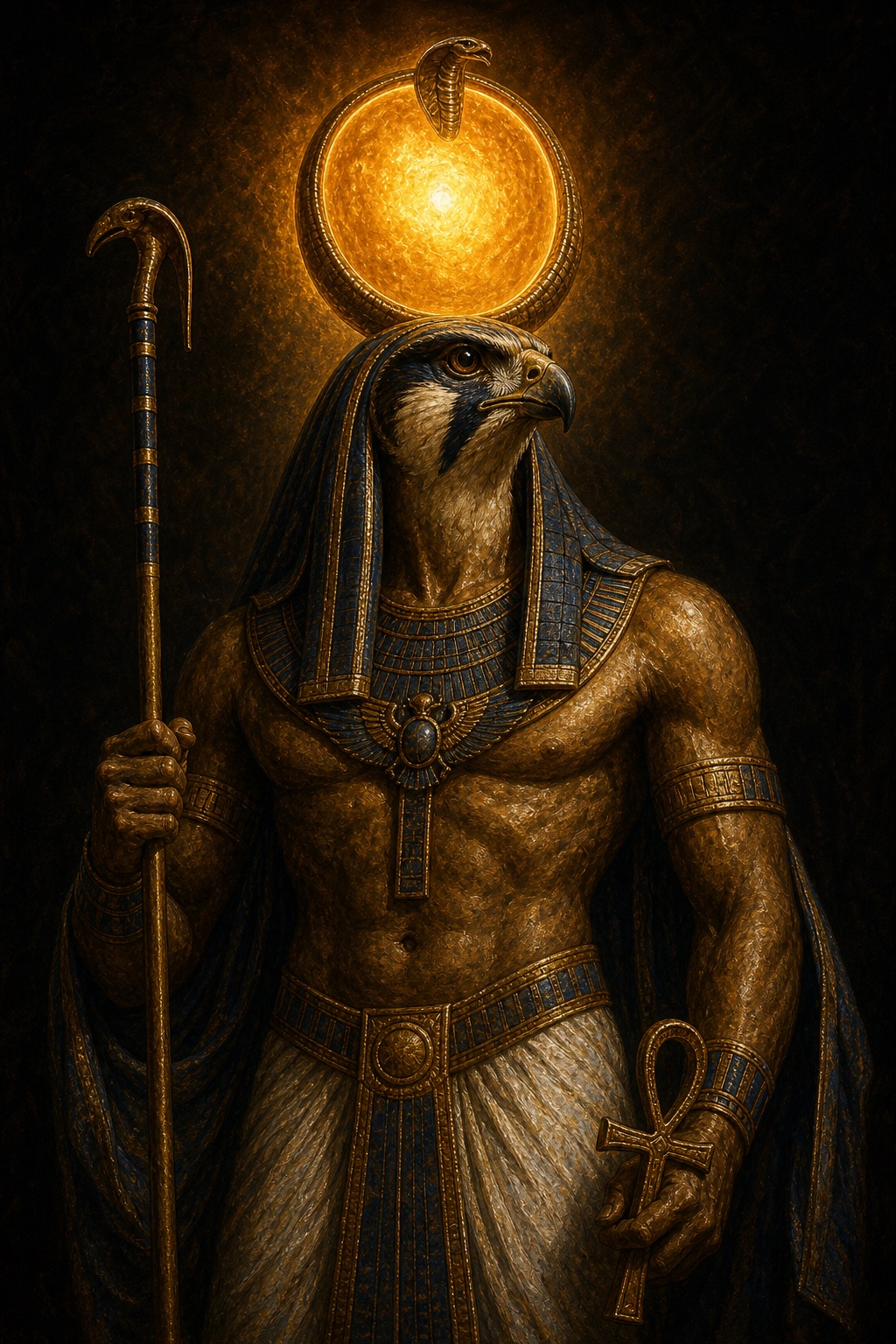
The self-begotten god
Legends of the Gods opens its account of the Destruction of Mankind by calling Ra the god who was self-begotten, and Budge, retelling the order of creation, places the sun’s first rising after the birth of the earliest gods: presumably at that time, he writes, the sun first rose out of the watery abyss, the water this atlas files under Nun. His cult, Budge notes in the same book, was of Heliopolitan origin.
The fullest statement of how a self-begotten god goes on to make everything else is a text Budge calls the Book of Knowing the Evolutions of Ra. It is spoken in the first person, and its opening words give it to the god Neb-er-tcher, who says he came into being in the form of Khepri; Budge files the whole of it under Ra’s evolutions and reads it as Ra’s own account of his beginnings, and this entry follows him while keeping the speaker’s name in view. The voice is unambiguous about its scope — “I was the creator of everything which came into being” — and it names the first two beings it produced, emitting Shu and then Tefnut, the pair this entry lists as Ra’s children. Elsewhere in Legends of the Gods Budge sums up the same idea from the other end: Khepri gave being to himself by uttering his own name.
Then comes the line that gives humanity its origin, and it is not a flattering one.
Now after these things I gathered together my members, and I wept over them, and men and women sprang into being from the tears which came forth from my Eye — E. A. Wallis Budge, Legends of the Gods (1912), “The Book of Knowing the Evolutions of Ra”
People are not shaped, breathed into or spoken; they are what fell out of the creator’s Eye while he was weeping over his own body. The men and women who came from those tears are the ones who will later complain against him, and a goddess sent out against them will answer the complaint.
The boat and the two horizons
What the sun does every day, the texts describe as a voyage with a crew. In the Legend of Ra and Isis, Ra enters heaven each day “at the head of his mariners”, establishing himself on the double throne of the two horizons. The hymn in the Papyrus of Qenna greets him at sunrise.
“Homage to thee, O Ra, when thou risest [and to thee], O Temu, in thy risings of beauty. Thou risest, thou risest, thou shinest, thou shinest, at dawn of day. Thou art crowned king of the gods.” — The Book of the Dead: Theban Recension (1901), Papyrus of Qenna, tr. E. A. Wallis Budge
Two names stand in the first line, and the hymn makes no effort to keep them apart. A hymn to Ra in the Papyrus of Hunefer draws the line between them by the clock: he is “Ra when thou risest, and Temu when thou settest”, which makes Atum the evening of the same god rather than a second god. Budge’s summary of what Ra tells Isis about himself runs the division into three — Khepri in the morning, Ra at noon, Atum in the evening — and Wiedemann groups Harmakhis, Khepri and Atum together as Ra’s equivalents. The sun is one traveller whose name changes with the hour.
The night has its own reckoning. Wiedemann describes the twelve hours of the night taking over from the hours of the day in guiding the sun, and in the first hour of the night, as he describes an illustrated text, the sun-god stands in the cabin of a bark with a ram’s head surmounted by the solar disk; Wiedemann names that figure the flesh of Ra rather than Ra himself, for the sun is dead.
The names did not stop at the hours. In Thebes, Wiedemann reports, Amun joined with Ra was held to be the founder of the divine dynasty, and a hymn to that combined god in Budge’s second volume says of him that “thy names are manifold, and how many they are is unknown”, that he shines in the eastern and western horizons, and that he overthrows his enemies at his birth every day. The Greek name attaches to the other half of the pair: Plutarch, in the treatise Budge appends to Legends of the Gods, reports that Ammon is generally looked upon as the proper name of the Egyptian Zeus — a statement about Amun, not about Ra.
King of gods and men
Ra in these stories is not only the sun but a ruler, and a ruler who ages. The Destruction of Mankind begins with his reign and moves straight to its decline.
after he had assumed the sovereignty over men and women, and gods, and things, the ONE god. Now men and women were speaking words of complaint, saying:—“Behold, his Majesty (Life, Strength, and Health to him!) hath grown old, and his bones have become like silver, and his members have turned into gold — E. A. Wallis Budge, Legends of the Gods (1912), “The Destruction of Mankind”
The legend wraps the sun-god in the courtesies of a royal court, and Wiedemann reads the kingship from the other side as well: the king on earth was held to be as literally the son of Ra as of the queen. In the Heliopolitan list of divine rulers Wiedemann reports, Ra reigns second, succeeding Atum and followed by Shu, Geb, Osiris, Set and Horus.
The complaint is answered with a massacre. A goddess goes out against the men and women on the desert land and slays them, and Ra calls her back by name: “Come, come in peace, O Hathor, for the work is accomplished.” Her reply is that gaining the mastery over men and women was sweet to her heart. Later in the same legend Nut sets the Majesty of Ra upon her back.
The serpent in the dark
The boat has an enemy in the dark. Budge describes him in Legends of the Gods as a fiend called Apep, who appears in the sky in the form of a monster serpent and marshals all the fiends of the Tuat, the underworld, in an attempt to keep the sun-god imprisoned in the kingdom of darkness. Wiedemann sets the struggle in the Underworld and calls the Apep serpent the symbol of darkness.
The Book of Knowing the Evolutions of Ra gives the outcome, and it is a punishment carried out on a prisoner rather than a duel.
he is chained in one place whilst Ra inflicts upon him the blows which are decreed for him. He is thrown upon his accursed back, his face is slit open by reason of the evil which he hath done — E. A. Wallis Budge, Legends of the Gods (1912), “The Book of Knowing the Evolutions of Ra”
The blows are decreed, and the reason given is the evil Apep has done; the text frames the beating as justice owed, which is why this entry files Ra under order as well as under the sun. When the night is over, Wiedemann’s account has Ra meeting the scarab Khepri, the god of the new morning sun, who embarks with the dead god of the sun of yesterday — and the voyage the Qenna hymn greets begins again.
Isis and the name
One legend has Ra lose something. In Legends of the Gods he is poisoned, and the words that cure him belong to Isis: “Flow, poison, come out of Ra,” she says, and “It is I, Isis, who work, and I have made the poison to fall on the ground”. And in the Legend of Ra and Isis he agrees to let her have his name.
I will allow myself to be searched through by Isis, and my name shall come forth from my body and go into hers.” Then the divine one hid himself from the gods, and the throne in the Boat of Millions of Years — E. A. Wallis Budge, Legends of the Gods (1912), “The Legend of Ra and Isis”
The name passes from one body into another, and the god who gives it up then hides himself from the other gods. In the same exchange, by Budge’s summary, Ra tells Isis that he is Khepri in the morning, Ra at noon and Atum in the evening.