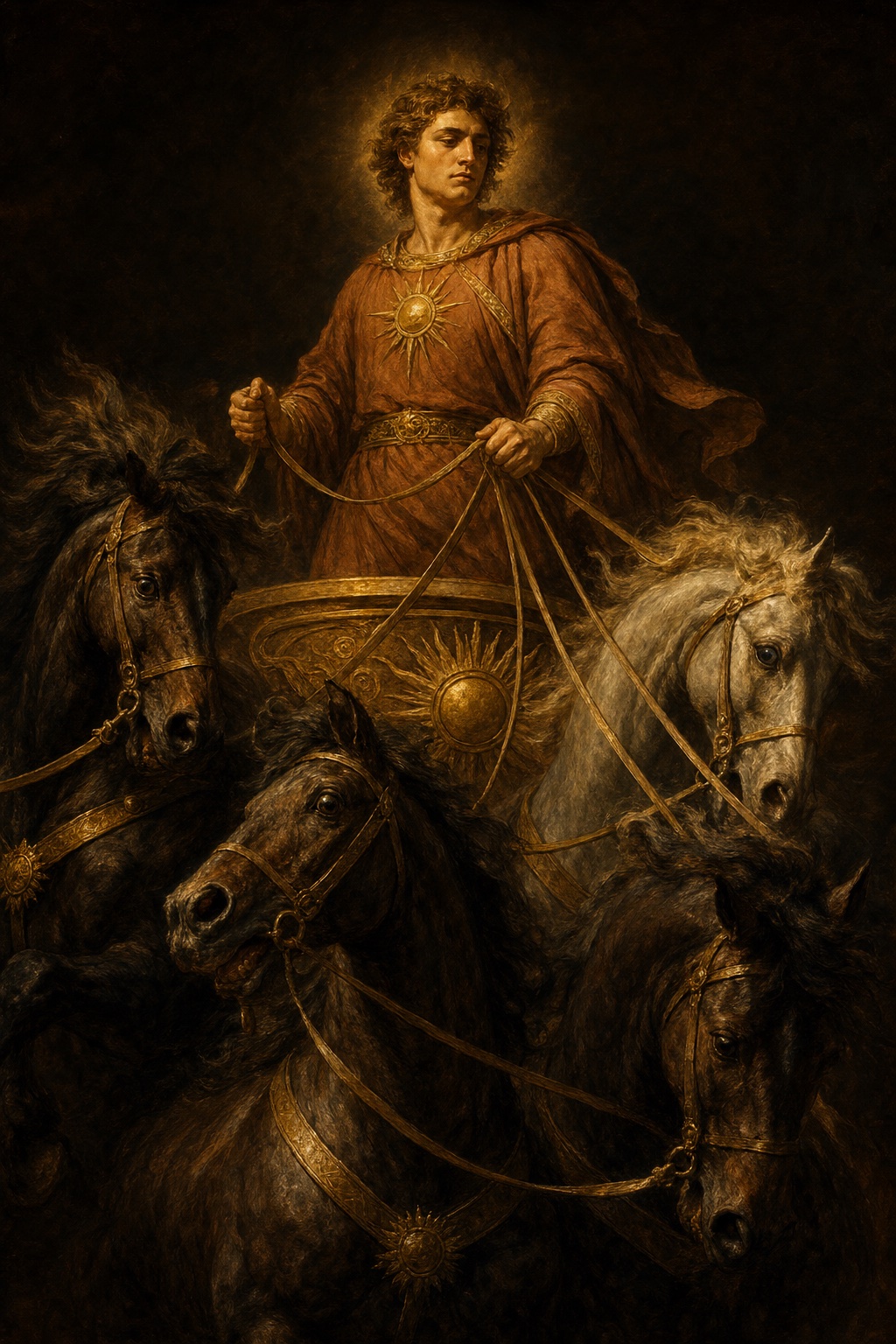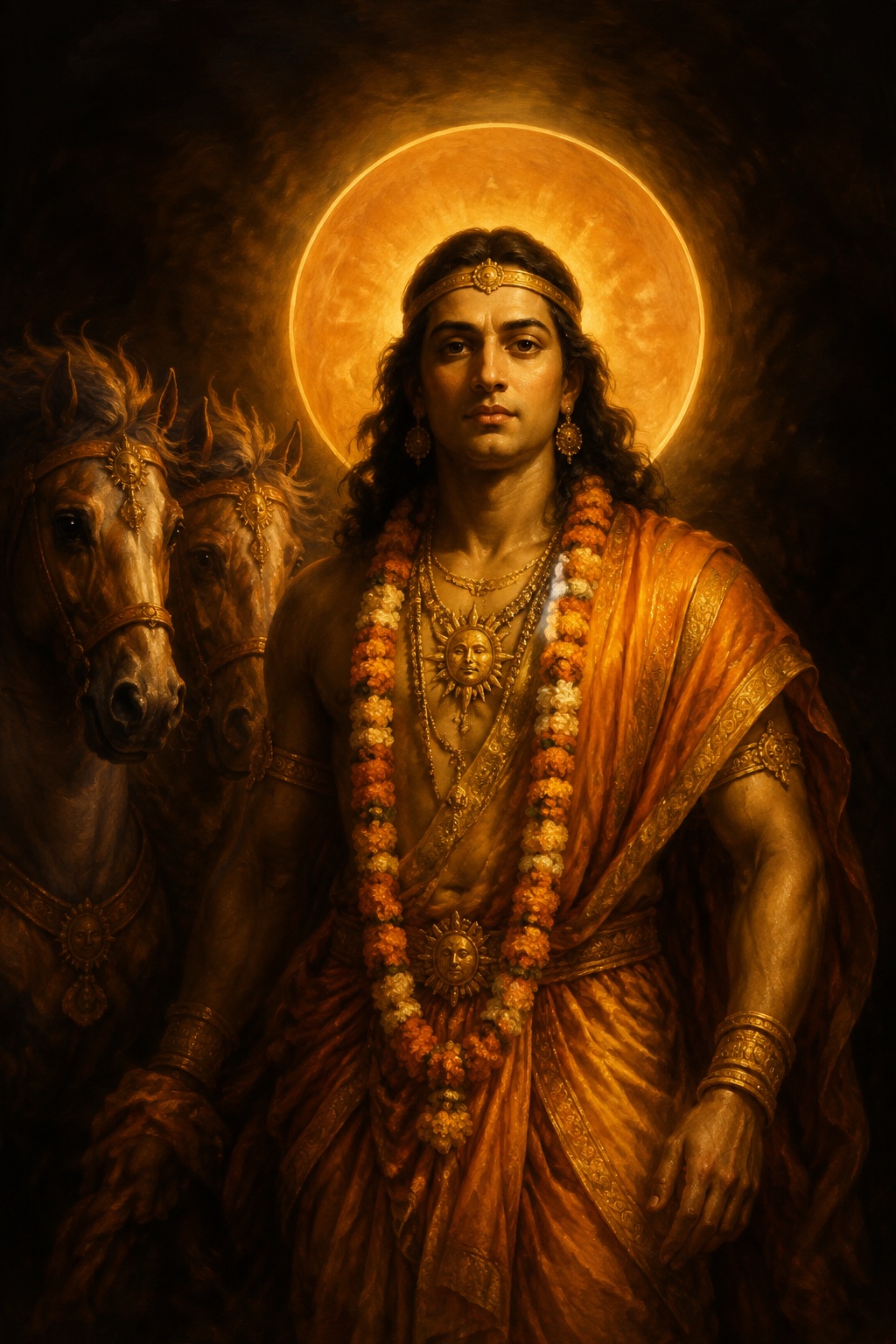
An eye that belongs to other gods
Rigveda 1.115 is addressed to Sūrya — the hymn’s own heading names him as its deity — and its first line does not begin with him. It begins with an appearance, and only then says whose.
चित्रं देवानामुदगादनीकं चक्षुर्मित्रस्य वरुणस्याग्नेः । आप्रा द्यावापृथिवी अन्तरिक्षं सूर्य आत्मा जगतस्तस्थुषश्च ॥१॥
“THE brilliant presence of the Gods hath risen, the eye of Mitra, Varuna and Agni. The soul of all that moveth not or moveth, the Sun hath filled the air and earth and heaven.” — Rigveda 1.115.1, tr. Ralph T. H. Griffith
चक्षुः is an eye, and the genitives after it are not his. He is the eye of Mitra, of Varuna, of Agni — the organ by which three other gods see. A sun-god defined this way is not primarily a person with a chariot; he is the faculty of sight that the sky lends to the rest of the pantheon. Mitra and Varuna are the gods of oath and of order, and what they most need is to see who is keeping their agreements. The sun is how they do it.
अनीकम्, which Griffith renders “presence”, is a face or a front — the visible side of something. The hymn’s opening move is to call him the visible aspect of the gods in general, before narrowing to any one of them.
आत्मा — the soul of what moves and what does not
The second half of the same verse makes the largest claim in the hymn, and Griffith keeps its shape. सूर्य आत्मा जगतस्तस्थुषश्च: the Sun is the आत्मा — soul, self, breath — of जगतः, the moving, and of तस्थुषः, the standing-still. Between them those two words are the Rigveda’s way of saying everything: what walks and what is rooted, animals and stones, the two halves of the world sorted by whether they go anywhere.
The verb that follows is आप्रा, he has filled: earth, air and heaven, all three at once. This is a hymn about the moment of sunrise, and its account of that moment is not that light arrives but that a self arrives — one interior belonging to the whole of things. The rest of Vedic and later Indian thought does a great deal with that line. The hymn itself states it in eight syllables and moves on.
Behind the Dawn, like a young man behind a girl
Having made him the soul of the universe, the hymn’s next verse makes him a man walking behind a woman.
सूर्यो देवीमुषसं रोचमानां मर्यो न योषामभ्येति पश्चात् । यत्रा नरो देवयन्तो युगानि वितन्वते प्रति भद्राय भद्रम् ॥२॥
“Like as a young man followeth a maiden, so doth the Sun the Dawn, refulgent Goddess: Where pious men extend their generations, before the Auspicious One for happy fortune.” — Rigveda 1.115.2, tr. Ralph T. H. Griffith
मर्यो न योषाम् — as a young man a girl — is the whole comparison, and पश्चात्, behind, is the point of it. The sun does not rise with the dawn; he rises after her, always, and never catches her. The Rigveda’s Ushas is a goddess in her own right and the sun’s daily failure to overtake her is the fixed order of the sky rendered as an unfinished courtship. It is also, as the verse’s second half says, a calendar: this is where generations of worshippers set out their yugas, their yokings and ages, one auspicious thing after another.
Two verses in, the hymn has given him both extremes it has — cosmic interior and ordinary desire — and made no attempt to reconcile them.
Two suns in this corpus, and one of them is later
This wiki already carries Vivasvat, and the two figures need separating carefully, because the tradition eventually merges them.
Vivasvat’s entry is built on Rigveda 10.17, a wedding hymn in which he is married, deceived and deserted; that entry says plainly that nothing in his own two verses calls him a sun, and that the solar reading of him rests on his name and on Sāyaṇa’s mediaeval commentary. Sūrya’s entry is the opposite case. Nothing here is inferred: the hymn names him सूर्य, calls him an eye and a risen face, and has him fill the three worlds. He is the Rigveda’s own sun, addressed as such, in a hymn assigned to him.
His horses belong to the hymn as well — verse three calls them auspicious, tawny and dappled, and has them mount the back of heaven and compass earth and sky in a day. The seven-horse chariot, the charioteer Aruna and the lotus in each hand are the sun of later iconography, and are worth naming as that rather than reading back into a hymn that has none of them.