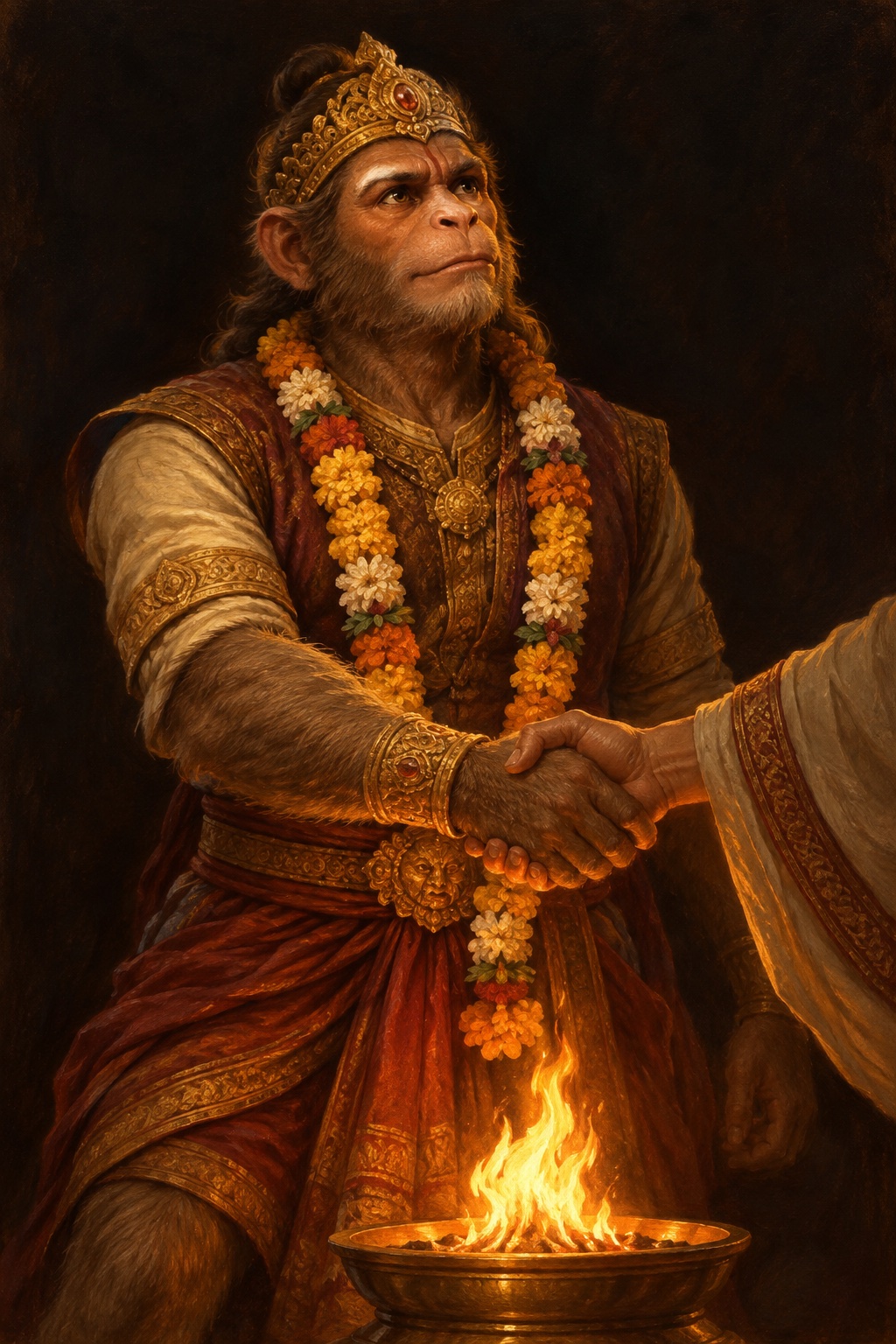
Friends before the fire
Sugriva is a king of the monkeys, the vanaras, in the Kishkindhakanda, the fourth book of the Ramayana, and his father is Surya, the sun. When Rama first hears of him he is a king without a kingdom. His brother Vali has driven him out, and he lives in fear on the mountain Rishyamuka with a band of his lords, Hanuman among them. In Griffith’s Book III, Canto LXXIII, Kabandha tells Rama to go to him and to make him a friend “before the attesting flame”. The friendship is a rite from the start.
He is a frightened king when the story reaches him. In Griffith’s Canto II he sees two armed strangers on the mountain and takes them for spies of Vali in the dress of hermits. He runs with all his band to a higher peak, and Hanuman scolds him for “The weakness of the Vánar kind”, a mind that moves from one thought to the next. Sugriva’s answer is the answer of a careful king. A wise enemy, he says, strikes through other hands, so he sends Hanuman to sound out the strangers and to speak for him as his envoy. Hanuman brings Rama and Lakshmana to him, and the fifth sarga opens on Sugriva’s reply. श्रुत्वा हनूमतो वाक्यं, hearing Hanuman’s words, the lord of the monkeys, वानराधिपः, speaks to Rama with affection. He calls it an honour and the highest gain, सत्कारो लाभश्चैवोत्तमः, यत्त्वमिच्छसि सौहार्दं वानरेण मया सह, that Rama wants friendship with him, a monkey. Then he holds out his hand.
रोचते यदि मे सख्यं बाहुरेष प्रसारितः। गृह्यतां पाणिना पाणिर्मर्यादा बध्यतां ध्रुवा॥ ११॥ एतत् तु वचनं श्रुत्वा सुग्रीवस्य सुभाषितम्। सम्प्रहृष्टमना हस्तं पीडयामास पाणिना॥ १२॥ हृष्टः सौहृदमालम्ब्य पर्यष्वजत पीडितम्। ततो हनूमान् संत्यज्य भिक्षुरूपमरिंदमः॥ १३॥ काष्ठयोः स्वेन रूपेण जनयामास पावकम्। दीप्यमानं ततो वह्निं पुष्पैरभ्यर्च्य सत्कृतम्॥ १४॥ तयोर्मध्ये तु सुप्रीतो निदधौ सुसमाहितः। ततोऽग्निं दीप्यमानं तौ चक्रतुश्च प्रदक्षिणम्॥ १५॥
“If thou my true ally wouldst be Accept the pledge I offer thee, This hand in sign of friendship take, And bind the bond we ne’er will break.’ He spoke, and joy thrilled Ráma’s breast; Sugríva’s hand he seized and pressed And, transport beaming from his eye, Held to his heart his new ally. In wanderer’s weed disguised no more, His proper form Hanúmán wore. Then, wood with wood engendering, came Neath his deft hands the kindled flame. Between the chiefs that fire he placed With wreaths of flowers and worship graced. And round its blazing glory went The friends with slow steps reverent.” — Valmiki, Ramayana 4.5.11–15, tr. Griffith
The offer is Sugriva’s. बाहुरेष प्रसारितः: here is my arm, held out. गृह्यतां पाणिना पाणिर्मर्यादा बध्यतां ध्रुवा: let hand be taken by hand, and let a firm bound be set. A मर्यादा is a boundary, a limit that holds, and Griffith makes it “the bond we ne’er will break”. Rama presses the hand, पीडयामास पाणिना, and embraces him. Then ततो हनूमान् संत्यज्य भिक्षुरूपमरिंदमः: Hanuman, the tamer of enemies, puts off the form of a beggar that he wore to meet the strangers. काष्ठयोः स्वेन रूपेण जनयामास पावकम्: in his own form he makes fire from two sticks. He honours the fire with flowers, पुष्पैरभ्यर्च्य, and sets it between the two, तयोर्मध्ये, and they walk round it with their right sides towards it, चक्रतुश्च प्रदक्षिणम्.
The next two verses give the result. सुग्रीवो राघवश्चैव वयस्यत्वमुपागतौ: Sugriva and Raghava have become companions. They look at each other and cannot look enough, न तृप्तिमभिजग्मतुः. Then Sugriva says the line that the rite was for: त्वं वयस्योऽसि हृद्यो मे ह्येकं दुःखं सुखं च नौ, you are my dear friend, and we two have one sorrow and one joy. Griffith gives it as “Friend of my soul art thou: we share Each other’s joy, each other’s care”. The sorrow is his to bring. A few cantos later, in Griffith’s Canto VIII, Sugriva tells Rama that his brother has driven him out and that he wanders the mountain in fear, and he asks Rama to save him. Rama promises to kill the one who robbed him.
The robe and the jewels
The friendship is put to use at once. In the sixth sarga Sugriva tells Rama what he saw. अनुमानात् तु जानामि मैथिली सा न संशयः: he knows by inference that it was Sita, the princess of Mithila, there is no doubt of it, being carried off by a rakshasa of cruel deeds, रक्षसा रौद्रकर्मणा. She was crying out रामरामेति लक्ष्मणेति च, Rama, Rama, and Lakshmana, and writhing in Ravana’s lap like the wife of a serpent king, पन्नगेन्द्रवधूर्यथा. Then she saw the monkeys on the mountain.
आत्मना पञ्चमं मां हि दृष्ट्वा शैलतले स्थितम्। उत्तरीयं तया त्यक्तं शुभान्याभरणानि च॥ ११॥ तान्यस्माभिर्गृहीतानि निहितानि च राघव। आनयिष्याम्यहं तानि प्रत्यभिज्ञातुमर्हसि॥ १२॥ तमब्रवीत् ततो रामः सुग्रीवं प्रियवादिनम्। आनयस्व सखे शीघ्रं किमर्थं प्रविलम्बसे॥ १३॥ एवमुक्तस्तु सुग्रीवः शैलस्य गहनां गुहाम्। प्रविवेश ततः शीघ्रं राघवप्रियकाम्यया॥ १४॥ उत्तरीयं गृहीत्वा तु स तान्याभरणानि च। इदं पश्येति रामाय दर्शयामास वानरः॥ १५॥
“High on a hill she saw me stand With comrades twain on either hand. Her outer robe to earth she threw, And with it sent her anklets too. We saw the glittering tokens fall, We found them there and kept them all. These will I bring: perchance thine eyes The treasured spoils will recognize.’ He ceased: then Raghu’s son replied To the glad tale, and eager cried: ‘Bring them with all thy speed: delay No more, dear friend, but haste away.’ Thus Ráma spoke. Sugríva hied Within the mountain’s caverned side, Impelled by love that stirred each thought The precious tokens quickly brought, And said to Raghu’s son: Behold This garment and these rings of gold. In Ráma’s hand with friendly haste The jewels and the robe he placed” — Valmiki, Ramayana 4.6.11–15, tr. Griffith
आत्मना पञ्चमं मां हि: she saw me, Sugriva says, myself the fifth, five monkeys in all on the mountain, and Griffith counts them out as a king “With comrades twain on either hand”. What she dropped was her उत्तरीयं, the upper garment, and शुभान्याभरणानि, her fine ornaments. Griffith names anklets when they fall and “rings of gold” when Sugriva hands them over. The monkeys did not leave them where they lay. तान्यस्माभिर्गृहीतानि निहितानि च राघव: we took them up and put them away, Raghava, Sugriva says, and you should know them again.
Rama’s answer uses the word of the pact. At the fire Sugriva offered सख्यं, friendship, and now Rama calls him सखे, friend. आनयस्व सखे शीघ्रं: bring them quickly, friend, why do you wait? The verse calls Sugriva सुग्रीवं प्रियवादिनम्, Sugriva who speaks kind words, and that is the part he plays here. He goes into the deep cave of the mountain, शैलस्य गहनां गुहाम्, comes back with the robe and the ornaments, and holds them out to Rama: इदं पश्येति, look at this. Before he has any army to give, he gives Rama a witness’s report and the things that Sita threw down.
Two brothers alike
Rama has shown Sugriva his strength and told him to call his brother out. Sugriva remembers it later as one arrow that split seven great trees, a mountain and the earth, येन सप्त महाद्रुमाः. So he goes to fight. सुग्रीवोऽप्यनदद् घोरं वालिनो ह्वानकारणात्: Sugriva roars a terrible roar to call Vali out, girded tight, गाढं परिहितो, as if his shouts would split the sky. Griffith has him draw his “cinctured vest” closer. Vali rushes out in a rage, and the brothers fight like two planets at war in the sky, बुधाङ्गारकयोरिव, Mercury and Mars.
तलैरशनिकल्पैश्च वज्रकल्पैश्च मुष्टिभिः। जघ्नतुः समरेऽन्योन्यं भ्रातरौ क्रोधमूर्च्छितौ॥ १८॥ ततो रामो धनुष्पाणिस्तावुभौ समुदैक्षत। अन्योन्यसदृशौ वीरावुभौ देवाविवाश्विनौ॥ १९॥ यन्नावगच्छत् सुग्रीवं वालिनं वापि राघवः। ततो न कृतवान् बुद्धिं मोक्तुमन्तकरं शरम्॥ २०॥ एतस्मिन्नन्तरे भग्नः सुग्रीवस्तेन वालिना। अपश्यन् राघवं नाथमृष्यमूकं प्रदुद्रुवे॥ २१॥ क्लान्तो रुधिरसिक्ताङ्गः प्रहारैर्जर्जरीकृतः। वालिनाभिद्रुतः क्रोधात् प्रविवेश महावनम्॥ २२॥
“To highest pitch of frenzy wrought With fists like thunderbolts they fought, While near them Ráma took his stand, And viewed the battle, bow in hand. Alike they stood in form and might, Like heavenly Aśvins paired in fight, Nor might the son of Raghu know Where fought the friend and where the foe; So, while his bow was ready bent, No life-destroying shaft he sent. Crushed down by Báli’s mightier stroke Sugríva’s force now sank and broke, Who, hoping naught from Ráma’s aid, To Rishyamúka fled dismayed, Weary, and faint, and wounded sore, His body bruised and dyed with gore, From Báli’s blows, in rage and dread, Afar to sheltering woods he fled.” — Valmiki, Ramayana 4.12.18–22, tr. Griffith
Griffith spells the brother Báli. The Sanskrit puts the whole problem in one compound, अन्योन्यसदृशौ, each like the other, two heroes like the twin Ashvin gods, देवाविवाश्विनौ. The next verse says what followed from it. यन्नावगच्छत् सुग्रीवं वालिनं वापि राघवः: because Raghava could not tell Sugriva from Vali, he did not make up his mind to loose the arrow that ends a life, मोक्तुमन्तकरं शरम्. Sugriva sees none of the help he was promised. अपश्यन् राघवं नाथमृष्यमूकं प्रदुद्रुवे: not seeing Raghava, his protector, he runs to Rishyamuka, his limbs wet with blood, रुधिरसिक्ताङ्गः. Vali chases him as far as the great forest and stops there, शापभयात्, for fear of a curse, and calls after him मुक्तो ह्यसि, you are let go.
Then the king speaks, and he speaks with shame. ह्रीमान् दीनमुवाचेदं वसुधामवलोकयन्: ashamed and wretched, his eyes on the ground, he says to Rama that Rama told him to challenge his brother and showed him his strength, and then let his enemy beat him. किमिदानीं त्वया कृतम्: what is this you have done? Rama should have said at that very hour वालिनं न निहन्मीति, I will not kill Vali, and then Sugriva would not have gone. Griffith turns the complaint into a charge of bad faith: “Why hast thou tried me with deceit And urged me to a sure defeat?”
Rama tells him that within one hour he will see Vali struck by an arrow, and asks for a badge to be tied on him, so that in the fight he can tell friend from foe. At the end of Griffith’s Canto XII, Lakshmana picks a flowering creeper from the mountain slope and winds it round Sugriva’s neck. Sugriva calls his brother out a second time, and in Griffith’s Canto XVI Rama’s arrow pierces Vali’s breast. Vali falls, and Sugriva becomes king. He did not win the kingdom back himself. Rama won it for him.
The garland broken
Rama does not ask for the help at once. In Griffith’s Canto XXVI, at the consecration, he tells Sugriva that the rains have begun, that they last four months and are no time for war, and that Sugriva should go home to his city while Rama and Lakshmana wait the season out on a hill. The rains end, and Sugriva does not come. Griffith’s Canto XXIX shows a king “lapped in bliss”, spending day and night in pleasure with his queens Ruma and Tara and leaving the work of the kingdom to his counsellors. Hanuman goes to him and reminds him of his promise. In Canto XXXI Lakshmana is ready to kill the king who broke his word, and Rama holds him back. He is to use gentle words and charge Sugriva “with the crime Of failing faith and wasted time”. Lakshmana goes, and Sugriva is afraid of him. In Canto XXXV Tara answers the angry prince, and the thirty-sixth sarga opens when her speech has been accepted.
तस्मिन् प्रतिगृहीते तु वाक्ये हरिगणेश्वरः। लक्ष्मणात् सुमहत् त्रासं वस्त्रं क्लिन्नमिवात्यजत्॥ २॥ ततः कण्ठगतं माल्यं चित्रं बहुगुणं महत्। चिच्छेद विमदश्चासीत् सुग्रीवो वानरेश्वरः॥ ३॥ स लक्ष्मणं भीमबलं सर्ववानरसत्तमः। अब्रवीत् प्रश्रितं वाक्यं सुग्रीवः सम्प्रहर्षयन्॥ ४॥ प्रणष्टा श्रीश्च कीर्तिश्च कपिराज्यं च शाश्वतम्। रामप्रसादात् सौमित्रे पुनश्चाप्तमिदं मया॥ ५॥
“His altered mood Sugríva saw, And cast aside the fear and awe Like raiment heavy with the rain Which on his troubled soul had lain. Then quickly to the ground he threw His flowery garland, bright of hue, Which round his royal neck he wore, And, sobered, was himself once more. Then turning to the princely man In soothing words the king began: ‘My glory, wealth, and royal sway To other hands had passed away: But Ráma to my rescue came, And gave me back my power and fame.” — Valmiki, Ramayana 4.36.2–5, tr. Griffith
The Sanskrit simile is plainer than Griffith’s. लक्ष्मणात् सुमहत् त्रासं वस्त्रं क्लिन्नमिवात्यजत्: he let go of his great fear of Lakshmana as a man lets go of a wet garment. Griffith’s raiment is heavy “with the rain”, which fits the season the king has just wasted. The next verse is ततः कण्ठगतं माल्यं चित्रं बहुगुणं महत्। चिच्छेद: then he broke the garland that hung at his throat, a large garland of many colours. Griffith has him throw it to the ground, and the verb चिच्छेद says that he broke it. Neither text says that this is the creeper Lakshmana wound round his neck before the second fight. The verse calls it only माल्यं चित्रं, a bright garland. The same line ends विमदश्चासीत् सुग्रीवो वानरेश्वरः: Sugriva, lord of the monkeys, was free of his intoxication. Griffith’s word is “sobered”.
His speech to Lakshmana counts the debt. प्रणष्टा श्रीश्च कीर्तिश्च कपिराज्यं च शाश्वतम्: his fortune, his fame and the lasting kingdom of the monkeys were lost, and रामप्रसादात्, by Rama’s grace, he has them back. No one could repay such a god even in part, कः शक्तस्तस्य देवस्य. Rama will win Sita and kill Ravana by his own power, स्वेन तेजसा, with Sugriva as no more than a helper, सहायमात्रेण मया. What need of helpers, he asks, has a man whose one arrow split seven great trees, a mountain and the earth, and at the sound of whose bow the earth shook with its hills? All the same he will march behind Rama. अनुयात्रां नरेन्द्रस्य करिष्येऽहं नरर्षभ: I will go in the train of the lord of men, he tells Lakshmana, when he goes to kill his enemy Ravana. Griffith makes it a promise of armies: “Yet all my legions will I bring”.
Last he asks to be forgiven, and he finds a new word for himself. यदि किंचिदतिक्रान्तं विश्वासात् प्रणयेन वा: if he has overstepped in anything, through trust or through affection, it should be forgiven him, प्रेष्यस्य, a servant. Griffith has “his loyal slave”. The verse ends न कश्चिन्नापराध्यति: there is no one who does not do wrong, or in Griffith’s words, “error cleaves to all who live”. At the fire Sugriva told Rama that the two of them had one sorrow and one joy. Now, after a season of rain, he calls himself Rama’s servant. This time he keeps his word. He gathers the monkey hosts and sends them out to search, and in Griffith’s Canto XLIV he gives Hanuman a special charge to find Sita.