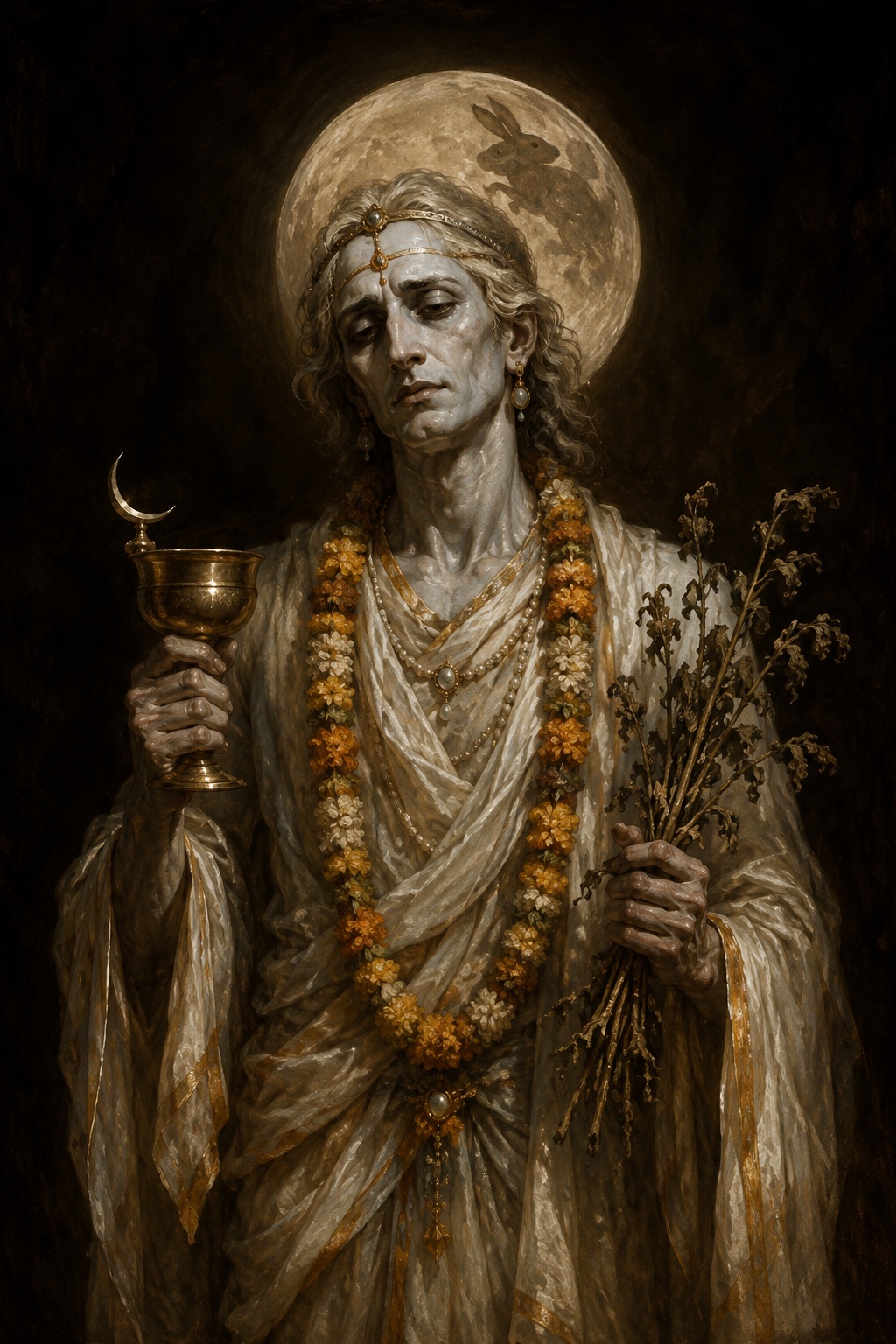
The twenty-seven, and the one he kept to
One word carries three things in Sanskrit: a stalk crushed between stones, the juice pressed out of it and poured at the fire, and the moon. This entry is about the moon, who in the epic is a person with a household and a father-in-law. The last section comes back to the stalk and the cup, which is what the corpus usually means when it uses the word.
The household is a gift, and it arrives with an arithmetic attached to it.
दक्षस्य तनयास्तात प्रादुरासन्विशाम्पते। स सप्तविंशतिं कन्या दक्ष सोमाय वै ददौ।। नक्षत्रयोगनिरताः सङ्ख्यानार्थं च ताभवन्। पत्न्यो वै तस्य राजेन्द्र सोमस्य शुभकर्मणः।।
“Daksha had seven and twenty daughters, O king! These he bestowed (in marriage) upon Soma. Connected with the several constellations, those wives, O king, of Soma of auspicious deeds, served to help men in calculating time” — Mahabharata 9.36.3–4 (Shalya Parva Section 35), tr. K. M. Ganguli
Twenty-seven wives who are also the lunar mansions, and the epic gives their function in the same breath as their marriage: men count the days by them. A calendar is handed to him as a family. What he does with it is choose. Rohini is the foremost of the twenty-seven in beauty and he lives with her alone, which leaves twenty-six stations of the month standing empty. The other wives go to their father twice. Daksha warns him once and is disregarded; the second time he does not warn, and hurls the curse of phthisis instead. That scene is told at length from the father’s side, in Daksha’s own entry, and nothing about it is disputed here. What follows is what it did to the moon.
The wasting, and what wasted with him
The curse is a disease, and the chapter follows it the way it would follow an epidemic — outward from the patient.
स यक्ष्मणाऽभिभूतात्माक्षीयताहरहः शशी।। यत्नं चाप्यकरोद्राजन्मोक्षार्थं तस्य यक्ष्मणः। इष्ट्वेष्टिभिर्महाराज विविधाभिर्निशाकरः।। न चामुच्यत शापाद्वै क्षयं चैवाधिगच्छति। क्षीयमाणे ततः सोमे ओषध्यो न प्रजज्ञिरे।। निरास्वादरसाः सर्वा हतवीर्याश्च सर्वशः। ओषधीनां क्षये जाते प्राणिनामपि सङ्क्षयः।। कृशाश्चासन्प्रजाः सर्वाः क्षीयमाणे निशाकरे।
“Afflicted with phthisis, Sasin began to waste away day by day. He made many endeavours for freeing himself from that disease by performing diverse sacrifices, O monarch! The maker of night, however, could not free himself from that curse. On the other hand, he continued to endure waste and emaciation. In consequence, however, of the wasting of Soma, the deciduous herbs failed to grow. Their juices dried up and they became tasteless, and all of them became deprived of their virtues. And, in consequence of this decadence of the deciduous herbs, living creatures also began to decay. Indeed, owing to the wasting of Soma, all creatures began to be emaciated” — Mahabharata 9.36.19b–23a (Shalya Parva Section 35), tr. K. M. Ganguli
He acts here, and every action fails. He sacrifices — the god who is elsewhere the substance of the offering, holding rites of his own to shake off an illness — and is not released. Then the passage stops being about him and becomes about everything downstream of him. The herbs do not come up; the juice goes out of them and the taste with it; the creatures that live on the herbs thin out in turn.
This is why the entry carries agriculture as a domain rather than as decoration. The connection is made by the text and not by later cult: twice in four verses the same locative absolute does the joining work, क्षीयमाणे, while he wastes — while Soma wastes, the herbs failed to grow; while the maker of night wastes, all creatures were lean. Grammatically the state of the world is a subordinate clause hanging off the state of his body. Nothing here is a metaphor for famine. Famine is what the sentence says.
A word that could be turned aside, not unsaid
The gods come and ask for a repeal. What they are given instead is a piece of legal engineering.
नैतच्छक्यं मम वचो व्यावर्तयितुमञ्जसा।। हेतुना तु महाभागा निवर्तिष्यति केनचित्। समं वर्ततु सर्वासु शशी भार्यासु नित्यशः।। सरस्वत्या वरे तीर्थे निमज्जञ्शशलक्षणः। पुनर्वर्धिष्यते देवास्तद्वै सत्यं वचो मम।।
“It is impossible to make my words become otherwise! By some contrivance, however, ye blessed ones, my words may be withdrawn! Let Sasin always behave equally towards all his wives! Having bathed also in that foremost of tirthas on the Sarasvati, the god having the hare for his mark shall, ye gods, grow once more” — Mahabharata 9.36.29b–31 (Shalya Parva Section 35), tr. K. M. Ganguli
Read as procedure it is exact. The curse is not cancelled, because the word of a Prajapati cannot be made false; it is given terms it can be discharged against. The original complaint becomes the first term — equal behaviour toward all the wives, which is the twenty-six empty stations being filled. The second term is a bath at one named ford. Daksha’s next sentence supplies the rate at which the sentence is to be served: half a month waning, half a month waxing, and no end to it. In this chapter the phases of the moon are not a fact about the moon. They are the residue of a curse that could not be revoked and so had to be metered out.
The epithet the verdict reaches for is worth keeping. शशी, which Ganguli keeps as Sasin, and शशलक्षण, which he spells out as the god having the hare for his mark, both name him by the animal in the disk. The dark patches on the disk are already a hare here, in the oldest text this entry uses, which is why the entry’s symbols are drawn from the words of the chapter and not from later painting.
The bath at Prabhasa
He does not argue the terms. He goes.
सरस्वतीं ततः सोमः स जगामर्षिशासनात्। प्रभासं प्रथमं तीर्थं सरस्वत्या जगाम ह।। अमावास्यां महातेजास्तत्रामज्जन्महाद्युतिः। लोकान्प्रभासयामास शीतांशुत्वमवाप च।।
“At this command of the (celestial) Rishi (Daksha), Soma then proceeded to the Sarasvati. He arrived at that foremost of tirthas called Prabhasa belonging to the Sarasvati. Bathing there on the day of the new moon, that god of great energy and great effulgence got back his cool rays and continued once more to illumine the worlds” — Mahabharata 9.36.34–35 (Shalya Parva Section 35), tr. K. M. Ganguli
Two things are being accounted for at once and the verse does not separate them. One is the moon: he goes into the water on अमावास्या, the new-moon day, the one night in the month when there is nothing of him to see, and comes out with his cool rays back. The other is a place. Prabhasa is a ford on the Sarasvati and this is its charter — first among the tirthas, and the reason given is that the moon was made whole in it. The name and the verb are the same root, प्रभासं प्रथमं तीर्थं and लोकान्प्रभासयामास, the ford called Shining and the god who made the worlds shine; the aetiology is built into the sound of the sentence.
The bath is told once and the phases go on for ever, and the chapter leaves the join between the two alone. What it does insist on is the direction of the cure. The disease was his and the remedy was not: Daksha set the terms, the gods did the asking, and the only thing Soma contributes is compliance. He is not a healer in this story. He is the patient, and the world is the ward.
The plant, the draught and the moon
Most of the times this word appears in the corpus it is not this god. It is the offering — ghee, grain and soma going into Agni’s fire; Indra fortified with soma before he strikes Vritra down; Vayu asked to come and drink what has been poured out for him; soma set on the mountain in Varuna’s inventory of placements, the way the sun is set in heaven. Those are the plant and the drink pressed from it. The Rigveda’s marriage hymn draws the line between them itself, in a single verse, and does not soften it.
सोमं मन्यते पपिवान्यत्सम्पिंषन्त्योषधिम् । सोमं यं ब्रह्माणो विदुर्न तस्याश्नाति कश्चन ॥३॥
“One thinks, when they have brayed the plant, that he hath drunk the Soma’s juice; Of him whom Brahmans truly know as Soma no one ever tastes” — Rigveda 10.85.3, tr. R. T. H. Griffith
The man at the pressing stones thinks he has drunk Soma. He has drunk a herb. The Soma the Brahmans know is the one nobody swallows, and the verse before it has already said which one that is, setting him in the lap of the constellations — the same twenty-seven the epic will marry him to. This is not a demotion of the rite. It is a claim that the material and the god are two things, and that knowing the difference is what the priests are for.
Then the hymn puts them back together on the far side of the distinction.
यत्त्वा देव प्रपिबन्ति तत आ प्यायसे पुनः । वायुः सोमस्य रक्षिता समानां मास आकृतिः ॥५॥
“When they begin to drink thee then, O God, thou swellest out again. Vayu is Soma’s guardian God. The Moon is that which shapes the years” — Rigveda 10.85.5, tr. R. T. H. Griffith
Drinking him fills him. That is the same swelling the Shalya Parva will spend a whole chapter explaining by way of a curse, and here it needs no quarrel and no father-in-law — it is simply what he does when he is consumed. The second half of the verse states the consequence without ornament: the moon is the thing that gives the year its shape, which is the calendar of the twenty-seven put in four words.
Between the hymn and the epic the mechanism changes completely and the observation does not. Something is taken out of the moon and something is put back. A reader who followed the word here from a passage about the offering has therefore not quite arrived at the wrong page — but verse three is the Veda’s own caution against assuming so, and the god at the end of the link is the one nobody drinks.