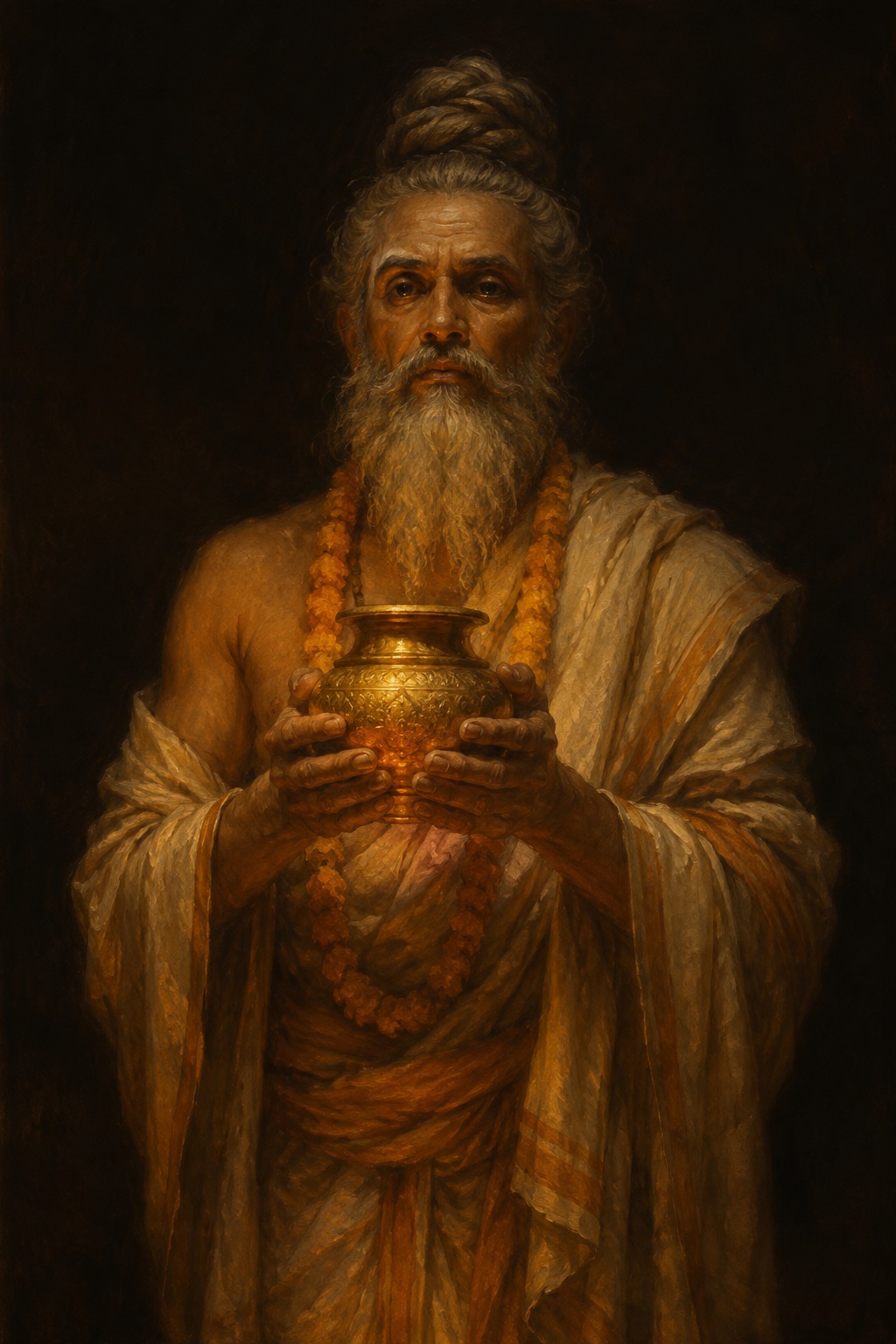
Born of Aditi, and her father
The creation hymn in the tenth book of the Rigveda states his birth twice, in opposite directions, and treats the contradiction as an answer rather than a fault.
अदितेर्दक्षो अजायत दक्षाद्वदितिः परि ॥४॥
“Daksa was born of Aditi, and Aditi was Daksa’s Child.” — Rigveda 10.72.4, tr. R. T. H. Griffith
The next verse says the same thing from his side, and it is the only verse in the hymn addressed to him: दक्ष in the vocative, a name that means skill, and in particular the competence that makes a rite work.
अदितिर्ह्यजनिष्ट दक्ष या दुहिता तव । तां देवा अन्वजायन्त भद्रा अमृतबन्धवः ॥५॥
“For Aditi, O Daksa, she who is thy Daughter, was brought forth. After her were the blessed Gods born sharers of immortal life.” — Rigveda 10.72.5, tr. R. T. H. Griffith
He does nothing here. He is produced and he produces; every verb around him is a birth, and the gods arrive only afterwards, as what follows from the pair. Sayana’s commentary on the passage raises the objection a reader would make — that a thing cannot be the cause of its own cause — and answers it by citing Yaska, who lets the two be born of each other in the manner of gods. The hymn’s own ascription turns the same screw once more: among the seers it offers for these verses is Aditi herself, listed as the daughter of Daksha.
That is the whole of the Vedic figure. Everything a reader associates with the name — the great sacrifice, the curse, the wrecking — belongs to the epic, where a Prajapati called Daksha is a person with a household, a temper and a guest list.
The lord of creatures and his daughters
The Mahabharata gives him a second birth that is not the Vedic one. In the Adi Parva he springs from the right toe of Brahma and his wife from the left, and he begets fifty daughters on her. Having no sons, he makes those daughters Putrikas, so that their children count as his line as well as their husbands’. Ten go to Dharma; thirteen to the sage Kashyapa, from whom most of the living world descends; and twenty-seven to Soma, the moon. Those twenty-seven are the constellations, and the epic gives them a job — by them, men reckon time.
Soma takes one of the twenty-seven, Rohini, and lives with her alone. The other twenty-six come back to their father. He warns Soma once and sends them home with a command; Soma ignores it. They come back again, and this passage is the one place in the epic where Daksha acts from beginning to end.
तासां तद्वचनं श्रुत्वा दक्षः सोममथाब्रवीत्। समं वर्तस्व सर्वासु मा त्वां शप्स्ये विरोचन।। अनादृत्य तु तद्वाक्यं दक्षस्य भगवाञ्शशी। रोहिण्या सार्धमवसत्ततस्ताः कुपिताः पुनः।। गत्वा च पितरं प्राहुः प्रणम्य शिरसा तदा। सोमो वसति नास्मासु तस्मान्नः शरणं भव।। रोहिण्यामेव भगवान्सदा वसति चन्द्रमाः। न त्वद्वचो गणयति नास्मासु स्नेहमिच्छति।। तस्मान्नस्त्राहि सर्वा वै यथा नः सोम आविशेत्। तच्छ्रुत्वा भगवान्क्रुद्धो यक्ष्माणं पृथिवीपते।। ससर्ज रोषात्सोमाय स चोडुपतिमाविशत्।
“Hearing these words of theirs, Daksha once more said unto Soma, ‘Behave equally towards all thy wives! Let me not, O Virochana, curse thee!’ Disregarding, however, these words of Daksha, the adorable Soma continued to live with Rohini alone. At this, his other wives became once more angry. Repairing to their sire, they bowed unto him by lowering their heads, and said, ‘Soma doth not live with us! Give us thy protection! The adorable Candramas always lives with Rohini exclusively! He sets no importance to thy words, and does not wish to show us any affection! Therefore, save us so that Soma may accept us all!’ Hearing these words, the adorable Daksha, O king, became angry and in consequence thereof hurled the curse of phthisis upon Soma. Thus did that disease overtake the Lord of the stars.” — Mahabharata 9.36.14–19 (Shalya Parva Section 35), tr. K. M. Ganguli
The consequence runs outward from the moon. Soma wastes; the herbs lose their juices and go tasteless; the creatures that eat them waste too. The gods come and ask for the curse to be lifted, and Daksha answers that his word cannot simply be reversed — but it can be turned aside. Let Soma treat all his wives alike, let him bathe where the Sarasvati meets the western sea, and he will grow again: half a month waning, half a month waxing, for ever. The phases of the moon, in this telling, are the settlement of a family quarrel. He legislates the moon; he is not a moon god, and this entry does not file him as one.
The sacrifice that was torn apart
The other episode is the one the name is remembered for. It is told in the Santi Parva, twice, twelve pages apart. In the first telling the sacrifice is announced and the whole pantheon decides to go.
कस्यचित्त्वथ कालस्य दक्षो नाम प्रजापतिः। पूर्वोक्तेन विधानेन यक्ष्यमाणोऽन्वपद्यत।। ततस्तस्य मखं देवाः सर्वे शक्रपुरोगमाः। गमनाय समागम्य बुद्धिमापेदिरे तदा।।
“After some time had passed away, the Prajapati Daksha commenced to perform a Sacrifice according to the ancient rites (laid down in the Vedas). Unto the Sacrifice of Daksha, all the deities headed by Sakra, assembling together, resolved to repair.” — Mahabharata 12.289.19–20 (Santi Parva Section CCLXXXIII), tr. K. M. Ganguli
One god stays behind. Asked by his wife why he is not going, Shiva explains that the deities long ago made an arrangement under which no share of any sacrificial offering is assigned to him, and that sacrificers keep to the old custom. This is worth reading exactly: in this telling the omission is not Daksha’s decision but an inherited rule, and the grievance belongs first to the goddess, who says the disability fills her with grief and sets her trembling from head to foot. She then falls silent, and her husband acts on what he has understood.
ततो योगबलं कृत्वा सर्वयोगेश्वरेश्वरः। तं यज्ञं स महातेजा भीमैरनुचरैस्तदा।। सहसा घातयामास देवदेवः पिनाकधृत्। केचिन्नादानमुञ्चन्त केचिद्धासांश्च चक्रिरे।। रुधिरेणापरे राजंस्तत्राग्निं समवाकिरन्। केचिद्यूपान्समुत्पाट्य व्याक्षिपन्विकृताननाः।। आस्यैरन्ये चाग्रसन्त तथैव परिचारकान्।
“Summoning all his Yoga force, that Lord of all lords of Yoga, that god of gods, that wielder of Pinaka, possessed of mighty energy, quickly proceeded to the place (where Daksha was sacrificing) accompanied by all his terrible followers and destroyed that Sacrifice. Amongst these followers of his, some uttered loud cries, and some laughed terribly, and some, O king, extinguished the (Sacrificial) fires with blood; and some, possessed of awful faces, pulling up the sacrificial stakes, began to whirl them. Others began to devour those that were ministering to the Sacrifice.” — Mahabharata 12.289.32–35a (Santi Parva Section CCLXXXIII), tr. K. M. Ganguli
Neither telling kills him. The sacrifice is wrecked and the sacrificer survives it, joins his hands, praises the god whose share was missing, and has what was burnt restored to him. That is the shape of the episode in the text the corpus can reach: a rite done by the book, a share withheld, and a correction that the man who was corrected lives through.
One name over two figures
The Vedic Daksha and the epic Prajapati are conventionally one figure, and reading them as one is how a Puranic detail ends up cited to a Vedic verse. This entry keeps them in separate sections for that reason. The abstraction that produces Aditi and is produced by her never holds a sacrifice; the lord of creatures who holds one is second-generation in every account, born of Aditi in the hymn and from Brahma’s toe in the epic, and nothing in these chapters calls him boundless or self-caused.
Two things most readers expect are missing from both Mahabharata tellings, and are recorded here as later Puranic tradition with nothing cited behind them: his daughter Sati, who burns herself at the sacrifice, and the goat’s head fixed on his shoulders afterwards. In the epic the offended goddess is Parvati, daughter of Himavat, Shiva’s wife and not Daksha’s child at all, and no head is exchanged. The patronymic that later tradition attaches to Sati — the feminine form meaning a descendant of Daksha — belongs in the Rigveda’s own apparatus to Aditi instead, which is the trap this entry is built to avoid.
What survives across both halves is narrower than the legend and more consistent: a figure who is competence at the rite, personified, and who is undone twice by the arithmetic of who gets a share.