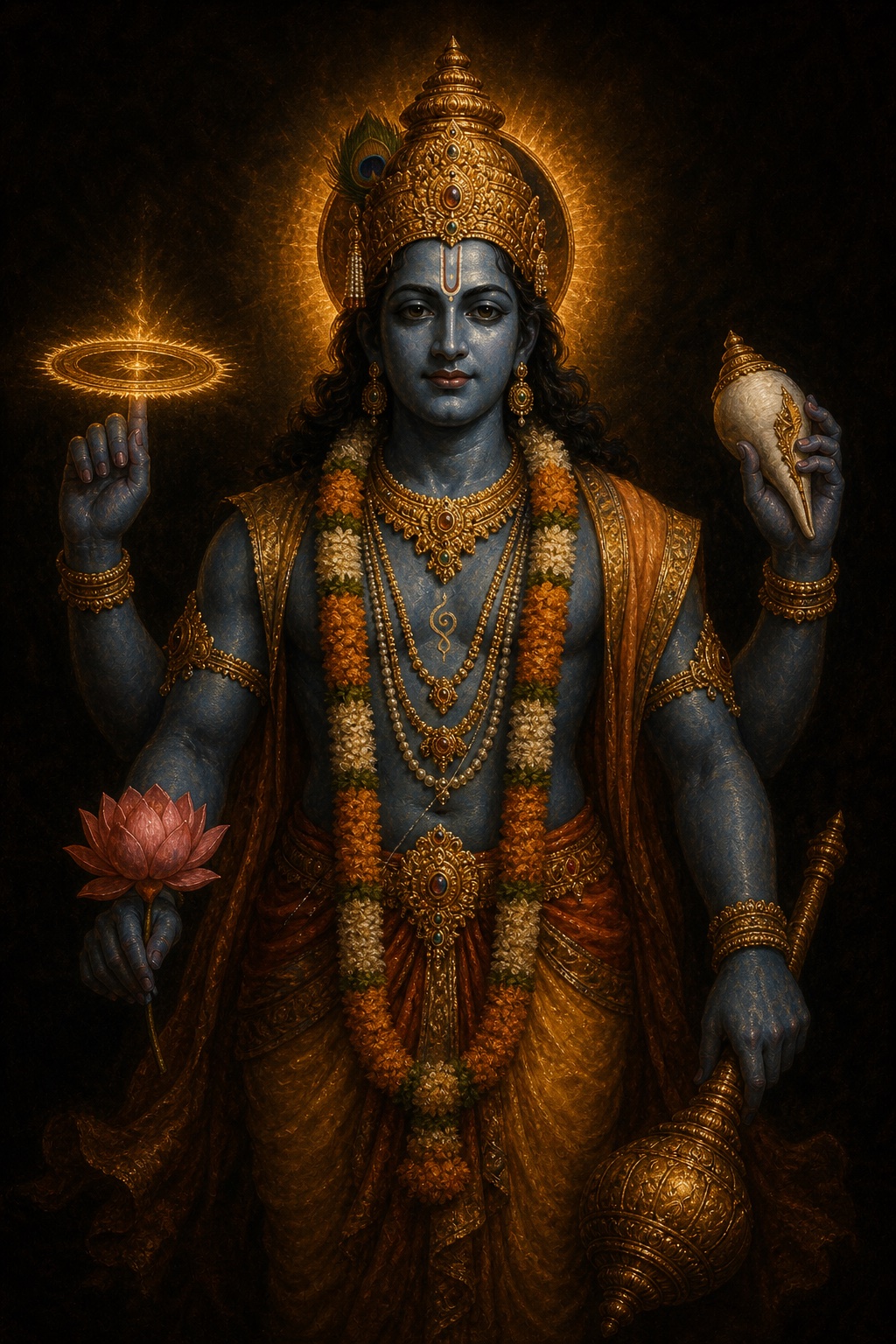
Vishnu is the Preserver, one of the three great functions of the divine alongside Brahma the creator and Shiva the destroyer, and for the many hundreds of millions of Hindus within the Vaishnava tradition he is worshipped as the supreme being itself, the ground from which even Brahma and Shiva arise. He reclines on the coils of the serpent Shesha upon the cosmic ocean, a lotus growing from his navel from which Brahma emerges to begin each cycle of creation, while Vishnu himself sustains the ordered world (dharma) between one creation and the next dissolution.
Already in the Rigveda he is the god who strides across the universe in three great steps, measuring out earth, sky, and the heavens; this Vedic feat becomes, in later Puranic theology, the seed of his doctrine of avatars — the belief that whenever dharma is gravely threatened, Vishnu descends to earth in bodily form to restore it. Tradition counts ten principal avatars, the Dashavatara, culminating so far in Krishna, with a final incarnation, Kalki, still awaited at the end of the present age. He is shown deep blue, four-armed, bearing discus, conch, mace, and lotus, borne by the eagle Garuda, with Lakshmi, goddess of fortune, as his consort.
विष्णोर्नु कं वीर्याणि प्र वोचं यः पार्थिवानि विममे रजांसि । यो अस्कभायदुत्तरं सधस्थं विचक्रमाणस्त्रेधोरुगायः ॥१॥
“I will declare the mighty deeds of Vishnu, of him who measured out the earthly regions, who propped the highest place of congregation, thrice setting down his footstep, widely striding.” — Rigveda 1.154.1, tr. Ralph T. H. Griffith