Lakshmi is the goddess of fortune, and her emergence is one of the set pieces of Indian myth. Gods and asuras, in a rare alliance, use Mount Mandara as a churning-staff and the serpent Vasuki as the rope, and turn the ocean of milk. What comes up, in order, is a catalogue of the world’s best things — and one of the worst, the poison Halahala, which Shiva drinks to save everyone and which stains his throat blue.
“After a while, the mild Moon of a thousand rays emerged from the ocean. Thereafter, Lakshmi dressed in white, and wine, the white steed, and then the celestial gem Kaustuva which graces the breast of Narayana. Lakshmi, wine, and the steed fleet as the mind, all came before the gods on high.” — Mahabharata, Adi Parva 18, tr. Ganguli
Having risen, she chooses. In the fuller Puranic tellings she looks over the assembled gods and asuras and garlands Vishnu, and that choice is the whole theology of her: fortune is not distributed by merit or seized by force, it decides where to settle. The asuras’ subsequent war for possession of her and the nectar is the direct consequence of having been passed over, and they lose that too.
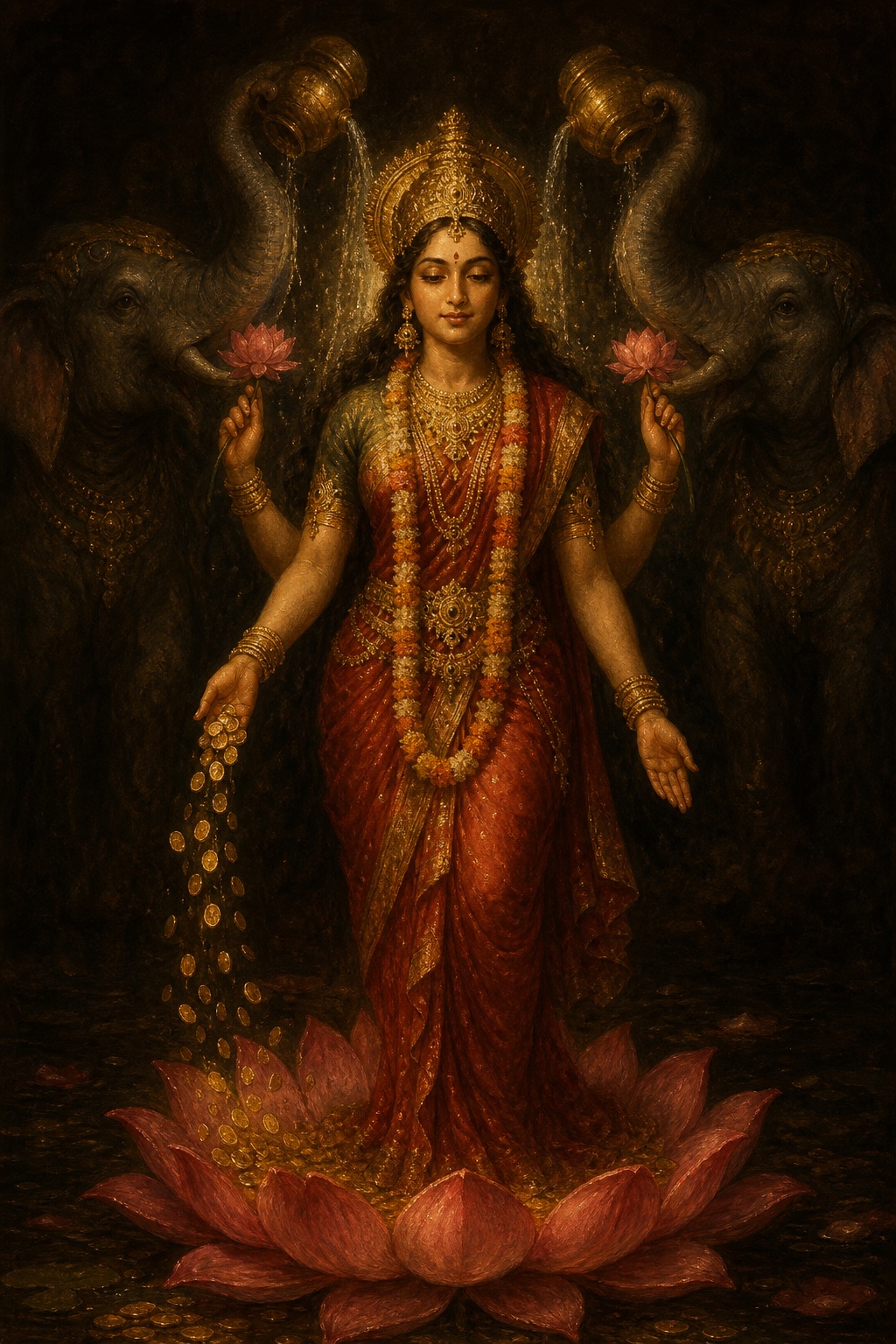
Her attributes are unusually literal. She sits or stands on an open lotus, holds lotuses, and is bathed by two elephants pouring water over her — an image of rain, and so of harvest, and so of wealth. Gold coins fall from one hand. She is called Shri, which is simply the word for splendour and prosperity, and the term is old enough that it functions as an honorific in front of names to this day. At Diwali, houses are lit and doors left open because she is understood to be mobile: she visits the swept and lit house and leaves the neglected one, and the goddess of fortune is therefore also a goddess of housekeeping.
Because she is Vishnu’s consort, she incarnates whenever he does — as Sita when he is Rama, as Rukmini when he is Krishna. This is why the Ramayana’s heroine and the goddess of the churned ocean are, in the developed tradition, the same person, and why Sita’s descent into the earth reads as a return rather than an ending. The other face of this is Alakshmi, or Jyeshtha, misfortune personified as her elder sister, who arose from the same churning and must be shown out of the house before Lakshmi will come in.