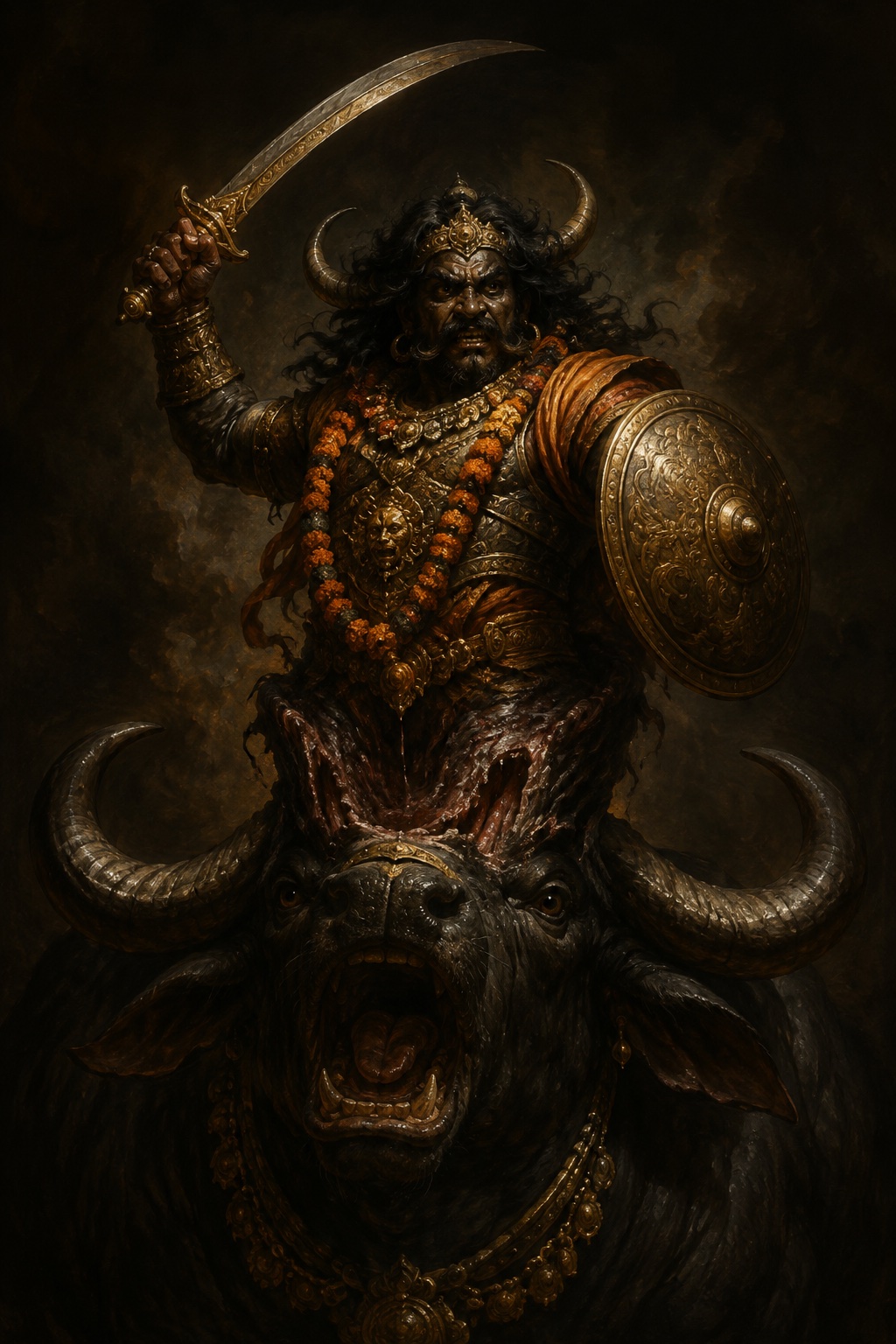
Heaven, and the gods put out of it
The Devi Mahatmya introduces him as a winner. It gives him no birth, no parents and no origin of any kind: he is lord of the Asuras when the canto opens, and he has already beaten the gods and taken the throne of heaven. Later texts give him a beginning; this one does not, and this entry keeps to this one. Pargiter’s text says that after conquering all the gods he became the Indra — not that he defeated Indra, but that he occupied the office — and when the gods come to complain, they list the jurisdictions he now holds in his own person: the Sun’s, Indra’s, Agni’s, Vayu’s, the Moon’s, Yama’s, Varuna’s. The eviction is the first fact the text gives about him and the largest thing he does.
“Cast out by that evil-souled Mahisha from Svarga all the hosts of the gods wander on the earth like mortals.” — Markandeya Purana, Canto LXXXII.6–7 (Devi Mahatmya 2), tr. F. E. Pargiter
Read the tense. Not fell, not were beaten: wander, and go on wandering, which is the standing condition the rest of the story has to undo. What undoes it is assembled out of the gods’ own anger. Their massed radiance takes shape as a single goddess and each of them arms her from his own hand, so that Durga exists because he won. The many arms, the borrowed weapons, the lion given her by Himavat — every part of her is a specification written against him. He is the reason there is a goddess, and he never finds this out.
The buffalo in the middle of her army
He brings an army and generals, of whom C’ikshura and C’amara are the two whose names come through Pargiter’s scan clean enough to repeat. When the army has been destroyed around him he goes in himself, in the buffalo shape, and the canto then spends more verses on the anatomy of that shape than on anything else about him. He kills with the muzzle, with the hooves, with the lashing tail, with the horns, with the rush of the body, and with his breath — six instruments, itemised, each with its own casualties.
“Having laid low the van of her army, the Asura rushed to attack the great goddess’ lion.” — Markandeya Purana, Canto LXXXIII.23 (Devi Mahatmya 3), tr. F. E. Pargiter
The lion is not incidental. Himavat gave it to the goddess when the gods equipped her, and it is the one part of her that can be met the way one animal meets another, so it is what he goes for first. From there the text keeps widening the frame until the fight is no longer happening at the scale of an army.
“and the clouds pierced by his swaying horns were rent to fragments; mountains fell in hundreds from the sky, being cast down by the blast of his breath.” — Markandeya Purana, Canto LXXXIII.26 (Devi Mahatmya 3), tr. F. E. Pargiter
Neither half of that sentence is landscape. The horns reach high enough to open the clouds and the breath is strong enough to bring mountains down out of the air, which is why the horns and the thrown mountains are listed among his symbols rather than described as scenery. They are things he holds and things he uses. He is fighting an infantry line and wrecking the weather while he does it.
Four shapes in one duel
Durga’s noose goes over him, and he leaves the shape it caught. The sequence is exact and worth keeping in order, because the received account compresses it: buffalo, then lion, then a man with scymitar and shield, then elephant, then buffalo again. Each time she cuts at what she has hold of, and what she has hold of has stopped being him.
ततः सोऽभून्महागजः॥८३.३१॥ करेण च महासिंहं तं चकर्ष जगर्ज च
“Then he became a huge elephant, and tugged at her great lion with his trunk and roared.” — Markandeya Purana 83.31–32 (Pargiter LXXXIII.30–31; Devi Mahatmya 3), tr. F. E. Pargiter
One word of the Sanskrit is worth keeping: करेण, the instrumental of the ordinary word for a hand, which is also the word for an elephant’s trunk. He has changed species twice in four verses and is still reaching for the lion with a hand. The changes are usually read as cunning, and in the canto they read more like a search. He is not fleeing through the shapes; he is trying them, looking for a body that can beat her, and the last one he tries is the one he started in.
“And the Asura roared out, puffed up with his strength and valour and frenzy, and hurled mountains against C’andika with his horns.” — Markandeya Purana, Canto LXXXIII.34–35 (Devi Mahatmya 3), tr. F. E. Pargiter
C’andika is Pargiter’s spelling of one of the goddess’s names in these cantos. The mountains have come back and their status has changed: earlier his breath knocked them out of the sky, and now he picks them up and throws them with the horns. It is the same body doing the same things with more effort, which is what the shape-changing has bought him.
Half out of his own mouth
The end is quick, and the text is precise about it in a way the images are not. She binds him, sets her foot on his neck and drives her spear in, and he begins to come out of the buffalo — through its mouth. The verse before the one quoted here says exactly that: he half issued from his own mouth. He is halfway out, and still fighting, when she takes the head.
अर्धनिष्क्रान्त एवासौ युध्यमानो महासुरः । तया महासिना देव्या शिरश्छित्त्वा निपातितः॥८३.४०॥
“That great Asura being thus attacked half issued forth indeed. The goddess struck off his head with her great sword and laid him low.” — Markandeya Purana 83.40 (Pargiter LXXXIII.39; Devi Mahatmya 3), tr. F. E. Pargiter
The two sides of the verse differ by one participle. युध्यमानो has him fighting as he emerges; Pargiter has him being thus attacked. The Sanskrit gives the half-emerged body one last act of its own and the English gives the initiative to the goddess, and the verse ends in the same place either way. The numbering differs for a related reason — the recension the Sanskrit follows carries two verses Pargiter’s does not, so his thirty-ninth is its fortieth — which is why the two sides of this entry are matched by content and never by counting.
The head comes off after he is already half out. That is the detail the received image loses. Every Durga Puja pandal and every Mahishasuramardini bronze shows a crowned warrior rising from a severed buffalo neck, sword in hand, which is later iconography and a tidier picture: it puts her stroke first and his emergence second, and turns him into something released by the killing. The canto has it the other way round. He climbs out of his own animal’s mouth, under her foot, mid-fight, into a stroke that is already falling.