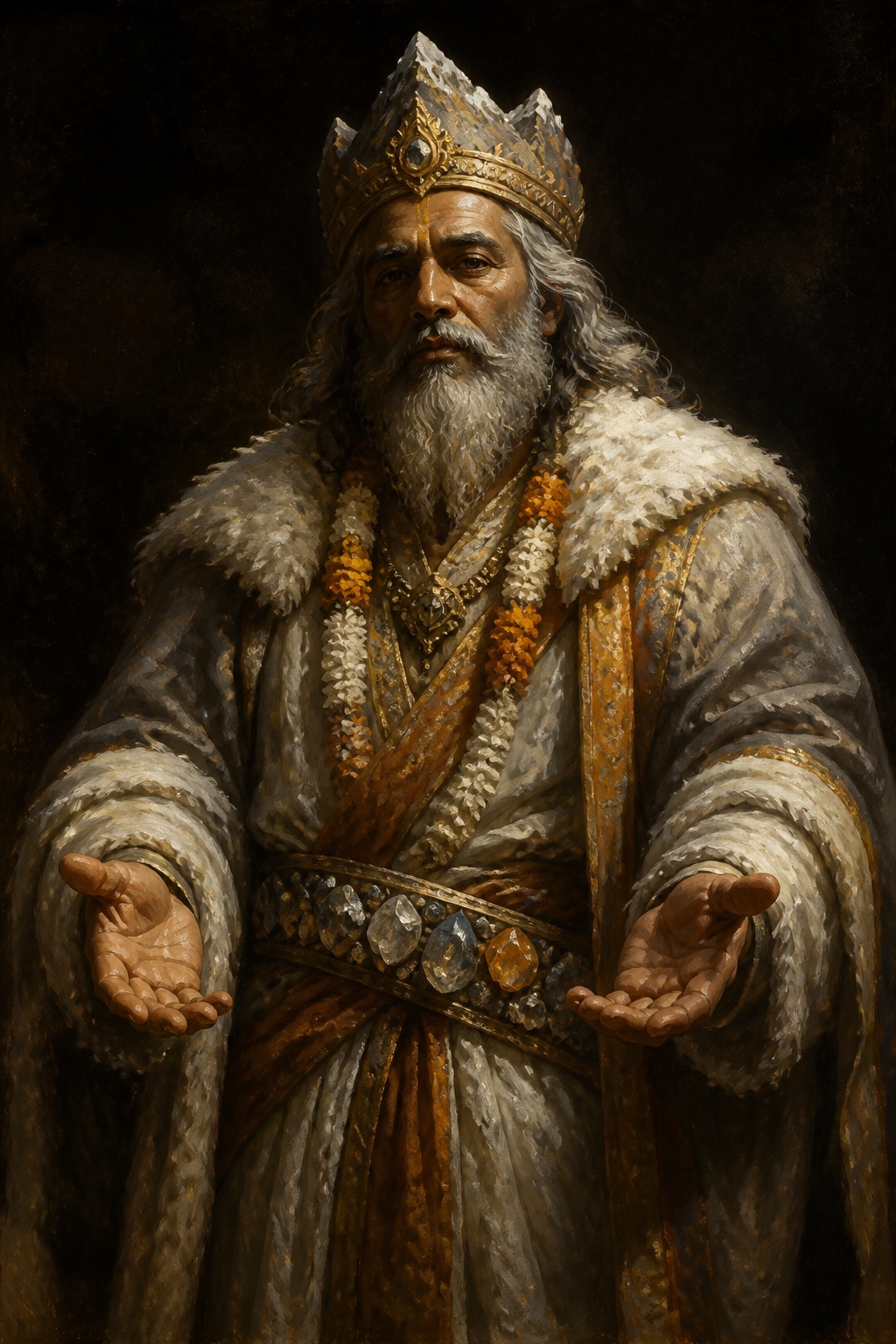
A king made of stone and snow
Himavat is the Himalaya given a face and a lineage: the mountain range itself, personified as a king. Valmiki’s Ramayana names him शैलेन्द्रः, and across a single canto Griffith renders that one title three different ways — “the mountains’ lord,” “The mountain King,” and, naming his two daughters together, “the King of Hills.” The same canto calls him “the mighty hill with metals stored,” crediting the range with the ore locked inside it. His own name, हिमवत्, is built on the word for snow and frost: he is, plainly, the snowy one, and the text gives him both winter and kingship as his domain.
Giving Ganga to the gods
Ganga, elder of Himavat’s two daughters, flows in heaven, and the gods have their own use for her. Valmiki’s Ramayana does not simply record her as his daughter; it shows the gods coming to her father and asking for her outright.
अथ ज्येष्ठां सुराः सर्वे देवकार्यचिकीर्षया । शैलेन्द्रं वरयामासुर्गङ्गां त्रिपथगां नदीम् ॥१-३५-१७॥ ददौ धर्मेण हिमवांस्तनयां लोकपावनीम् । स्वच्छन्दपथगां गङ्गां त्रैलोक्यहितकाम्यया ॥१-३५-१८॥ प्रतिगृह्य त्रिलोकार्थं त्रिलोकहितकांक्षिणः । गङ्गामादाय तेऽगच्छन् कृतार्थेनान्तरात्मना ॥१-३५-१९॥
Then all the Gods of heaven, in need Of Gangá’s help their vows to speed, To great Himálaya came and prayed The mountain King to yield the maid. He, not regardless of the weal Of the three worlds, with holy zeal His daughter to the Immortals gave, Gangá whose waters cleanse and save, Who roams at pleasure, fair and free, Purging all sinners, to the sea. The three-pathed Gangá thus obtained, The Gods their heavenly homes regained. — Valmiki, Ramayana 1.35.17–19, tr. Griffith
The verb is ददौ, gave: not a line in a family tree but an act performed in the poem’s own present tense, done “not regardless of the weal / Of the three worlds” — for the sake of all creation, not merely to please the petitioners. The gods take Ganga and go home satisfied, and what began as their need ends as Himavat’s own decision.
Keeping Parvati, then giving her too
The same canto turns, two verses later, to Himavat’s other daughter — Parvati, called Umá here — and the story it tells about her is far shorter than the courtship this corpus’s own Parvati entry preserves elsewhere: no Kama, no disguise, no burning. It says only that she took up a fierce vow and practiced austerities of her own for a long span of time, and that once they were finished, her father gave her too.
या चान्या शैलदुहिता कन्याऽसीद् रघुनन्दन । उग्रं सुव्रतमास्थाय तपस्तेपे तपोधना ॥१-३५-२०॥ उग्रेण तपसा युक्तां ददौ शैलवरः सुताम् । रुद्रायाप्रतिरूपाय उमां लोकनमस्कृताम् ॥१-३५-२१॥
Long time the sister Umá passed In vows austere and rigid fast, And the king gave the devotee Immortal Rudra’s bride to be, Matching with that unequalled Lord His Umá through the worlds adored. — Valmiki, Ramayana 1.35.20–21, tr. Griffith
Rudra is this passage’s own name for Shiva, and the verb Griffith renders as “gave” is ददौ again — the identical word the canto already used for Ganga two verses earlier. Himavat keeps Parvati only for the span of her own discipline, not permanently: the shape of the whole episode is that he parts with both daughters in the same canto, one because the gods asked and the three worlds needed her, the other because her own tapas had earned her the god she wanted.
Father of goddesses
Himavat’s wife appears in the same canto too, called there “Mená, Himálaya’s darling.” Between them the family’s whole reach divides along the two daughters: Ganga becomes the river later worshipped as it falls out of the sky onto Shiva’s own head, and Parvati becomes his wife outright. A separate work, the Devi Mahatmya, gives Himavat one further moment as a father: when the assembled gods arm the newly made warrior-goddess Durga for her fight with Mahishasura, it has him give her a lion to ride. This corpus’s own Durga entry tells that scene, sourced there to the Devi Mahatmya rather than to anything in the Ramayana.