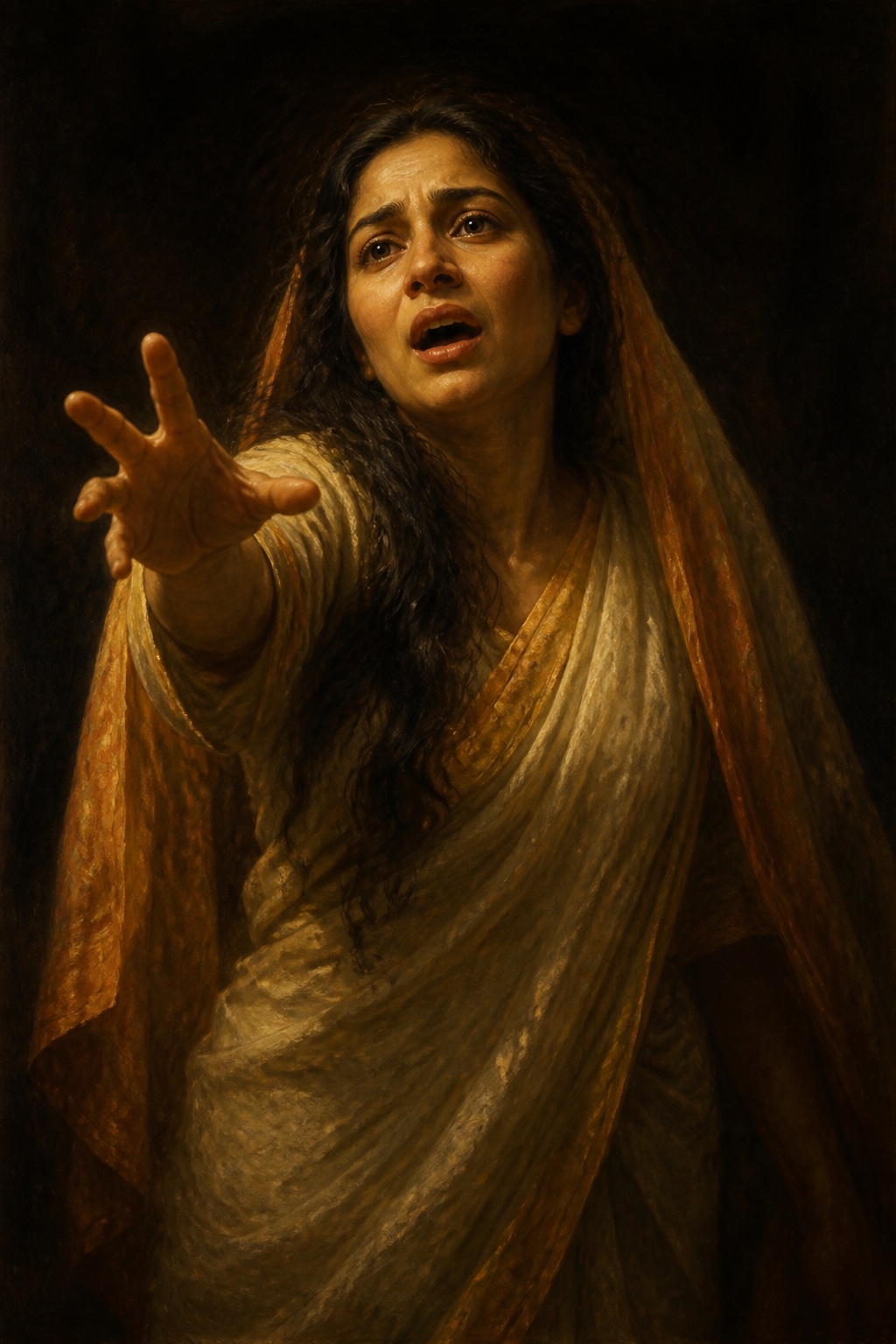
The cry that named Uma
Mena is one of this corpus’s quieter mothers, named repeatedly as wife and parent but caught acting in her own right only once. Her daughter — this corpus’s own citation of Ramayana 1.35.16 already calls her “The fair one known by Umá’s name” — has gone to the mountain to win Shiva through austerities so severe that Mena, watching, cannot stay silent.
तां पार्वतीत्याभिजनेन नाम्ना बन्धुप्रियां बन्धुजनो जुहाव । उमेति मात्रा तपसो निषिद्धा पश्चादुमाख्यां सुमुखी जगाम ।। १. २६ ।।
As yet the maiden was unknown to fame, And Mountain-lady was her only name; But when her mother, filled with anxious care At her stern penance, cried Forbear! Forbear! To a new title was the warning; turned, And Uma was the name the maiden earned. — Kalidasa, Kumarasambhava 1.26, tr. Griffith
Kinsfolk had called the girl Parvati, of the mountain — a family name and nothing more. It is Mena’s own protest that gives her the second one: Sanskrit tradition reads उमा, Uma, as built from her mother’s own two-syllable warning, u mā, oh, do not — the same prohibition Griffith renders as a doubled “Forbear! Forbear!” It is the one moment in the reachable sources where Mena does anything at all, rather than simply being named in someone else’s genealogy, and what she does is try, and fail, to stop it.
Wed to the mountain by rite
The same canto gives the marriage that makes Mena mother of that mountain’s daughters in the first place. Himavat, seeking a bride fit for his line, finds and weds her:
स मानसीं मेरुसखः पितॄणां कन्यां कुलस्य स्थितये स्थितिज्ञः । मेनां मुनीनामपि माननीयामात्मानुरुपां विधिनोपयेमे ।। १. १८ ।।
No child of earth, born of the Sages’ will, The fair nymph Mena pleased the sovran Hill; To her he sued, nor was his prayer denied, The Saints’ beloved was the Mountain’s bride; — Kalidasa, Kumarasambhava 1.18, tr. Griffith
विधिनोपयेमे, married… by rite, is a phrase this corpus takes seriously elsewhere: a proper, sanctioned union, not an abduction or a passing liaison. The same canto goes on, a little further, to give the couple a third child besides Ganga and Parvati: Mainaka, the mountain who later hides beneath the sea to escape Indra’s wrath. He has an entry of his own here, on the strength of the Sundarakanda, where he takes human form on his own summit and speaks — which is more than a place given a name does.
Himavat’s wife, mother of two goddesses
The Ramayana names her plainly, in the same canto this corpus already quotes for Parvati’s own naming:
शैलेन्द्रो हिमवान् राम धातूनामाकरो महान् । तस्य कन्याद्वयं राम रूपेणाप्रतिमं भुवि ॥१-३५-१४॥ या मेरुदुहिता राम तयोर्माता सुमध्यमा । नाम्ना मेना मनोज्ञा वै पत्नी हिमवतः प्रिया ॥१-३५-१५॥
The mighty hill with metals stored, Himálaya, is the mountains’ lord, The father of a lovely pair Of daughters fairest of the fair: Their mother, offspring of the will Of Meru, everlasting hill, Mená, Himálaya’s darling, graced With beauty of her dainty waist. — Valmiki, Ramayana 1.35.14–15, tr. Griffith
This is the passage that grounds what this corpus already records on Ganga’s and Parvati’s own pages: Mena as Himavat’s wife — पत्नी हिमवतः प्रिया, wife, dear to Himavat — and mother of both.
Not Menakā the apsara
This entry is Mena (मेना), Himavat’s wife. She is not Menakā (मेनका), the celestial dancer who seduces the sage Vishwamitra and bears him a daughter, Shakuntala — a different figure with a similar name, blurred together often enough in popular retelling that the distinction is worth stating outright.