Tataka’s son
Maricha is a rakshasa, and the Ramayana names him first as somebody’s son. In the twenty-fourth sarga of the Balakanda the sage Vishvamitra, who has taken the boy Rama and his brother Lakshmana with him to guard a sacrifice, tells Rama about the being who is laying waste the country they have come into. She is a यक्षिणी कामरूपिणी, a yakshi who takes any shape she wishes, ताटका नाम, Tataka by name, and भार्या सुन्दस्य धीमतः, the wife of the wise Sunda. The next verse turns to the son: मारीचो राक्षसः पुत्रो यस्याः, she whose son is the rakshasa Maricha. The text says that she is Sunda’s wife and that Maricha is her son. It does not say in so many words that he is Sunda’s son.
Then it describes him. He is शक्रपराक्रमः, as valiant as Shakra, that is, as Indra. He is वृत्तबाहुर्महाशीर्षो, round-armed and great-headed, and विपुलास्यतनुर्महान्, wide of mouth, broad of body, huge. The verse after that goes on, राक्षसो भैरवाकारो नित्यं त्रासयते प्रजाः: a rakshasa of terrible form, he keeps the people in constant fear.
The next sarga tells how the son of a yakshi came to be a rakshasa at all. सुन्दे तु निहते, after Sunda was killed, Tataka and her son set out to attack the sage Agastya, and she ran at him roaring, to eat him. Agastya saw her coming, and he spoke to the son first. राक्षसत्वं भजस्वेति मारीचं व्याजहार सः: take on the state of a rakshasa, he said to Maricha. Then, in great anger, he cursed Tataka as well, and his curse on her begins पुरुषादी महायक्षी विकृता विकृतानना: great yakshi, be an eater of men, deformed, with a deformed face, and give up this form for a dreadful one. The fearful rakshasa of the twenty-fourth sarga was therefore made, not born. His rakshasa body is a punishment that a sage laid on him, and everything the poem tells about him afterwards concerns the other shapes he puts on over it.
Two sargas later Rama kills his mother. शरेणोरसि विव्याध सा पपात ममार च: he pierced her in the chest with an arrow, and she fell and died. Maricha is not in that fight. He meets Rama four sargas later, when the sacrifice itself begins.
A hundred yojanas into the sea
In the thirtieth sarga the sacrifice is under way, with its mantras in their proper order, when a great and terrifying noise breaks out in the sky. The poem compares what comes next to a cloud that covers the sky in the rains: two rakshasas rush in, मायां विकुर्वाणौ, working illusion. The next verse names them, मारीचश्च सुबाहुश्च, Maricha and Subahu, with their followers behind them, and says what they came to do: they रुधिरौघानवासृजन्, let loose floods of blood, and the altar is drenched with it. Griffith’s canto announces the pair as “Máricha, Rover of the Night, Suváhu, and their train”. Rama sees the blood on the altar and the two rakshasas coming down on him out of the sky, and he turns to Lakshmana and speaks.
मानवं परमोदारमस्त्रं परमभास्वरम् । चिक्षेप परमक्रुद्धो मारीचोरसि राघवः ॥१-३०-१७॥ स तेन परमास्त्रेण मानवेन समाहतः । सम्पूर्णं योजनशतं क्षिप्तः सागरसम्प्लवे
“An arrow, swift as thought, Upon his bow he pressed, And smote, to utmost fury wrought, Máricha on the breast. Deep in his flesh the weapon lay Winged by the mystic spell, And, hurled a hundred leagues away, In ocean’s flood he fell” — Valmiki, Ramayana 1.30.17–18, tr. Griffith
The Sanskrit names the weapon, and Griffith does not. मानवं परमोदारमस्त्रं is the Manava, a missile of the highest power, and Rama throws it परमक्रुद्धो, in the height of his anger, मारीचोरसि, at Maricha’s chest. Griffith’s “An arrow, swift as thought” leaves the name out and makes it an arrow like any other. The distance changes too: सम्पूर्णं योजनशतं, a full hundred yojanas, becomes “a hundred leagues”. The two versions agree on where it ends, सागरसम्प्लवे, in the flood of the ocean.
The next two verses say what kind of shot it was. Rama sees Maricha flung away, senseless and reeling under the force of the cold arrow, and shows him to Lakshmana. पश्य लक्ष्मण शीतेषुं मानवं मनुसंहितम्: look, Lakshmana, at the cold arrow, the Manava, which is Manu’s. मोहयित्वा नयत्येनं न च प्राणैर्वियुज्यते: it has stunned him and it carries him away, and he is not parted from his life. Griffith’s Rama says that the dart “Hath struck him senseless with the smart, But left him breathing still.” The shot was meant to spare him, and the shots after it were not. Rama’s next arrow, a shaft “Aglow with living flame”, strikes Subahu in the chest and kills him, and a third, “the Wind-God’s own”, brings down all the rest. Of the rakshasas who came to spoil Vishvamitra’s sacrifice, Maricha is the only one whom Rama decided not to kill.
The hermit by the sea
Maricha comes back into the poem in the Aranyakanda, and by then he has stopped raiding. In Griffith’s Canto XXXI Ravana, who has learned that Rama has killed the rakshasas of Janasthan, comes to him and asks for help in carrying off Rama’s wife. Maricha answers that whoever put the plan into his head is an enemy, that Rama is a sleeping lion, and that the lion should be left asleep. Ravana takes the advice and goes home. It is Shurpanakha, arriving at Lanka with her wounded face and her account of Sita’s beauty, who sends him back a second time.
Canto XXXV shows where Maricha now lives. Ravana finds him in a hermitage on the shore of the ocean, “With deerskin garb, and matted hair” coiled up in the manner of a hermit, living by strict rule, and Maricha receives him as a host receives a guest, with food and with water for his feet. Ravana asks for his help, and Maricha answers with the story of his life, which fills two cantos and is told as a warning. In his own account he was once vast and proud, with golden armlets and an axe, and he fed on the flesh of hermits in the Dandaka forest. Then Vishvamitra went to Dasharatha and asked for Rama, a boy who, as the king objected, “The age of twelve has scarce attained”. The boy’s shaft threw Maricha a hundred leagues into the sea. “He would not kill, but, nobly brave, My forfeit life he chose to save,” Maricha says. The rest of his band died.
The second half of his story is one that the Balakanda does not tell. When his strength came back, Maricha says, he and two other rakshasas took the shapes of deer, with terrible horns, flaming tongues and pointed teeth, and went through the Dandaka forest killing hermits, eating their flesh and drinking their blood. Then he came on Rama again, who was now living in the forest as a hermit himself, with his wife and Lakshmana beside him. Remembering his old wound, Maricha charged him with his horns. Rama loosed three arrows at once. The two rakshasas who stayed where they were died, and Maricha lived only because he ran. So the deer is not a new shape for him. He had worn it against Rama once already, and it had nearly cost him his life.
Since then, he says, he has lived as a hermit, and he sees Rama in every shrub and every tree and in his dreams at night: “A thousand Rámas mock my sight.” Even a sound frightens him. “The letter that begins his name Sends terror through my startled frame,” he says, and so do the names of the chariots he rides in and of the jewels that were once his pride, because, as a footnote of Griffith’s explains, the Sanskrit words for car and for jewels begin with the syllable ra.
Ravana does not listen. In Canto XL he tells Maricha that a counsellor should wait until he is asked, and that he did not come for advice: he came with a plan already made. Then he gives the plan, and every part of it is his. Maricha is to take the shape of a golden deer adorned with silver drops, wander near Rama’s hut until Sita sees him and sends her husband to catch him, and then, once Rama is far away, call out “With voice resembling Ráma’s tone”, so that Lakshmana too will leave Sita and run to help. For this Ravana promises him half his kingdom. If Maricha refuses, “My hand this day thy blood shall spill.”
Maricha’s reply, in Canto XLI, is that the plan will ruin Ravana, his sons, his kingdom and all the rakshasas, and that he himself does not fear the threat: “I die, and if by Ráma slain And not by thee, I count it gain.” At the start of the next canto he gives in. He has met Rama and his bow once, he says, and if Rama bends that bow again their lives will end within the hour; his words cannot reach Ravana’s mind, and so he will go. Ravana embraces him and praises him as a hero again, “Márícha’s proper self once more: Some other took thy shape before.” Ravana has it the wrong way round. The Maricha who argued against the plan was himself, and the one who agrees to it is about to take a shape that is not his own.
The golden deer
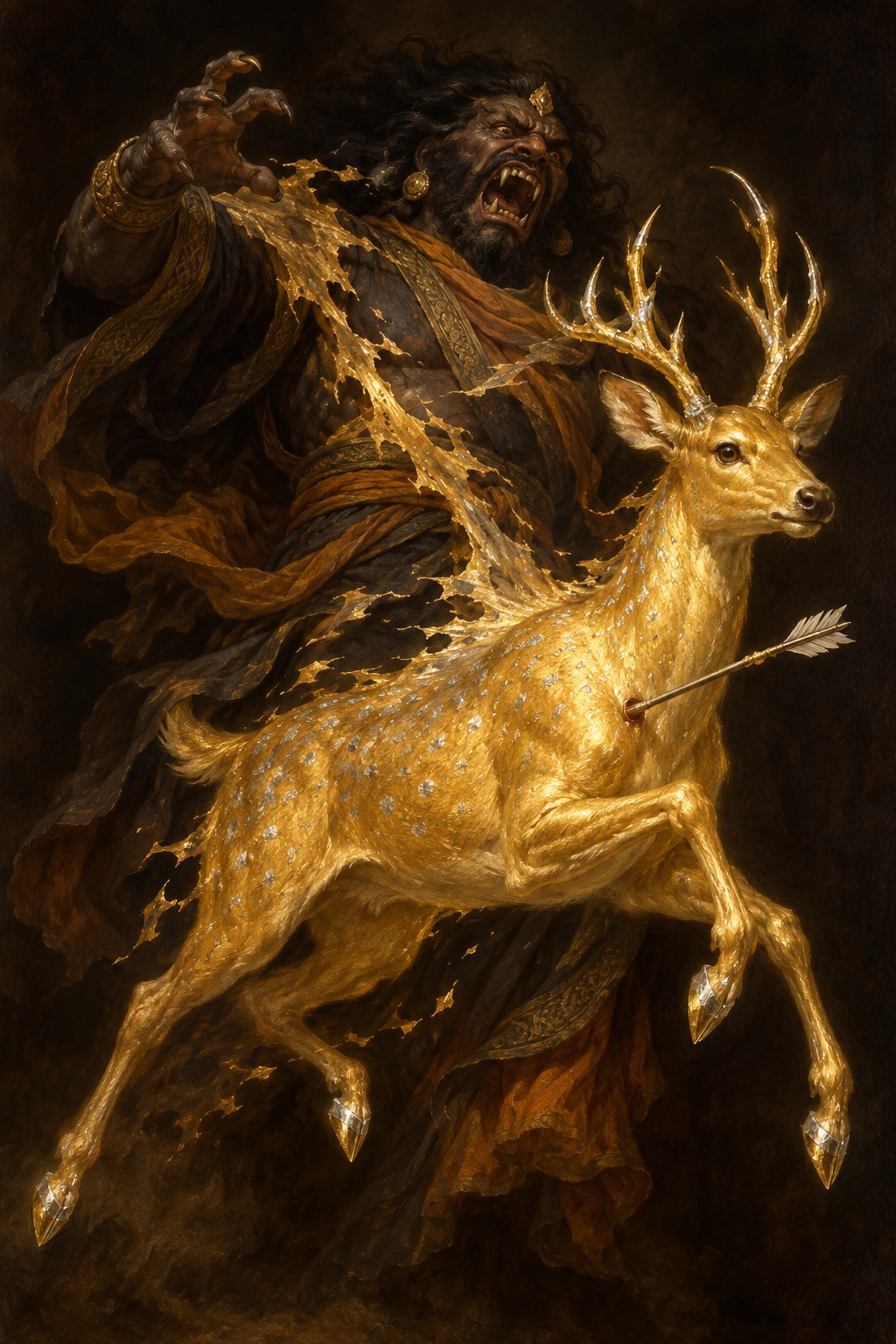
In the forty-second sarga the chariot comes down in the Dandaka forest, and Ravana takes Maricha by the hand and shows him Rama’s hermitage in its ring of plantains. स रावणवचः श्रुत्वा मारीचो राक्षसस्तदा: hearing Ravana’s words, Maricha the rakshasa मृगो भूत्वा, became a deer, and wandered at the door of Rama’s hermitage. The sarga then describes the deer part by part, and nearly every part of it is a jewel, beginning with मणिप्रवरशृङ्गाग्रः, the tips of its horns made of the finest gems. Griffith’s canto keeps the whole catalogue. Its coat is रौप्यैर्बिन्दुशतैश्चित्रं, dappled with hundreds of silver drops, and it moves slowly round the hut, nibbling the young shoots of the trees. The poem says plainly why: सीतादर्शनमाकांक्षन् राक्षसो मृगतां गतः, the rakshasa who had become a deer wanted Sita to see him.
The other animals of the forest are not deceived. All the wild deer look at him, come up to him, sniff him and run: उपगम्य समाघ्राय विद्रवन्ति दिशो दश, they scatter in the ten directions. The rakshasa inside the shape is मृगवधे रतः, one who delights in killing deer, and he touches them as they come, but he does not eat them, प्रच्छादनार्थं भावस्य, in order to hide what he is. Then Sita, busy gathering flowers among the trees, sees the रत्नमयं मृगम्, the deer made of jewels. The same sarga calls it मायामयो मृगः, the deer made of illusion, and says that it wandered about as if it lit up the whole forest.
सा तं सम्प्रेक्ष्य सुश्रोणी कुसुमानि विचिन्वती। हेमराजतवर्णाभ्यां पार्श्वाभ्यामुपशोभितम्
“She stooped, her hands with flowers to fill, But gazed upon the marvel still: Gazed on its back and sparkling side Where silver hues with golden vied” — Valmiki, Ramayana 3.43.1, tr. Griffith
The Sanskrit verse is short. सा तं सम्प्रेक्ष्य सुश्रोणी कुसुमानि विचिन्वती: she, the fair-hipped one, gathering flowers, gazed at him. हेमराजतवर्णाभ्यां पार्श्वाभ्यामुपशोभितम्: he was made beautiful by two flanks, one gold in colour and one silver. Griffith spreads the one verse over four lines and turns the two colours into a contest, “Where silver hues with golden vied”. Sita calls to Rama and Lakshmana to come and look.
Lakshmana knows at once what it is. शङ्कमानस्तु तं दृष्ट्वा, suspicious as soon as he sees it, he says: तमेवैनमहं मन्ये मारीचं राक्षसं मृगम्, I think this deer is that same rakshasa, Maricha. Kings who came into this forest to hunt, he says, अनेन निहता राम राजानः कामरूपिणा, have been killed, Rama, by this one who takes any shape he wishes. The word is the one the Balakanda used for Maricha’s mother, कामरूपिणी. Then Lakshmana names the trick: अस्य मायाविदो माया मृगरूपमिदं कृतम्, this deer shape is the illusion of a master of illusion. No deer dappled with jewels like this one exists anywhere in the world, he says, and मायैषा हि न संशयः, this is illusion, there is no doubt of it.
Sita wants the deer anyway, and Rama goes for it. He would like its golden skin for her, but later in the sarga he also takes up his brother’s word and gives it the opposite sense. यदि वायं तथा यन्मां भवेद् वदसि लक्ष्मण। मायैषा राक्षसस्येति कर्तव्योऽस्य वधो मया: and if it is as you tell me, Lakshmana, that this is the illusion of a rakshasa, then I must kill it. Griffith’s Rama puts the same thought in rhyme: “But, brother, if thy fears be true, And this bright creature that we view Be fierce Márícha in disguise, Then by this hand he surely dies.” The next verse gives his reason. एतेन हि नृशंसेन मारीचेनाकृतात्मना: it was by this cruel and lawless Maricha, Rama says, that the best of the sages were harmed when he roamed this forest before. Lakshmana has called the deer an illusion to keep Rama at home, and Rama calls it an illusion as his reason to go. Either way, the deer draws him out, as Ravana meant it to. Rama tells Lakshmana to stay and guard Sita, and follows the deer into the forest.
A voice like Rama’s
The chase in Griffith’s Canto XLIV is long. The deer stands in full view and then vanishes into the trees, runs slowly and then is gone, and each time it comes back it draws Rama farther from the hut. Rama grows tired and angry and stops to rest in the shade, and the deer shows itself again, close by, among a herd of real deer. At last Rama sets on his bow an arrow that, in Griffith’s version, Brahma himself had made, and it flies at the deer like a fiery serpent.
मारीचस्यैव हृदयं बिभेदाशनिसंनिभः। तालमात्रमथोत्प्लुत्य न्यपतत् स भृशातुरः॥ १६॥ व्यनदद् भैरवं नादं धरण्यामल्पजीवितः। म्रियमाणस्तु मारीचो जहौ तां कृत्रिमां तनुम्॥ १७॥ स्मृत्वा तद्वचनं रक्षो दध्यौ केन तु लक्ष्मणम्। इह प्रस्थापयेत् सीता तां शून्ये रावणो हरेत्॥ १८॥ स प्राप्तकालमाज्ञाय चकार च ततः स्वनम्। सदृशं राघवस्येव हा सीते लक्ष्मणेति च
“Cleaving his flesh that wonderous dart Stood quivering in Márícha’s heart. Scarce from the ground one foot he sprang, Then stricken fell with deadly pang. Half lifeless, as he pressed the ground, He gave a roar of awful sound And ere the wounded giant died He threw his borrowed form aside Remembering still his lord’s behest He pondered in his heart how best Sítá might send her guard away, And Rávaṇ seize the helpless prey. The monster knew the time was nigh, And called aloud with eager cry, “Ho, Sítá, Lakshmaṇ” and the tone He borrowed was like Ráma’s own” — Valmiki, Ramayana 3.44.16–19, tr. Griffith
The four verses keep a strict order. First the wound: मारीचस्यैव हृदयं बिभेदाशनिसंनिभः, like a thunderbolt the arrow split Maricha’s heart. Then the leap and the fall. The Sanskrit makes the leap huge, तालमात्रमथोत्प्लुत्य, he sprang up as high as a palm tree, and Griffith makes it small, “Scarce from the ground one foot he sprang”. Then the roar, व्यनदद् भैरवं नादं, a terrible cry from the ground, with little life left in him. Only then does he give up the deer: म्रियमाणस्तु मारीचो जहौ तां कृत्रिमां तनुम्, dying, Maricha cast off that made body. कृत्रिमां means made by art, not born, and Griffith’s “borrowed form” says the same thing another way. The body he goes back to was not born his either. Agastya’s curse made it.
The last two verses happen inside that rakshasa body. स्मृत्वा तद्वचनं रक्षो: the rakshasa remembers those words, Ravana’s, and thinks how Sita might be made to send Lakshmana away, so that Ravana can carry her off from the empty hut. स प्राप्तकालमाज्ञाय: he sees that the moment has come, and he makes the sound, सदृशं राघवस्येव, just like Raghava’s, that is, like Rama’s: हा सीते लक्ष्मणेति च, ah Sita, and Lakshmana. Griffith uses the same word twice in these lines. The deer is a “borrowed form”, and the voice is one that “He borrowed”. Maricha gives the first back before he dies and keeps the second to the end. He had told Ravana that he would rather die by Rama’s hand than by Ravana’s, and he has his wish. With the last of his breath he still does exactly what Ravana asked of him.
In Griffith, Maricha then “Resumed his giant shape and size” and died. Rama looks at the rakshasa gasping in his blood, thinks at once of Sita, remembers Lakshmana’s warning, and understands that the deer was Maricha. Then he thinks of the cry, and of what Sita must be feeling if she has heard it. She has heard it. At the hut she takes it for her husband calling for help and drives Lakshmana out to go to him, in verses that are quoted in the entry on Lakshmana and are not quoted again here. With both brothers gone, Ravana carries her off, as the plan meant him to.
Two of Rama’s arrows mark the ends of Maricha’s story. The first, at Vishvamitra’s sacrifice, was chosen so that it would not kill him, and he spent the years after it afraid of the man who had spared him. The last one killed him, and he used his last breath to speak in that man’s voice.