The Ramayana opens with Valmiki asking the sage Narada whether any man alive holds every virtue at once, and Narada’s answer is a portrait of one person, given before the story starts.
इक्ष्वाकुवंशप्रभवो रामो नाम जनैः श्रुतः । नियतात्मा महावीर्यो द्युतिमान्धृतिमान्वशी ॥१-१-८॥
“From old Ikshváku’s line he came, / Known to the world by Ráma’s name: / With soul subdued, a chief of might, / In Scripture versed, in glory bright.” — Valmiki, Ramayana 1.1.8, tr. Griffith
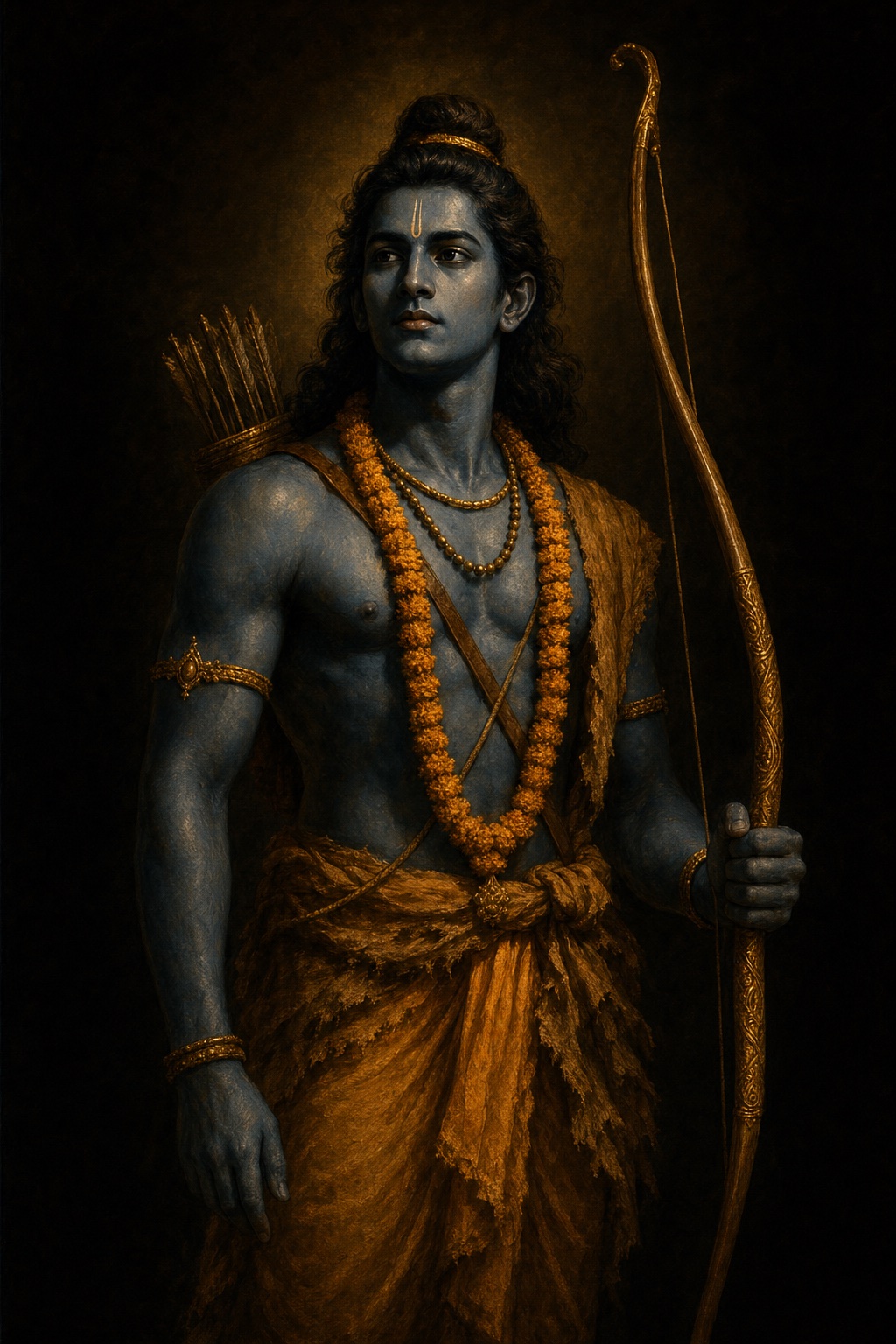
Rama is the eldest son of Dasharatha of Ayodhya, and the seventh avatar of Vishnu, born to make an end of the demon-king Ravana, whose boon protects him from gods and demons but not from men. The plot turns on an old promise: Dasharatha once granted his junior queen Kaikeyi two boons, and on the eve of Rama’s consecration she calls them in — the throne for her own son Bharata, and fourteen years of forest exile for Rama. Rama goes the same day, without arguing, because his father’s word has been given. Sita insists on going with him, Lakshmana follows, and Bharata, when he learns what has been done in his name, refuses the crown and rules as regent with Rama’s sandals on the throne.
In the forest Ravana takes Sita, and the second half of the epic is the search and the war: the alliance with the monkey king Sugriva, Hanuman’s leap to Lanka and the burning of the city, the causeway built across the strait, and the long battle that ends with Ravana dead. What follows the victory is what has kept the poem argued over for two millennia. Rama, restored to Ayodhya, submits Sita to an ordeal by fire to answer public doubt about her captivity, and later — in the seventh book, which many scholars regard as a later addition — banishes her anyway on the strength of a rumour. She bears their sons in Valmiki’s own hermitage, and at the end, asked to prove herself a second time, calls on the earth to take her back instead, and it does.
He is worshipped across South and Southeast Asia, and retold in as many registers as there are audiences: Kamban’s Tamil version, Tulsidas’s Hindi Ramcharitmanas, the Thai Ramakien, the Javanese shadow-play cycles. The phrase that follows him is maryada purushottama — the ideal man precisely in the sense of one who observes the limits — and the tradition has always been willing to hold that ideal up against what it costs Sita.