The hump-back on the palace floor
Shatrughna is the youngest of the four sons of Dasharatha, king of Ayodhya. His mother is Sumitra, and the Balakanda’s birth chapter has her bear him together with Lakshmana, twin sons who share between them half of Vishnu’s portion (1.18.14–15). His name, शत्रुघ्न, means slayer of enemies. At the wedding in Mithila, where Janaka gives Sita to Rama, Janaka also tells Shatrughna to take the hand of Shrutakirti (1.73.32–33). After that the poem has little for him to do while his brothers carry the story: Rama into exile, Lakshmana after him, Bharata home to a throne he will not keep. Shatrughna’s first scene of his own comes after that homecoming. Dasharatha is dead and burned, Rama is in the forest, and Bharata has already reproached Kaikeyi for the plan that did it.
Griffith’s Canto LXXVIII opens with Shatrughna talking to Bharata, and his complaint is aimed at his own twin. Rama has been banished by a woman’s scheme, he says, and Lakshmana was there and strong: why did he not restrain the king before the wrong was done? While he is still speaking, the maid whose scheme it was appears at the door, dressed like a queen, smeared with sandal-oil and hung with ornaments. The doorkeeper seizes her and brings her in to him as the cause of the king’s death and Rama’s exile. Shatrughna calls her the woman who killed his father, and lays hands on her. The other women scatter and run to Kausalya for protection.
स च रोषेण ताम्र अक्षः शत्रुघ्नः शत्रु तापनः । विचकर्ष तदा कुब्जाम् क्रोशन्तीम् पृथिवी तले ॥२-७८-१६॥ तस्या हि आकृष्यमाणाया मन्थरायाः ततः ततः । चित्रम् बहु विधम् भाण्डम् पृथिव्याम् तत् व्यशीर्यत ॥२-७८-१७॥ तेन भाण्डेन सम्कीर्णम् श्रीमद् राज निवेशनम् । अशोभत तदा भूयः शारदम् गगनम् यथा ॥२-७८-१८॥
“His eyes with burning wrath aglow, Śatrughna, shatterer of the foe, Dragged on the ground the hump-back maid Who shrieked aloud and screamed for aid. This way and that with no remorse He dragged her with resistless force, And chains and glittering trinkets burst Lay here and there with gems dispersed, Till like the sky of Autumn shone The palace floor they sparkled on” — Valmiki, Ramayana 2.78.16–18, tr. Griffith
The verses introduce him by his rage and by his name. रोषेण ताम्र अक्षः, his eyes copper-red with anger, is Griffith’s “burning wrath aglow”. शत्रु तापनः, scorcher of enemies, stands beside शत्रुघ्नः and says the same thing twice, and Griffith renders it “shatterer of the foe”. Then the act: विचकर्ष तदा कुब्जाम् क्रोशन्तीम् पृथिवी तले, he dragged the hump-back, screaming, along the ground. The first verse calls her only कुब्जा, the hump-back. The second gives her name, मन्थरायाः, as she is pulled this way and that, ततः ततः, and the ornaments she came in wearing break and scatter. The third verse turns the scattered jewels into a picture: the royal palace, strewn with them, shone like the autumn sky, शारदम् गगनम् यथा. The picture has been used once before. When Kaikeyi stripped off her garlands and jewels in the anger-chamber, the ornaments lit the floor as the stars light the sky, नक्षत्राणि यथा नभः, and the same verb, to shine, carries both images. The queen’s jewels on the floor began the plot. The maid’s jewels on the floor are the end of her part in it.
A woman may not be slain
He does not stop at the maid. Griffith has him haul her on to Kaikeyi’s own rooms and turn on the queen with reproaches, and Kaikeyi, afraid of him, runs to her son for protection. So it is Bharata who stops him, and the argument he uses is not about Manthara.
ताम् प्रेक्ष्य भरतः क्रुद्धम् शत्रुघ्नम् इदम् अब्रवीत् । अवध्याः सर्व भूतानाम् प्रमदाः क्षम्यताम् इति ॥२-७८-२१॥ हन्याम् अहम् इमाम् पापाम् कैकेयीम् दुष्ट चारिणीम् । यदि माम् धार्मिको रामः न असूयेन् मातृ घातकम् ॥२-७८-२२॥ इमाम् अपि हताम् कुब्जाम् यदि जानाति राघवः । त्वाम् च माम् चैव धर्म आत्मा न अभिभाषिष्यते ध्रुवम् ॥२-७८-२३॥ भरतस्य वचः श्रुत्वा शत्रुघ्नः लक्ष्मण अनुजः । न्यवर्तत ततः रोषात् ताम् मुमोच च मन्थराम् ॥२-७८-२४॥
“He looked and saw the prince inflamed With burning rage, and thus exclaimed: “Forgive! thine angry arm restrain: A woman never may be slain. My hand Kaikeyí’s blood would spill, The sinner ever bent on ill, But Ráma, long in duty tried, Would hate the impious matricide: And if he knew thy vengeful blade Had slaughtered e’en this hump-back maid, Never again, be sure, would he Speak friendly word to thee or me.” When Bharat’s speech Śatrughna heard He calmed the rage his breast that stirred, Releasing from her dire constraint The trembling wretch with terror faint” — Valmiki, Ramayana 2.78.21–24, tr. Griffith
Bharata opens with a rule. अवध्याः सर्व भूतानाम् प्रमदाः: women are not to be killed by any creature, and so, क्षम्यताम्, let it be forgiven. Griffith gives the rule a line to itself, “A woman never may be slain”. The next verse shows that the rule is not what holds Bharata back. हन्याम् अहम् इमाम् पापाम् कैकेयीम्: I would kill this wicked Kaikeyi myself, he says, if the righteous Rama would not despise me as a matricide, मातृ घातकम्. The third verse carries the real reason. If Raghava learns that even this hump-back was killed, he will surely never speak to you or to me again, न अभिभाषिष्यते ध्रुवम्. What saves Manthara is Rama’s good opinion, and the fear of losing it belongs to Bharata as much as to Shatrughna.
Shatrughna does not answer. The fourth verse names him a second time, and this time not by his anger but by his family: शत्रुघ्नः लक्ष्मण अनुजः, Shatrughna, Lakshmana’s younger brother. He turns back from his rage, न्यवर्तत ततः रोषात्, and lets Manthara go, ताम् मुमोच च मन्थराम्. Griffith closes the canto on the two women. Manthara crawls to Kaikeyi’s feet and weeps there, still shaking from Shatrughna’s grip, and the queen comforts her with gentle words.
The arrow for Lavana
His next scene of his own comes near the other end of the poem, in the Uttarakanda, when Rama is king. Seers come to Rama about Lavana, a rakshasa who is making the three worlds suffer, and the ascetics most of all. They also tell where his strength comes from. His father, the asura Madhu, won a trident from Shiva, and Shiva promised that it would pass to one son, and that while the son held it in his hand no creature could kill him. Madhu went into the ocean and left the trident to Lavana (7.61.7–21). When Rama has heard them, Bharata is the first to speak: he will kill Lavana himself, and asks for it as his share. Shatrughna rises from his golden seat, bows to the king, and asks to go instead. Bharata, he says, has already guarded Ayodhya while it stood empty, and has already lived at Nandigrama on fruit and roots, in matted hair and bark, lying on a bed of grief; while Shatrughna is there to be sent, Bharata should not have to suffer again. Rama agrees and names his terms. He will consecrate Shatrughna king in the city of Madhu; Shatrughna is to kill Lavana, the son of Madhu, and then rule that kingdom justly, and he is not to argue, because a younger brother does what the elder commands (7.62.9–21).
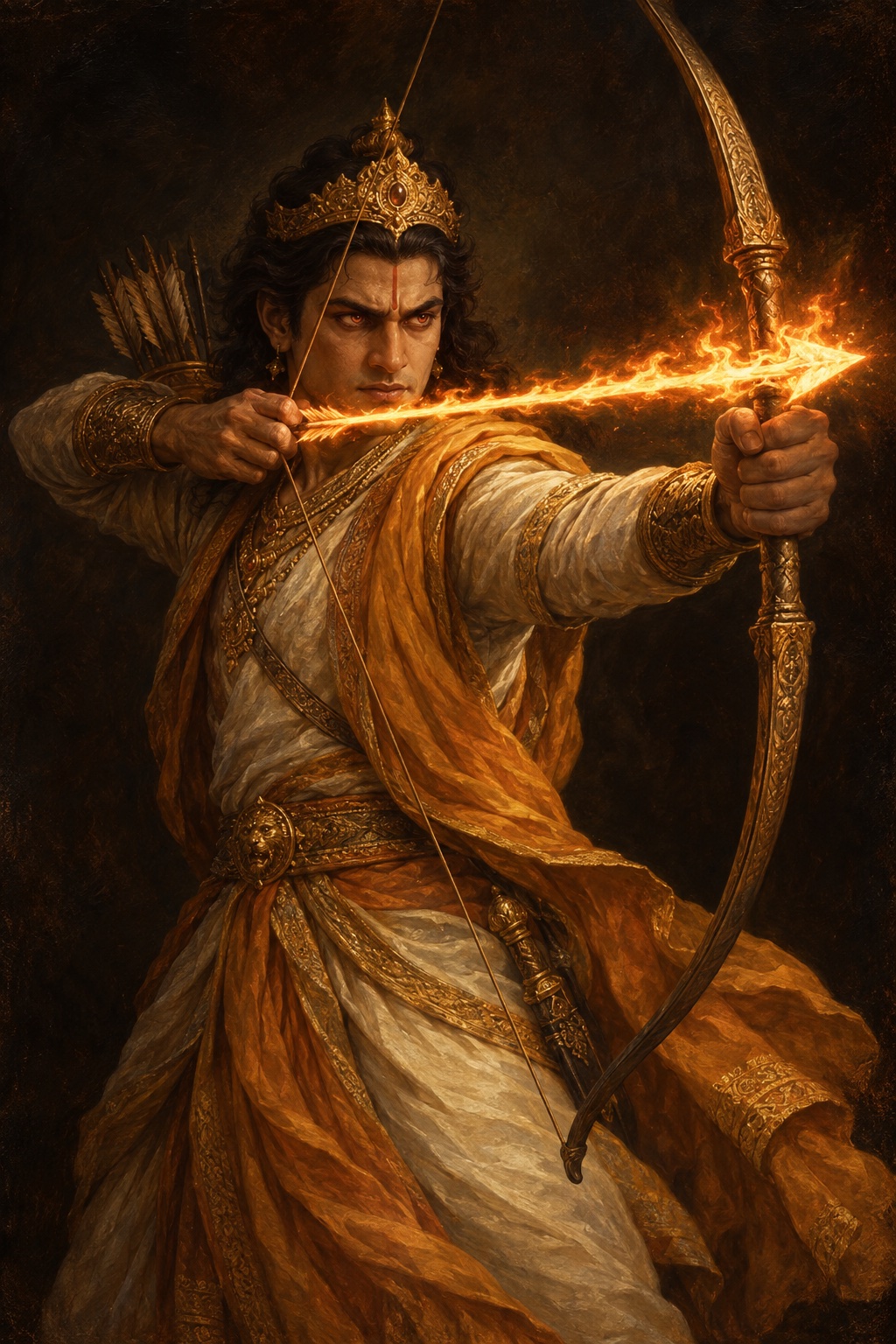
The fight goes badly at first. In Dutt’s prose Lavana hurls trees at him and Shatrughna cuts them to pieces, but his arrows do not hurt the rakshasa, and a tree to the head knocks him senseless. Lavana takes him for dead, and does not go into his own house or pick up the trident, though he has the chance to; he goes on carrying the food he has gathered. A moment later Shatrughna is on his feet again at the city gate, weapon in hand (7.69.12–16). Then he takes up the great arrow. The gods and every other creature, frightened by its blaze, go to Brahma, and Brahma tells them what it is: the arrow Vishnu made to kill the demons Madhu and Kaitabha, whose power Vishnu alone knows, now in Shatrughna’s hand for Lavana’s death. The gods come to the battlefield to watch. The arrow burns like the fire at the end of an age, and Shatrughna roars like a lion and looks again and again at Lavana (7.69.17–33).
आकर्णात्स विकृष्याथ तद्धनुर्धन्विनां वरः । तं मुमोच महाबाणं लवणस्य महोरसि ।। ७.६९.३४ ।।
“Thereupon expanding his bow up to ears, Satrughna, the most accomplished archer, discharged his arrow against the spacious breast of Lavana” — Valmiki, Ramayana 7.69.34, tr. Manmatha Nath Dutt
आकर्णात्स विकृष्याथ: then, having drawn it back to the ear. The full draw is the pose of the whole episode, and धन्विनां वरः, best of bowmen, is the title the verse gives him for it, which Dutt makes “the most accomplished archer”. The target is named with the same care: लवणस्य महोरसि, the great chest of Lavana. In Dutt’s next lines the arrow goes through the heart and on down into Rasatala, and then comes back to Shatrughna.
शत्रुघ्नशरनिर्भिन्नो लवणः स निशाचरः । पपात सहसा भूमौ वज्राहत इवाचलः ।। ७.६९.३७ ।।
“And being pierced by that shaft the night-ranger Lavana fell down on earth like a mountain clapped by a thunder-bolt” — Valmiki, Ramayana 7.69.37, tr. Manmatha Nath Dutt
The Sanskrit puts the killer’s name inside the wound. शत्रुघ्नशरनिर्भिन्नो is one compound, split open by Shatrughna’s arrow, and Dutt resolves it into “pierced by that shaft”. निशाचरः, the night-ranger, is what Lavana was. He falls all at once, सहसा, like a mountain struck by the thunderbolt, वज्राहत इवाचलः. Dutt then has Shatrughna, bow and arrow in hand, shining like the sun that drives off the dark, having lifted the fear of the three worlds with one shaft. The name has done what it says: the slayer of enemies has slain one.
The city on the Yamuna
The gods, led by Agni and Indra, offer him a boon. He asks for a city. Valmiki’s Sanskrit calls it Madhura, the city of Madhu, built by the gods, and Shatrughna’s one request is that it be settled quickly. The gods agree and promise that it will be the lovely Shurasena (7.70.1–6). Griffith, in a note of his own, places the Shurasenas at Mathura, the city in which Krishna is later born.
ते तथोक्त्वा महात्मानो दिवमारुरुहुस्तदा । शत्रुघ्नो ऽपि महातेजास्तां सेनां समुपानयत् ।। ७.७०.७ ।। सा सेना शीघ्रमागच्छच्छ्रुत्वा शत्रुघ्नशासनम् । निवेशनं च शत्रुघ्नः श्रावणेन समारभत् ।। ७.७०.८ ।।
“The high-souled celestials having ascended the welkin saying this, the highly effulgent Satrughna brought the soldiers there, that were encamped on the banks of the Ganges. When the soldiers arrived there on hearing the commands of Satrughna he engaged in making encampments in the month of Sraban” — Valmiki, Ramayana 7.70.7–8, tr. Manmatha Nath Dutt
The gods go back up to heaven, दिवमारुरुहुस्तदा, and Shatrughna sends for his army. It comes quickly at his order, शत्रुघ्नशासनम्, and he begins the settlement, निवेशनं, in the month of Shravana. Dutt adds where the soldiers had been waiting. The Sanskrit verse says only that he brought the army up, तां सेनां समुपानयत्, and names no place.
The rest of the sarga is the city. In the twelfth year it is settled, and the Shurasena country has nothing to fear from any side. The fields are full of crops, Indra sends rain at the right time, and the men are brave and free of disease under the protection of Shatrughna’s arms. The city lies on the bank of the Yamuna in the shape of a half-moon, with houses, squares, markets, streets and traders from many countries, and Shatrughna adorns the great white buildings that Lavana had put up before him. Looking at it, he is happy. Then, with the twelfth year come, he decides that it is time to go and see Rama’s feet (7.70.9–17). The prince whose first scene was a rage that his brother had to stop, and whose next began by taking a hardship off that same brother, ends the sarga as a king, turning back toward the eldest.