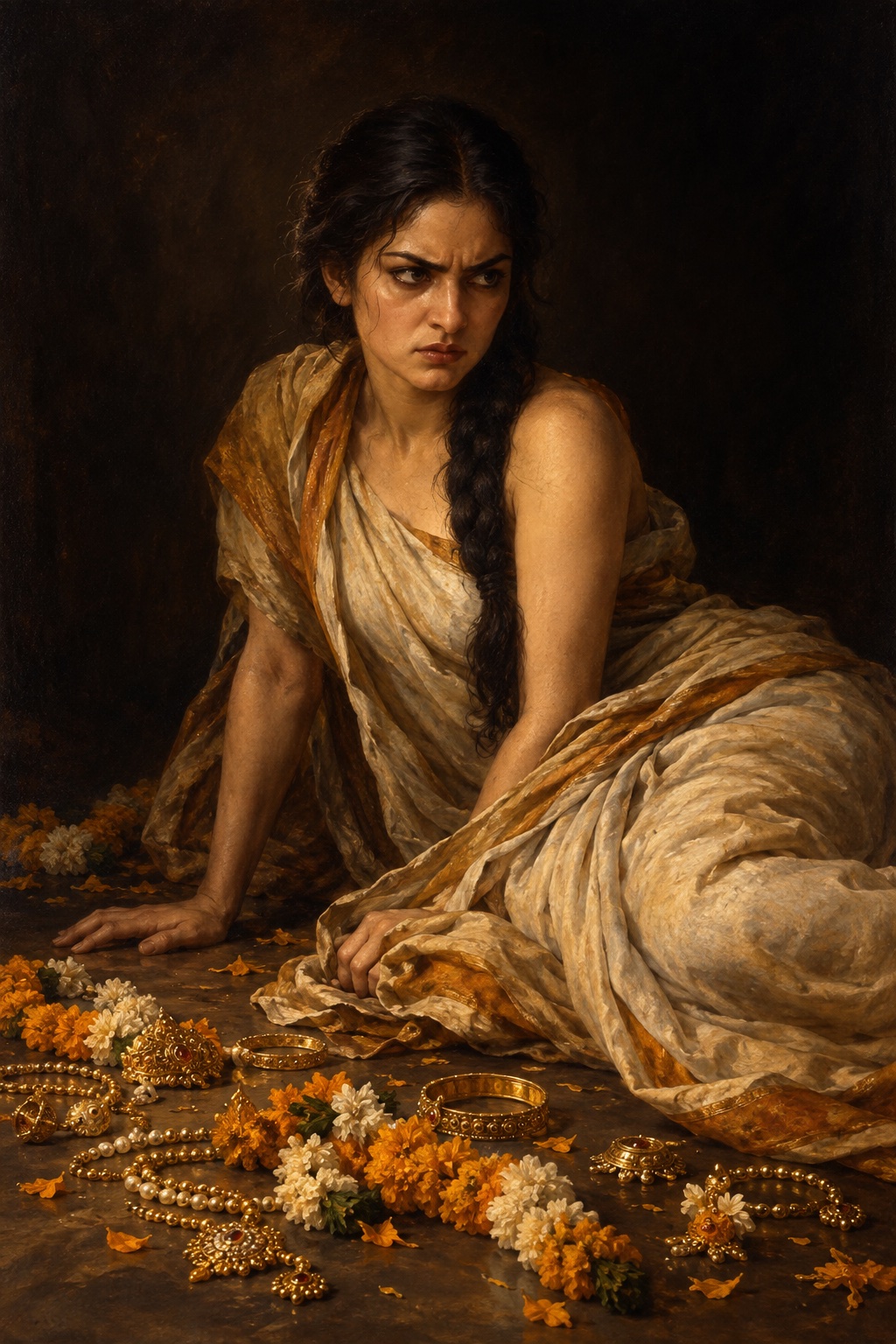
The anger-chamber
Kaikeyi is one of the three queens of Dasharatha, king of Ayodhya, and the mother of Bharata. Her name, कैकेयी, is a patronymic formed from Kekaya: it names her by the house she comes from. Manthara, urging her on, calls her the daughter of Aśvapati. The Ramayana gives her one decisive night, the night before Rama is to be consecrated as his father’s heir. Her maid Manthara has persuaded her that the rite must not happen, and at the opening of Griffith’s Canto IX Kaikeyi has already made up her mind that Bharata shall be consecrated and Rama sent to the forest. What she lacks is a way to do it, and she asks the maid for one.
Manthara’s answer is the whole plot, and it comes with stage directions. Stop the preparations for Rama’s consecration. Ask the king for the two boons he still owes you, and ask for them as Bharata’s consecration and Rama’s banishment for fourteen years, वर्षाणि च चतुर्दश, because fourteen years with Rama gone is long enough for Bharata to win the people’s affection and stand firm. Then the setting and the costume: क्रोधागारं प्रविश्याद्य, go into the anger-chamber today, and lie on the bare ground in soiled clothes, भूमौ मलिनवासिनी. Griffith’s Canto IX gives the rest of the instructions. When the king comes, do not speak and do not meet his eye. Refuse the jewels he will offer. Bind him with oaths before you name the demand. Kaikeyi praises the maid for her cunning, goes to the room with her, and in the tenth sarga she carries the directions out.
अथ सा रुषिता देवी सम्यक् कृत्वा विनिश्चयम्॥ ५॥ संविवेशाबला भूमौ निवेश्य भ्रुकुटिं मुखे। ततश्चित्राणि माल्यानि दिव्यान्याभरणानि च॥ ६॥ अपविद्धानि कैकेय्या तानि भूमिं प्रपेदिरे। तया तान्य् अपविद्धानि माल्यान्य् आभरणानि च॥ ७॥ अशोभयन्त वसुधां नक्षत्राणि यथा नभः। क्रोधागारे च पतिता सा बभौ मलिनाम्बरा॥ ८॥ एकवेणीं दृढां बद्ध्वा गतसत्त्वेव किंनरी
“Then bent upon her purpose dire, Kaikeyí with her soul on fire, Upon the floor lay, languid, down, Her brows contracted in a frown. The bright-hued wreath that bound her hair, Chains, necklets, jewels rich and rare, Stripped off by her own fingers lay Spread on the ground in disarray, And to the floor a lustre lent As stars light up the firmament. Thus prostrate in the mourner’s cell, In garb of woe the lady fell, Her long hair in a single braid, Like some fair nymph of heaven dismayed.” — Valmiki, Ramayana 2.10.5–9, tr. Griffith
The verses match the instructions item by item. क्रोधागारे, in the anger-chamber, is the room Manthara named. भूमौ, on the ground, is where she was told to lie. मलिनाम्बरा, in soiled garments, answers Manthara’s मलिनवासिनी with a synonym. What the verses add is the picture. The garlands and the divine ornaments, माल्यानि दिव्यान्याभरणानि, are thrown off, अपविद्धानि, and where they fall they light the floor the way the stars light the sky. She ties her hair into one tight braid, एकवेणीं दृढां, and lies there like a Kinnari whose strength has gone out of her, गतसत्त्वेव किंनरी. Griffith turns the anger-chamber into “the mourner’s cell” and the soiled clothes into “garb of woe”, and he is right to: every sign in the scene is a sign of mourning, and nobody has died. The first verse says what is underneath it. रुषिता देवी, the angry queen, सम्यक् कृत्वा विनिश्चयम्, having fixed her resolve. The grief is the method.
Calling in the debt
Dasharatha has ordered everything for the morning’s rite, and he comes to her palace to tell her the news himself. Griffith’s Canto X has him find her couch empty and hear from the woman at the door that the queen has gone to the anger-chamber. He finds her on the floor and does what Manthara said he would. He strokes her, offers her his physicians, offers to punish anyone who has wronged her and to enrich anyone she names, lists the kingdoms that obey him, and swears by his own merit that whatever she wants will be done. She still does not name it. In Canto XI she tells him that nobody has slighted her, that she has one wish, and that he must pledge his word before she speaks. He swears by the one person dearer to him than she is: “I swear by Ráma my dear son, Speak, and thy bidding shall be done.” She has the oath witnessed by the thirty-three gods with Indra, by the sun and the moon and the planets, by heaven and the quarters and the day and the night. Only when the king is bound does she speak about the past.
स्मर राजन् पुरा वृत्तं तस्मिन् देवासुरे रणे। तत्र त्वां च्यावयच्छत्रुस्तव जीवितमन्तरा॥ १८॥ तत्र चापि मया देव यत् त्वं समभिरक्षितः। जाग्रत्या यतमानायास्ततो मे प्रददौ वरौ॥ १९॥ तौ दत्तौ च वरौ देव निक्षेपौ मृगयाम्यहम्। तवैव पृथिवीपाल सकाशे रघुनन्दन॥ २०॥ तत् प्रतिश्रुत्य धर्मेण न चेद् दास्यसि मे वरम्। अद्यैव हि प्रहास्यामि जीवितं त्वद्विमानिता॥ २१॥
“Remember, King, that long-past day Of Gods’ and demons’ battle fray. And how thy foe in doubtful strife Had nigh bereft thee of thy life. Remember, it was only I Preserved thee when about to die, And thou for watchful love and care Wouldst grant my first and second prayer. Those offered boons, pledged with thee then, I now demand, O King of men, Of thee, O Monarch, good and just, Whose righteous soul observes each trust. If thou refuse thy promise sworn, I die, despised, before the morn.” — Valmiki, Ramayana 2.11.18–21, tr. Griffith
स्मर राजन्, remember, king: the speech opens with a command to remember. The battle is देवासुरे रणे, the war of the gods and the asuras, where the enemy all but took his life. The rescue is hers, मया, by me, and Griffith sharpens it to “it was only I”. The next half-line says what the boons were paid for: जाग्रत्या यतमानायास्ततो मे प्रददौ वरौ, because I kept awake and struggled for you, the two boons were given to me. Then the word she uses for them. निक्षेपौ मृगयाम्यहम्, I seek the two deposits: things left in another person’s keeping, to be claimed back. She does not ask him for a gift. She asks for what she left with him. The last verse puts a price on refusal. अद्यैव हि प्रहास्यामि जीवितं त्वद्विमानिता, this very day I will give up my life, dishonoured by you, which Griffith gives as “I die, despised, before the morn.”
The battle itself is told only once, and not by her. In the ninth sarga Manthara reminds her of it. Dasharatha went south toward the Dandaka forest, taking Kaikeyi with him, to help Indra, the king of the gods, against Śambara, शतमायो महासुरः, the great asura of a hundred illusions, at the city called Vaijayanta. In that battle the demons came by night and killed the wounded as they slept. Dasharatha fought and was hacked by the weapons of the asuras, and Kaikeyi carried him from the field unconscious and kept him alive. The king was pleased and granted her two boons. She told him she would choose them when she wanted them, and he agreed. Then Manthara says where she learned all this: अनभिज्ञा ह्यहं देवि त्वयैव कथितं पुरा, I did not know it, queen, you told it to me yourself long ago. The story of the debt is Kaikeyi’s own. The maid only handed it back to her as a plan.
The two boons
Then she names them.
तौ तावदहमद्यैव वक्ष्यामि शृणु मे वचः। अभिषेकसमारम्भो राघवस्योपकल्पितः॥ २४॥ अनेनैवाभिषेकेण भरतो मेऽभिषिच्यताम्। यो द्वितीयो वरो देव दत्तः प्रीतेन मे त्वया॥ २५॥ तदा देवासुरे युद्धे तस्य कालोऽयमागतः। नव पञ्च च वर्षाणि दण्डकारण्यमाश्रितः॥ २६॥ चीराजिनधरो धीरो रामो भवतु तापसः। भरतो भजतामद्य यौवराज्यमकण्टकम्॥ २७॥ एष मे परमः कामो दत्तमेव वरं वृणे। अद्य चैव हि पश्येयं प्रयान्तं राघवं वने॥ २८॥
“These rites in Ráma’s name begun— Transfer them, and enthrone my son. The time is come to claim at last The double boon of days long-past, When Gods and demons met in fight, And thou wouldst fain my care requite. Now forth to Daṇḍak’s forest drive Thy Ráma for nine years and five, And let him dwell a hermit there With deerskin coat and matted hair. Without a rival let my boy The empire of the land enjoy, And let mine eyes ere morning see Thy Ráma to the forest flee.” — Valmiki, Ramayana 2.11.24–28, tr. Griffith
The first boon uses the king’s own preparations. अभिषेकसमारम्भो राघवस्योपकल्पितः, the consecration made ready for Raghava, that is for Rama, is to be used exactly as it stands: अनेनैवाभिषेकेण भरतो मेऽभिषिच्यताम्, with this very consecration let my Bharata be consecrated. Nothing has to be prepared again. Only the name changes. The second boon is worded like a sentence, with a term, a place and a dress. नव पञ्च च वर्षाणि, nine years and five, is Manthara’s fourteen counted another way, and Griffith keeps her count as she gives it. दण्डकारण्यमाश्रितः, living in the Dandaka forest, is the place. चीराजिनधरो, wearing bark and deerskin, is the dress. रामो भवतु तापसः, let Rama be an ascetic, is the condition. The two boons are one exchange, and the next line says so: भरतो भजतामद्य यौवराज्यमकण्टकम्, let Bharata take the heir’s office today, and take it without a thorn, which Griffith gives as “Without a rival”. The thorn is Rama. The last line fixes the hour. अद्य चैव हि पश्येयं प्रयान्तं राघवं वने, and let me see Raghava going to the forest today; Griffith has “ere morning”.
The demand holds, because the king swore by Rama before he knew that Rama was what she would ask for. Rama goes to the forest dressed as a hermit, with Lakshmana and Sita, and Dasharatha dies of grief for him. Through all of it the son the plan was made for is away from Ayodhya and knows nothing about it.
Her son’s reproach
When Bharata comes home and cannot find his father, he goes to his mother. Griffith’s Canto LXXII has her spring up from her golden seat to hold him and ask about his journey. When he asks for the king, she tells him that his father is dead, and she tells it as if it were good news. He asks where Rama is. She tells him the whole plan and tells him to rise and reign: “For thee, my darling son, for thee All this was planned and wrought by me.” Bharata’s answer is Griffith’s Canto LXXIII.
दुह्खे मे दुह्खम् अकरोर् व्रणे क्षारम् इव आदधाः । राजानम् प्रेत भावस्थम् कृत्वा रामम् च तापसम् ॥२-७३-३॥ कुलस्य त्वम् अभावाय काल रात्रिर् इव आगता । अन्गारम् उपगूह्य स्म पिता मे न अवबुद्धवान् ॥२-७३-४॥ मृत्युमापादितो राजा त्वया मे पापदर्शिनि । सुखम् परिहृतम् मोहात्कुलेऽस्मिन् कुलपाम्सनि ॥२-७३-५॥
“Grief upon grief thy hand has made, And salt upon gashes laid: For my dear sire has died through thee, And Ráma roams a devotee. Thou camest like the night of Fate This royal house to devastate. Unwitting ill, my hapless sire Placed in his bosom coals of fire, And through thy crimes his death he met, O thou whose heart on sin is set. Shame of thy house! thy senseless deed Has reft all joy from Raghu’s seed.” — Valmiki, Ramayana 2.73.3–5, tr. Griffith
The reproach turns her own words back on her. In the demand she asked for रामो भवतु तापसः, let Rama be an ascetic. Bharata charges her with it in almost the same words, कृत्वा रामम् च तापसम्, you have made Rama an ascetic. The grief she put on in the anger-chamber is real now, and it is his: दुह्खे मे दुह्खम् अकरोर्, you have laid grief on my grief, like caustic on a wound, व्रणे क्षारम् इव. Then he names what she has been to the family: कुलस्य त्वम् अभावाय काल रात्रिर् इव आगता, you came like the night of doom, to bring the house to nothing, Griffith’s “the night of Fate”. His father, he says, clasped a live coal to himself without knowing it, अन्गारम् उपगूह्य. The last word of the passage is कुलपाम्सनि, disgrace of the family, which Griffith makes “Shame of thy house!”
The sarga ends on his speech and records no reply from her. Before it ends, Bharata says that he would leave her, and that what stops him is Rama, who still thinks of her as his mother. Then he says that he will go to the forest and bring his brother home. The throne she won with the boons was won for Bharata, and Bharata will not take it.