Meghanada, and the name he won
Indrajit is a rakshasa, the son of Ravana, and the name the Ramayana knows him by is one he earned. How he earned it is told not in the war books but in the Uttarakanda, the last book of the poem, which goes back over the history of the rakshasas and whose narrator addresses Rama by name as he tells it. In Manmatha Nath Dutt’s translation the Uttarakanda gives his birth in Section XII. Mandodari bears Ravana a son who roars at the moment he is born, and his father names him Meghanada, cloud-roar, for that sound. The same passage adds that this is the son now called Indrajit.
The new name comes out of a war in heaven. By the thirtieth sarga of the Uttarakanda, Ravana has conquered the three worlds, as Brahma himself says in it, but it is the son, not the father, who has beaten Indra, the king of the gods, and who holds him prisoner. The gods come to Lanka with Brahma at their head to get him back. Brahma does not come down. He speaks to Ravana while standing in the sky, and he speaks gently: he is pleased with the boy’s fighting, and the boy’s valour is equal to his father’s, or greater.
अयं च पुत्रो ऽतिबलस्तव रावण वीर्यवान् । जगतीन्द्रजिदित्येव परिख्यातो भविष्यति
“O Ravana, this thy son is highly powerful and gifted with great strength and he shall be celebrated in the world under the appellation of ‘Indrajit’ or the conqueror of Indra.” — Valmiki, Ramayana 7.30.5, tr. Manmatha Nath Dutt
The name is given to the father. Brahma speaks to रावण, to Ravana, and tells him what the world will call his son: जगतीन्द्रजिदित्येव परिख्यातो भविष्यति, in the world he will be known far and wide as Indrajit. The Sanskrit does not explain the name, because the compound is its own explanation, Indra and the one who conquers him. Dutt adds the gloss “or the conqueror of Indra” for readers without Sanskrit, and the verse itself has no such words. In the next verse Brahma says plainly what the name records: this rakshasa will be strong and hard to conquer, and by relying on him Ravana has put the gods in his power. Then Brahma asks for Indra back.
A chariot out of the fire
Brahma asks what the gods should give in exchange for Indra, and Indrajit asks for the largest thing there is. If Indra is to go free, he says, he chooses immortality. Brahma refuses: no living creature on earth has complete immortality. Indrajit then names a narrower gift, in his own words. Whenever he has honoured the fire with offerings and mantras and is ready to go down into battle to defeat his enemies, a chariot yoked with horses is to rise for him out of the fire, and while he stands on it he is to be immortal. In the next verse he names the price himself: if he fights while the prayers and offerings in that fire are unfinished, he will be destroyed. He closes with a boast. Other men, he says, choose immortality through austerity, and he has won his through valour. Brahma answers, so be it. Indrajit lets Indra go, the gods return to heaven, and the sarga turns to Indra, downcast, the shine gone from his robes, sunk in thought.
It is an odd shape for immortality. He does not ask to be unkillable, but to be unkillable on one chariot, which rises from one fire, and only when the rite in that fire is complete. Everything that protects him depends on a ritual being finished, and the poem puts that condition in his own mouth, spoken to the god who grants it.
Serpent-arrows from an empty sky
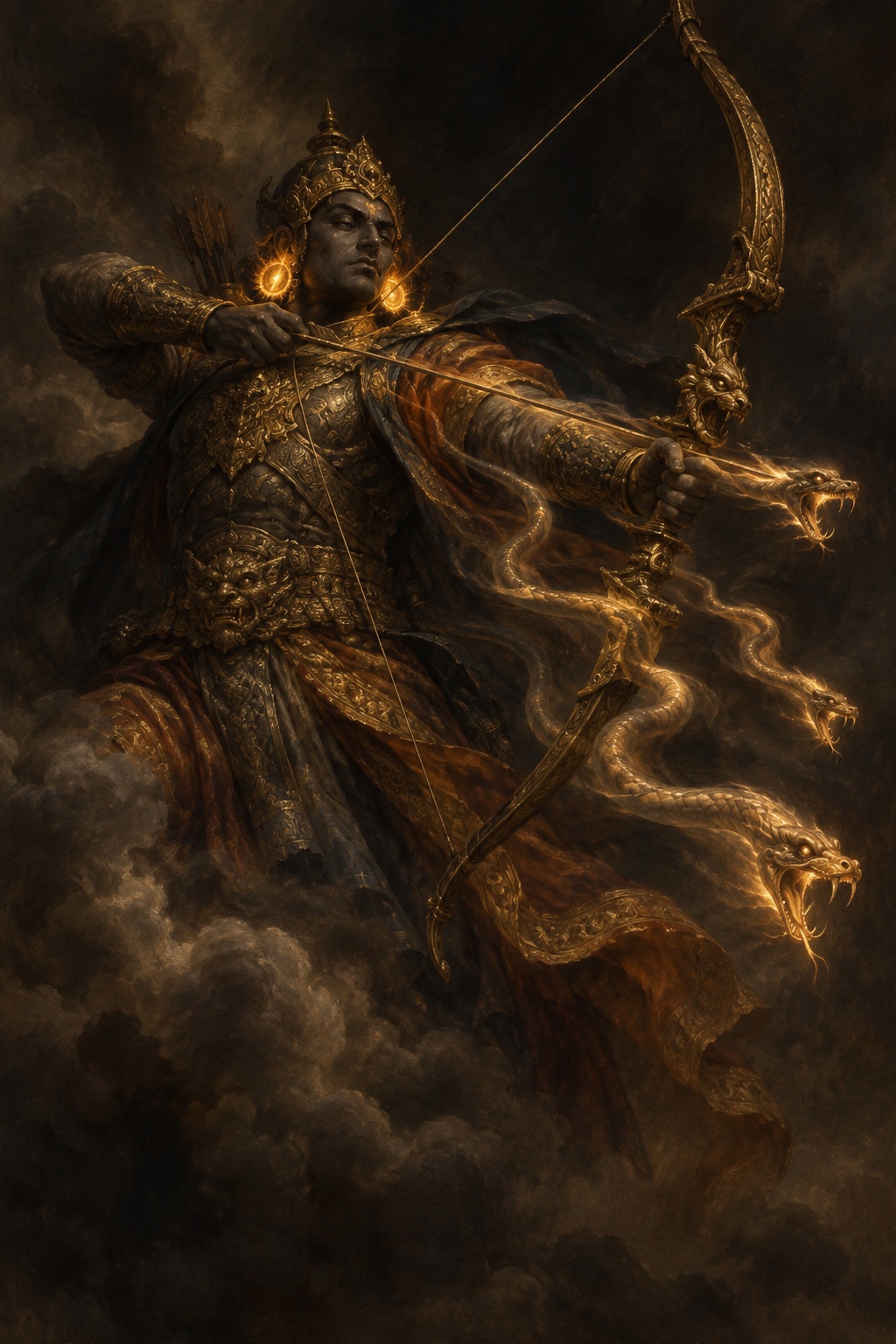
In the war at Lanka, the forty-fourth sarga of the Yuddhakanda shows him beaten before it shows him winning. Angada, the son of Vali, defeats him in battle, and the monkeys, with Sugriva and Vibhishana among them, shout their approval at the sight of the enemy beaten. Defeated by Vali’s son, Indrajit is seized by a terrible anger, and then he disappears. सोऽन्तर्धानगतः, gone into invisibility, the next verse says of him, and in the same line it calls him ब्रह्मदत्तवरो, the holder of a boon given by Brahma.
अदृश्यो निशितान् बाणान् मुमोचाशनिवर्चसः। रामं च लक्ष्मणं चैव घोरैर्नागमयैः शरैः॥ ३५॥ बिभेद समरे क्रुद्धः सर्वगात्रेषु राक्षसः। मायया संवृतस्तत्र मोहयन् राघवौ युधि॥ ३६॥ अदृश्यः सर्वभूतानां कूटयोधी निशाचरः। बबन्ध शरबन्धेन भ्रातरौ रामलक्ष्मणौ॥ ३७॥
“…remaining invisible, began to discharge sharpened shafts of the splendour of the thunder-bolt. And worked up into rage, he in the conflict pierced Raghu’s sons, Rama and Lakshmana all over their bodies, with terrific arrows consisting of serpents. And himself engirt with illusion, that night-ranger, given to fighting in crooked ways,— remaining invisible to all creatures,—stupified the descendants of Raghu in battle; and by means of his shafts bound the brothers, Rama and Lakshmana.” — Valmiki, Ramayana 6.44.35–37, tr. Manmatha Nath Dutt
Three verses, and the first word of the first and the first word of the last are the same: अदृश्यो, unseen, and अदृश्यः सर्वभूतानां, unseen by all creatures. Between them stands मायया संवृतस्तत्र, wrapped in illusion there. The rakshasa who has just lost a fight in the open does not come back into the open. The last verse gives him two names side by side. निशाचरः, night-ranger, is a common name for any rakshasa. कूटयोधी, which Dutt renders as “given to fighting in crooked ways”, belongs to this moment: it names a way of fighting, not a race. The weapon is as strange as the fighter. घोरैर्नागमयैः शरैः, with dreadful arrows made of serpents: Dutt’s “arrows consisting of serpents” keeps the literal sense, that these shafts are nagas. They pierce the brothers in every limb, and then they do something that arrows do not do. बबन्ध शरबन्धेन भ्रातरौ रामलक्ष्मणौ: he bound the brothers Rama and Lakshmana with a bond of arrows.
The bond holds until the fiftieth sarga, when Garuda arrives. At the sight of him the serpents that had bound the two men in the form of arrows flee. Garuda touches the brothers and strokes their faces with his hands, their wounds close, and their energy, strength and memory come back to them doubled. The shafts that no one saw him loose were serpents all along, and they ran from Garuda as serpents.
The rite at Nikumbhila
The condition he set before Brahma comes back in the Yuddhakanda from the other side. In the eighty-fifth sarga Rama asks Vibhishana to repeat what he has told him, and Vibhishana does. Ravana’s son has gone with his army to Nikumbhila, and if he rises from his rite with it completed, Rama should count them all as dead. But the boon has a condition, and Vibhishana repeats it in the words in which it was given to Indrajit, calling him enemy of Indra: the foe who strikes you before you reach Nikumbhila and before you have made your fire offering will be your death. Let Lakshmana go, he says, with a large force, and kill him there. In the Uttarakanda Indrajit named that condition himself, as the price of his chariot; in the Yuddhakanda his father’s brother tells it to his enemies as the way to kill him. Lakshmana bows at Rama’s feet, walks round him, and goes with Vibhishana to Nikumbhila, the shrine that Ravana’s son guards.
In the ninetieth sarga Lakshmana swears on Rama’s truth and shoots at Indrajit ऐन्द्रास्त्रेण, with the Aindra weapon, the weapon of Indra. It takes off his head, सशिरस्त्राणं, with the helmet still on it and the blazing ear-rings, and the head lies on the ground the colour of gold and covered in blood. The body falls after it, कवची, still in its corslet, with the bow flung from its hand. Those verses, and the oath before them, are quoted in the entry on Lakshmana and are not quoted again here. The rakshasa whom the forty-fourth sarga made unseen by all creatures leaves the poem in full view, every piece of his war-gear named as it falls: helmet, ear-rings, corslet, bow.