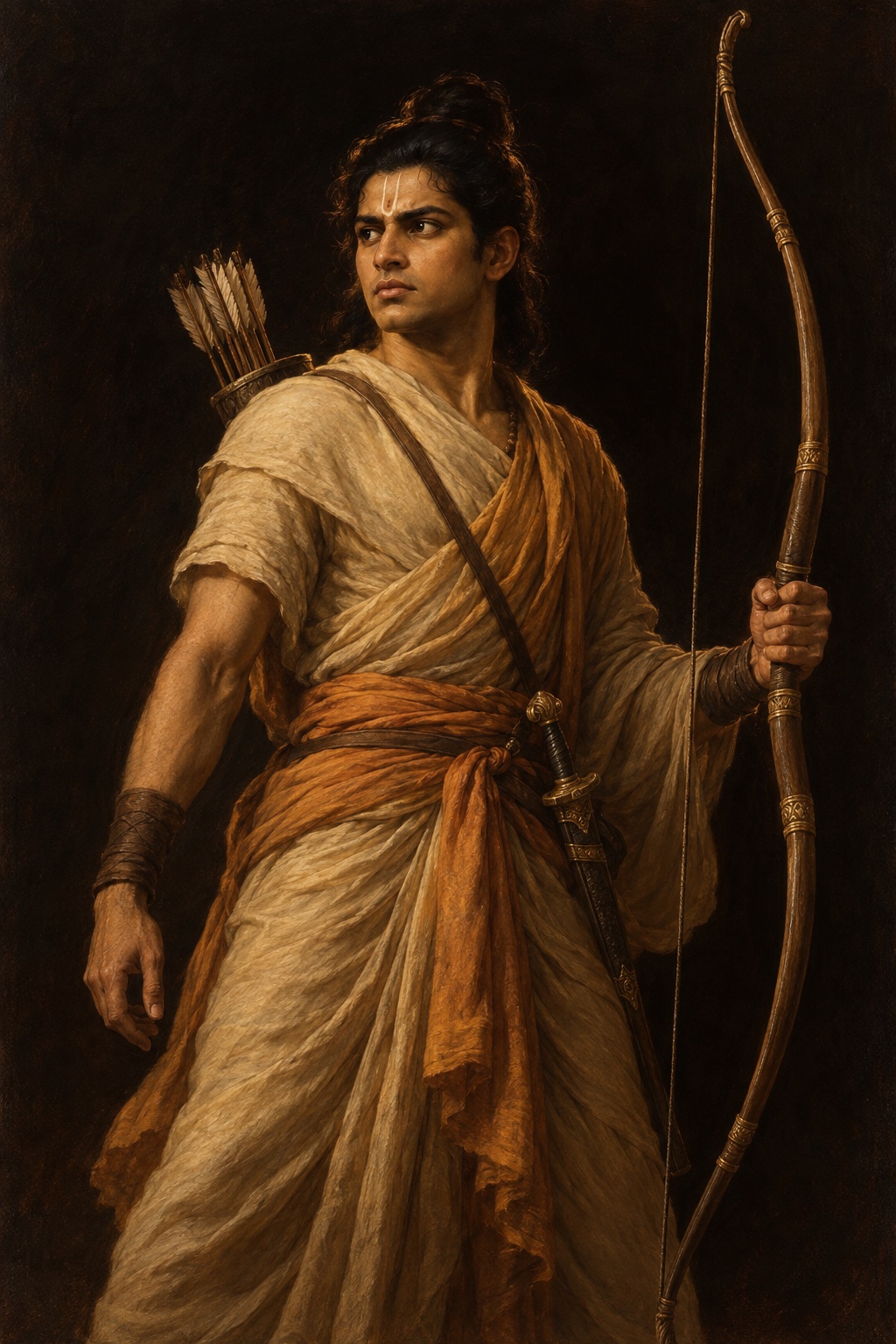
Ahead of him, with the bow
Lakshmana is the son of Dasharatha of Ayodhya by Sumitra, one of the king’s queens. The Balakanda’s birth chapter has her bear two sons together, Lakshmana and Shatrughna, and credits the pair with a share of Vishnu (1.18.14). At the wedding in Mithila, Janaka gives Sita to Rama before the fire and in the next breath tells Lakshmana to take Urmila as his bride, and Bharata and Shatrughna are married in the same rite (1.73.30–31). When Kaikeyi’s claim sends Rama into the forest and Sita has won her argument to go with him, Lakshmana, who has been listening, presses his brother’s feet and speaks.
यदि गन्तुं कृता बुद्धिर्वनं मृगगजायुतम्। अहं त्वानुगमिष्यामि वनमग्रे धनुर्धरः॥ ३॥ मया समेतोऽरण्यानि रम्याणि विचरिष्यसि। पक्षिभिर्मृगयूथैश्च संघुष्टानि समन्ततः॥ ४॥ न देवलोकाक्रमणं नामरत्वमहं वृणे। ऐश्वर्यं चापि लोकानां कामये न त्वया विना॥ ५॥
“If thou wilt make the woods thy home, Where elephant and roebuck roam, I too this day will take my bow And in the path before thee go. Our way will lie through forest ground Where countless birds and beasts are found, I heed not homes of Gods on high, I heed not life that cannot die, Nor would I wish, with thee away, O’er the three worlds to stretch my sway.” — Valmiki, Ramayana 2.31.3–5, tr. Griffith
Griffith’s “before thee” keeps the one detail of position that the Sanskrit insists on. वनमग्रे धनुर्धरः: into the forest, in front, holding the bow. He does not ask to walk beside Rama or behind him, but ahead, where whatever the forest holds will be met first. The fifth verse is a refusal made before anything has been offered. न देवलोकाक्रमणं नामरत्वमहं वृणे: he does not choose to tread the world of the gods, and he does not choose immortality. The last clause declines lordship of the worlds with a condition attached, न त्वया विना, not without you, and that condition is the only reason the verse gives for any of it. What he gives up is not a throne in Ayodhya but everything above it.
Rama refuses at first. In the rest of the canto he asks Lakshmana to stay and look after Kausalya and Sumitra, since the king lies captive to his passion and Kaikeyi has won the throne for her son. Lakshmana answers that Bharata will care for the queens, and that if Bharata fails them he will kill him and the three worlds with him if they take his side. It is the same three worlds he has just declined to rule. Then he describes what he means to do in the forest: he will carry the spade and the basket, find roots and wild fruit, and keep watch over Rama awake or asleep. Rama gives way and sends him to fetch the two celestial bows that Varuna once gave Janaka, so the bow he promised to carry ahead of his brother is, by the end of the canto, a god’s gift. Urmila, married to him at the same fire as Sita, is not named in the canto at all.
The joke, the order and the sword
In the Dandaka forest a rakshasa woman, Shurpanakha, offers herself to Rama. He answers with a joke: he already has a wife, but his brother is unmarried and would suit her. The wedding at Mithila makes that untrue, and Lakshmana plays along anyway. In Griffith’s canto he calls himself his brother’s bondsman, asks whether so high a lady could agree to be the slave-wife of a slave, and sends her back to Rama with mocking praise that she takes at face value. She turns on Sita, whom she means to devour so that no rival is left, and rushes at her. Rama stops her, and turns the blame on his brother: they should never have joked with a creature of her kind, and she must not leave without a mark on her.
इत्युक्तो लक्ष्मणस्तस्याः क्रुद्धो रामस्य पश्यतः। उद्धृत्य खड्गं चिच्छेद कर्णनासे महाबलः॥ २१॥ निकृत्तकर्णनासा तु विस्वरं सा विनद्य च। यथागतं प्रदुद्राव घोरा शूर्पणखा वनम्॥ २२॥
“He spoke: then Lakshman’s wrath rose high, And there before his brother’s eye, He drew that sword which none could stay, And cleft her nose and ears away. Noseless and earless, torn and maimed, With fearful shrieks the fiend exclaimed, And frantic in her wild distress Resought the distant wilderness.” — Valmiki, Ramayana 3.18.21–22, tr. Griffith
The order is Rama’s. The anger is Lakshmana’s own. इत्युक्तो लक्ष्मणस्तस्याः क्रुद्धो रामस्य पश्यतः: so told, Lakshmana, enraged at her, while Rama looked on. One half-line holds the order, the anger and the witness together, and the next gives the act with no interval at all. खड्गं, the sword, appears here and in none of the other passages this entry quotes. Where those arm him, it is with a bow, and he fights at the length of an arrow’s flight; here, at arm’s length, he cuts a woman’s face. The poem gives him महाबलः, of great strength, at exactly that moment, and says nothing further about it.
It does not need to, because the rest of the Aranyakanda is the consequence. Shurpanakha flies bleeding to Khara at Janasthan. In a later canto of Griffith’s she looks over a plain of fourteen thousand dead, Khara among them, killed by Rama alone, and goes on to Lanka and to Ravana. What Ravana sends back into the forest is a deer. Lakshmana himself dates the enmity to that battle when he argues with Sita at their dwelling, saying that they drew the giants’ hatred on themselves when Rama killed Khara. The cut he made in Rama’s sight is where that account begins.
A blessing instead of a line
At Ravana’s bidding Maricha takes the shape of a deer, and Rama follows it deep into the forest, leaving Lakshmana to guard Sita. When Rama’s arrow at last strikes home, the dying Maricha calls out for Sita and Lakshmana in a voice made to sound like Rama’s own. Sita hears her husband crying for help and orders Lakshmana to run to him. He will not go. He tells her that no one among gods or demons would dare to meet Rama in a fight, that the cry is some giant’s trick, and that she is a pledge Rama gave into his keeping and he cannot leave her. She answers that he wants Rama dead because he wants her, or that Bharata has set him to it, and that she will die before she belongs to anyone else.
अब्रवील्लक्ष्मणः सीतां प्राञ्जलिः स जितेन्द्रियः। उत्तरं नोत्सहे वक्तुं दैवतं भवती मम॥ २८॥ वाक्यमप्रतिरूपं तु न चित्रं स्त्रीषु मैथिलि। स्वभावस्त्वेष नारीणामेषु लोकेषु दृश्यते॥ २९॥ विमुक्तधर्माश्चपलास्तीक्ष्णा भेदकराः स्त्रियः। न सहे हीदृशं वाक्यं वैदेहि जनकात्मजे॥ ३०॥ श्रोत्रयोरुभयोर्मध्ये तप्तनाराचसंनिभम्। उपशृण्वन्तु मे सर्वे साक्षिणो हि वनेचराः॥ ३१॥ न्यायवादी यथा वाक्यमुक्तोऽहं परुषं त्वया। धिक् त्वामद्य विनश्यन्तीं यन्मामेवं विशङ्कसे॥ ३२॥ स्त्रीत्वाद् दुष्टस्वभावेन गुरुवाक्ये व्यवस्थितम्। गच्छामि यत्र काकुत्स्थः स्वस्ति तेऽस्तु वरानने॥ ३३॥ रक्षन्तु त्वां विशालाक्षि समग्रा वनदेवताः। निमित्तानि हि घोराणि यानि प्रादुर्भवन्ति मे। अपि त्वां सह रामेण पश्येयं पुनरागतः॥ ३४॥
“No words have I to answer now: My deity, O Queen, art thou. But ‘tis no marvel, dame, to find Such lack of sense in womankind. Throughout this world, O Maithil dame, Weak women’s hearts are still the same. Inconstant, urged by envious spite, They sever friends and hate the right. I cannot brook, Videhan Queen, Thy words intolerably keen. Mine ears thy fierce reproaches pain As boiling water seethes the brain. And now to bear me witness all The dwellers in the wood I call, That, when with words of truth I plead, This harsh reply is all my meed. Ah, woe is thee! Ah, grief, that still Eager to do my brother’s will, Mourning thy woman’s nature, I Must see thee doubt my truth and die. I fly to Ráma’s side, and Oh, May bliss attend thee while I go! May all attendant wood-gods screen Thy head from harm, O large-eyed Queen! And though dire omens meet my sight And fill my soul with wild affright, May I return in peace and see The son of Raghu safe with thee!” — Valmiki, Ramayana 3.45.28–34, tr. Griffith
Before he says a word, the Sanskrit gives his posture. प्राञ्जलिः, with his palms joined, and जितेन्द्रियः, master of his senses: the second answers the charge before he does, since what she has accused him of is desire. Then उत्तरं नोत्सहे वक्तुं दैवतं भवती मम: I cannot bring myself to answer, you are a deity to me. The next two verses are the ones a reader stops at. It is no wonder, he says, to hear such words from a woman; this is the nature of women throughout the world, loose from dharma, fickle, harsh, makers of division. They are spoken by a man who has just been told that he is waiting for his brother to die so that he can have his brother’s wife, and the poem gives them to him in that anger without softening them. They belong to him and to that moment, in a speech that opened by calling her his deity.
Then he calls the creatures of the forest as witnesses, साक्षिणो हि वनेचराः, that he spoke fairly and was answered harshly, and turns on her: धिक् त्वामद्य विनश्यन्तीं, shame on you, heading for ruin today, for suspecting me like this. The next verse lays one more charge on a woman’s nature and then turns in the middle of the line. He is going to Rama, he says, and स्वस्ति तेऽस्तु वरानने, may it go well with you, fair-faced one. Then रक्षन्तु त्वां विशालाक्षि समग्रा वनदेवताः: may all the deities of the forest guard you, large-eyed one. The omens he sees are terrible, and he hopes to come back and find her with Rama. Sita answers only that if she is widowed she will drown herself in the Godavari, hang herself, leap from a rock, take poison or walk into fire rather than touch another man. He tries to comfort her, and she does not speak to him again. He raises his joined hands once more, looks at her, and goes.
That prayer is what he leaves at the door. Later retellings give him something more solid, a protective line drawn on the ground before he goes, which Sita then crosses. Valmiki has no such line. In this canto Lakshmana argues, is accused, answers, blesses her and leaves; in the next, Ravana comes to the door dressed as a mendicant, with both brothers far out of sight. The only guard Lakshmana sets over her in the Sanskrit is the forest gods he asked to watch her.
An oath on his brother’s truth
In the war at Lanka, Lakshmana’s own decisive fight is with Ravana’s son Indrajit, whose name means conqueror of Indra. In Manmatha Nath Dutt’s complete prose translation the duel is an exchange of divine weapons, each one cancelling the last. Lakshmana’s Varuna weapon is baffled by Indrajit’s Raudra weapon; Indrajit’s fire weapon is met by a solar one, and his Asura weapon, which pours out daggers, clubs and axes, by a weapon of Maheshvara. Vibhishana, fighting beside Lakshmana, kills Indrajit’s horses with his mace. Then Lakshmana fits the Aindra weapon to his bow, the shaft with which Indra once defeated the Danavas in the war between the gods and the Asuras, so the arrow meant for the conqueror of Indra is Indra’s own. Before he looses it, he speaks.
धर्मात्मा सत्यसंधश्च रामो दाशरथिर्यदि। पौरुषे चाप्रतिद्वन्द्वस्तदैनं जहि रावणिम्॥ ६९॥
“If Dacaratha’s son—Rama—is righteous and truthful, and if in prowess he hath no rival, then slay this son of Ravana.” — Valmiki, Ramayana 6.90.69, tr. Manmatha Nath Dutt
The oath is a conditional, and every term in it belongs to Rama. धर्मात्मा सत्यसंधश्च: righteous, and true to his word; and without a rival in manhood. If the son of Dasharatha is all of that, then जहि रावणिम्, kill this son of Ravana, an order spoken to the arrow. Lakshmana’s own strength, which the duel has just shown to be exactly matched by Indrajit’s, is not part of the claim at all. The shot is staked on the truth of the brother he refused to let go into the forest alone. The vow of the Ayodhyakanda said not without you of heaven and the three worlds; here it says the same of a single arrow.
लक्ष्मणः समरे वीरः ससर्जेन्द्रजितं प्रति। ऐन्द्रास्त्रेण समायुज्य लक्ष्मणः परवीरहा॥ ७०॥ तच्छिरः सशिरस्त्राणं श्रीमज्ज्वलितकुण्डलम्। प्रमथ्येन्द्रजितः कायात् पातयामास भूतले॥ ७१॥ तद् राक्षसतनूजस्य भिन्नस्कन्धं शिरो महत्। तपनीयनिभं भूमौ ददृशे रुधिरोक्षितम्॥ ७२॥ हतः स निपपाताथ धरण्यां रावणात्मजः। कवची सशिरस्त्राणो विप्रविद्धशरासनः॥ ७३॥
“…discharged it at Indrajit. And shooting the Aindra weapon, that destroyer of hostile heroes—Lakshmana—severing from its trunk the head of Indrajit with its corslet, graced with burning ear-rings, brought it down to the ground. And the mighty severed head of the Rakshasa’s son, resembling one made of gold, was seen covered with blood. And slain, Ravana’s son dropped to the earth, with his armour and corslet on, and his bow fallen (from his grasp).” — Valmiki, Ramayana 6.90.70–73, tr. Manmatha Nath Dutt
परवीरहा, destroyer of hostile heroes, is the Sanskrit’s name for him at the instant of the shot, and Dutt keeps it. The rest is an inventory of what falls: the head with its helmet and its bright ear-rings, gold-coloured on the ground and wet with blood, then the body in its armour, the bow gone from its hand. Only after that does the canto widen. The monkeys and Vibhishana cheer as the immortals cheered at the killing of Vritra, the rakshasas throw down their weapons and run for Lanka, and Indra rejoices with the great seers. Griffith, whose verse carries the other quotations in this entry, did not versify this canto and tells Indrajit’s end in a footnote of his own, so the complete English here is Dutt’s.