A lopped sal branch
Kausalya is the mother of Rama and the senior queen of Dasharatha, king of Ayodhya. Kaikeyi is her co-wife. This entry follows her through three scenes of the Ayodhyakanda, the book of the exile, and each one comes after a blow she did nothing to cause. The first is on the morning set for Rama’s consecration as heir. In Griffith’s Canto XX she has kept watch all night, and at dawn she makes offerings for her son, dressed in white, with oil, grain, wreaths, curds, milk, sesamum and rice set out for the rite. When Rama comes in she runs to him, “So runs a mare with eager feet To welcome back her foal”, kisses his head, and blesses him: his father, she says, will keep his promise and give him the regent’s power this day. Rama answers that he must go to the Dandaka forest for twice seven years, and that the king will give that power to Bharata.
सा निकृत्तेव सालस्य यष्टिः परशुना वने। पपात सहसा देवी देवतेव दिवश्च्युता॥ ३२॥ तामदुःखोचितां दृष्ट्वा पतितां कदलीमिव। रामस्तूत्थापयामास मातरं गतचेतसम्॥ ३३॥
“As when the woodman’s axe has lopped A S’al branch in the grove, she dropped: So from the skies a Goddess falls Ejected from her radiant halls. When Ráma saw her lying low, Prostrate by too severe a blow, Around her form his arms he wound And raised her fainting from the ground.” — Valmiki, Ramayana 2.20.32–33, tr. Griffith
The fall has two similes, one for the body and one for the rank. सा निकृत्तेव सालस्य यष्टिः परशुना वने: she went down like a branch of the sal tree cut by an axe in the forest. पपात सहसा देवी देवतेव दिवश्च्युता: the queen fell at once, like a goddess fallen from heaven. The next verse adds a third simile that Griffith leaves out. Rama sees her पतितां कदलीमिव, fallen like a plantain, and तामदुःखोचितां, not used to sorrow. She is गतचेतसम्, without her senses, when he lifts her. Then the poem finds a harsher picture. She is like a mare that has been driven too hard, वडवामिव वाहिताम्, and all her limbs are covered in dust, पांसुगुण्ठितसर्वाङ्गीं. Rama strokes her with his hand, विममर्श च पाणिना. Griffith has already used a mare for her a few lines before, running to meet her foal. The same animal now sinks on the road. She speaks to Rama as he sits beside her, पुरुषव्याघ्रमुपशृण्वति लक्ष्मणे, to the tiger among men, while Lakshmana listens.
The first of the consorts
Her lament opens with a wish that Rama had never been born. यदि पुत्र न जायेथा मम शोकाय राघव: if you had not been born, son, to be my grief, she would have known only the childless woman’s sorrow. एक एव हि वन्ध्यायाः शोको भवति मानसः, a barren woman has one sorrow only, in the mind, and its words are अप्रजास्मीति, I have no child. Griffith doubles them into a cry: “No child have I: no child have I”. The next verse says why the son made it worse. न दृष्टपूर्वं कल्याणं सुखं वा पतिपौरुषे: she has never seen good fortune or happiness from her husband’s power, and she hoped to see it through her son, अपि पुत्रे विपश्येयमिति. Griffith gives it as “When long I sought, alas, in vain, My husband’s love and bliss to gain, In Ráma all my hopes I set”.
Then she turns to the other queens. She will hear hard words, वाक्यानि हृदयच्छिदाम्, words that cut the heart, सपत्नीनामवराणां परा सती, from co-wives below her, she who is the highest. Griffith turns it into “I, of the consorts first and best, Must bear my rivals’ taunt and jest”. The last verse of the passage measures the future against the past. त्वयि संनिहितेऽप्येवमहमासं निराकृता: even with you near me I was pushed aside like this. किं पुनः प्रोषिते तात, what then when you are gone, my dear? ध्रुवं मरणमेव हि, surely nothing but death. Griffith: “They scorned me when my son was nigh; When he is banished I must die.” A few lines further on, Griffith’s translation names the co-wife: “Kaikeyí’s retinue despised With boundless insolence, though she Tops not in rank nor equals me.” Near its close the lament turns to her own heart, which she calls too hard to break: “Hard is my heart and wrought of steel That breaks not with the crushing blow”.
The blessing for the road
She does not keep him. Her blessing opens the twenty-fifth sarga, Griffith’s Canto XXV.
सा विनीय तमायासमुपस्पृश्य जलं शुचि। चकार माता रामस्य मङ्गलानि मनस्विनी॥ १॥ न शक्यसे वारयितुं गच्छेदानीं रघूत्तम। शीघ्रं च विनिवर्तस्व वर्तस्व च सतां क्रमे॥ २॥
“Her grief and woe she cast aside, Her lips with water purified, And thus her benison began That mother of the noblest man: ‘If thou wilt hear no words of mine, Go forth, thou pride of Raghu’s line. Go, darling, and return with speed, Walking where noble spirits lead.” — Valmiki, Ramayana 2.25.1–2, tr. Griffith
सा विनीय तमायासमुपस्पृश्य जलं शुचि: she put that distress away and touched pure water, the gesture that makes a person clean for a rite, and Griffith makes it her lips. Then चकार माता रामस्य मङ्गलानि मनस्विनी: the mother of Rama, firm of mind, performed the auspicious rites. मङ्गलानि are the rites and words that bring good fortune, and Griffith calls them her “benison”. The second verse begins with a defeat, न शक्यसे वारयितुं, you cannot be held back, and it is the only trace in these verses that she tried. गच्छेदानीं रघूत्तम, go now, best of the Raghus. What she asks for in return is short: शीघ्रं च विनिवर्तस्व, come back quickly, and वर्तस्व च सतां क्रमे, keep to the way of the good.
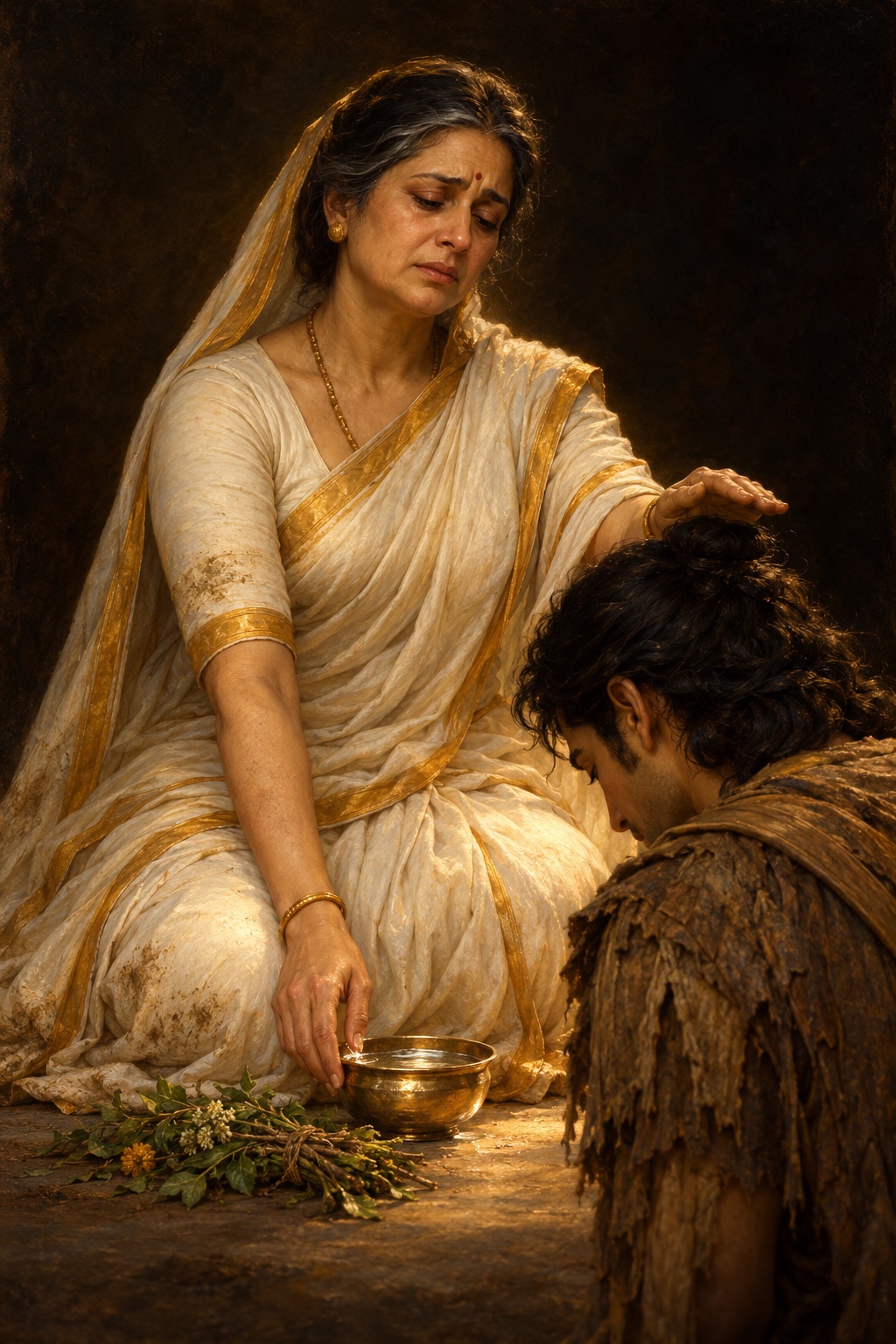
Griffith’s canto runs long past these two verses, and nearly all of it is protection. She calls on the gods and the stars, the mountains and the seas, Varuna the king, the sky and the wind to watch over him in the forest. She names what he must be kept from: the night-roving fiend, the lion, the tiger, the elephant and the bear, the scorpion and the creeping thing. She wishes on him the blessings that Indra had when Vritra was destroyed, and those that Vishnu had when he took his triple step. A Brahman lights the fire at her wish, and she sets out “oil, wreaths, fuel, mustard” for it herself. Then she sheds “Pure scent and grain upon his head”, and on his arm she binds “that prized herb whose sovereign power Preserves from dark misfortune’s hour”, “To be his faithful amulet”. All this time, Griffith says, she hides what she feels, “Concealing with obedient tongue The pangs with which her heart was wrung.” She walks round him, embraces him again and again, and he goes from her to Sita.
Turning on the king
The third scene comes after Rama has gone. He is in the forest with Lakshmana and Sita, and this time Kausalya speaks to her husband. In Griffith’s Canto LXI she asks the king how his sons will bear the wild “With Sita, all their care and pain”, and where Rama sleeps now, “by Lakshman’s side”. Then she asks when she will see his face.
पद्म वर्णम् सुकेश अन्तम् पद्म निह्श्वासम् उत्तमम् । कदा द्रक्ष्यामि रामस्य वदनम् पुष्कर ईक्षणम् ॥२-६१-८॥ वज्र सारमयम् नूनम् हृदयम् मे न सम्शयः । अपश्यन्त्या न तम् यद् वै फलति इदम् सहस्रधा ॥२-६१-९॥ यत्त्वया करुणम् कर्म व्यपोह्य मम बान्धवाः । निरस्ता परिधावन्ति सुखार्हः कृपणा वने ॥२-६१-१०॥
“When shall I see his flower-like eyes, And face that with the lotus vies, Feel his sweet lily breath, and view His glorious hair and lotus hue? The heart within my breast, I feel, Is adamant or hardest steel, Or, in a thousand fragments split, The loss of him had shattered it, When those I love, who should be blest, Are wandering in the wood distressed, Condemned their wretched lives to lead In exile, by thy ruthless deed” — Valmiki, Ramayana 2.61.8–10, tr. Griffith
The first verse is a mother’s catalogue of a face. वदनम्, the face, is पद्म वर्णम्, lotus-coloured, with fine hair, a breath like the lotus, and पुष्कर ईक्षणम्, lotus eyes, and the question over all of it is कदा द्रक्ष्यामि रामस्य, when shall I see Rama’s. The second verse comes back to the hard heart of her first lament. वज्र सारमयम् नूनम् हृदयम् मे: my heart must be made of the stuff of the thunderbolt, न सम्शयः, there is no doubt, because it does not burst into a thousand pieces, फलति इदम् सहस्रधा, when she cannot see him. The third verse says whose fault it is, and the word is त्वया, by you. Her kin, मम बान्धवाः, have been driven out, निरस्ता, and wander in the forest, fit for happiness and wretched, सुखार्हः कृपणा वने. Griffith gives the charge its full weight: “by thy ruthless deed”. In the twentieth sarga her grievance was the words of the co-wives. Here it is the deed of the king.
She does not stop there. She tells him that even when the fourteen years are over, Rama will not take back a kingdom another has used, “As tigers scorn another’s prey.” She ends on the three supports of a woman’s life, her husband, her son and her friends, and tells him that she has lost all three: “Thy heart, O King, I have not won; In wild woods roams my banished son; Far are my friends: ah, hapless me, Quite ruined and destroyed by thee.” In the next sarga, Griffith’s Canto LXII, Dasharatha answers her with joined hands, like a suppliant, and asks her not to speak one bitter word to a man already in distress. She takes his hands, lays them on her head, and asks his forgiveness: the wild words, she says, broke from her through grief. “The fifth long night has now begun Since the wild woods have lodged my son”. Her words ease him, and the king falls asleep.