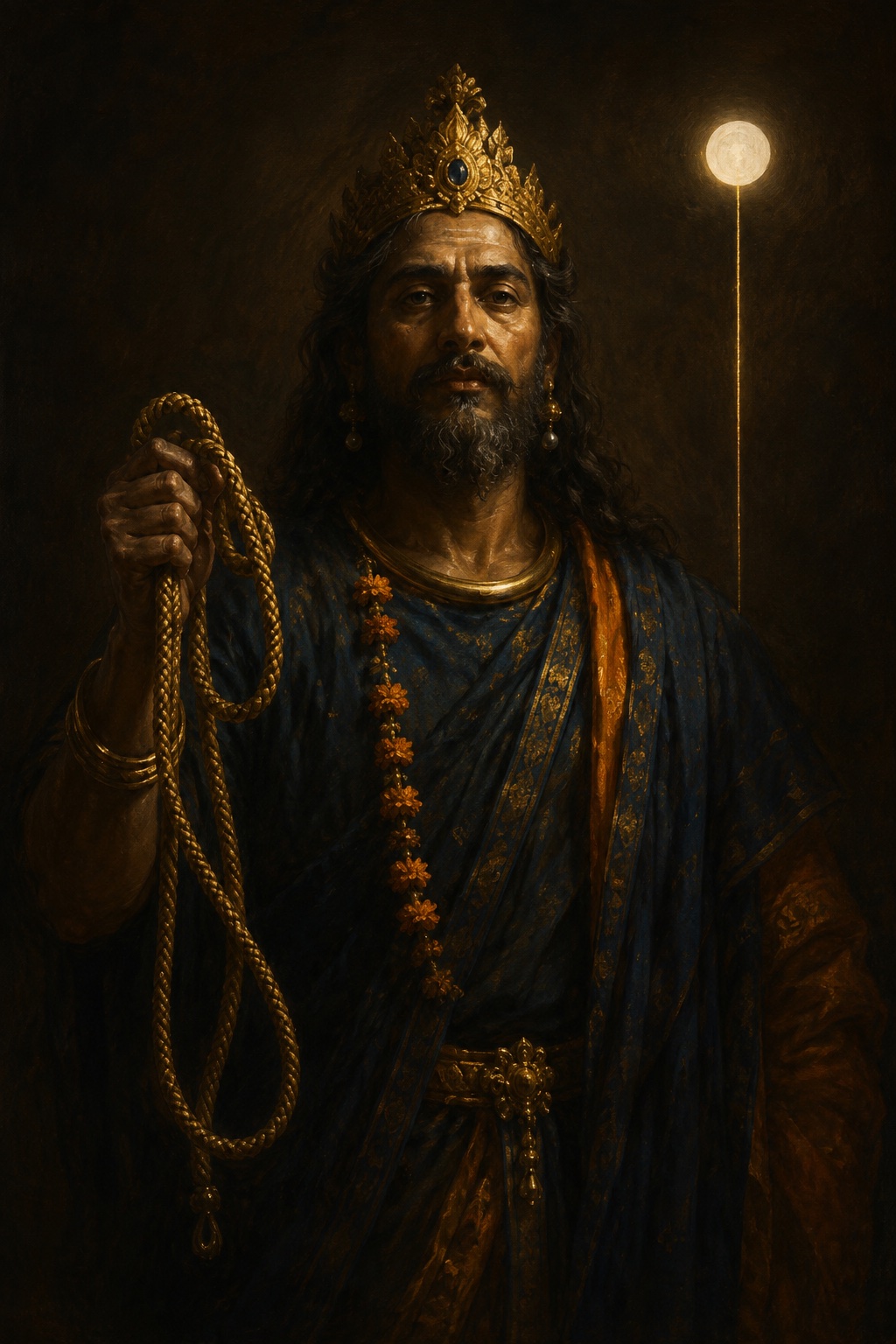
What he put where
The corpus has been naming Varuna without him for some time. Surya is called the eye of Mitra, Varuna and Agni; Vac says she holds Varuna and Mitra aloft. Both are quoting hymns in which Varuna is already the fixed point other gods are described against, and the hymn that says why is Rigveda 5.85, addressed to him alone.
It does not begin with a throne or a weapon. It begins with an inventory.
वनेषु व्यन्तरिक्षं ततान वाजमर्वत्सु पय उस्रियासु । हृत्सु क्रतुं वरुणो अप्स्वग्निं दिवि सूर्यमदधात्सोममद्रौ ॥२॥
“In the tree-tops the air he hath extended, put milk in kine and vigorous speed in horses, Set intellect in hearts, fire in the waters, Surya in heaven and Soma on the mountain.” — Rigveda 5.85.2, tr. Ralph T. H. Griffith
Read that as a list of placements and it is a strange one, because it does not sort itself into levels. Air in the treetops, milk in cows, speed in horses, intellect in hearts, fire in water, the sun in the sky, soma on the mountain: cosmology, husbandry and mind, in one breath, with no seam between them. The verb is the same for all seven. Varuna is not the god of the sky and the god of judgement by accident of accumulation — the hymn’s claim is that putting the sun where it goes and putting sense in a person’s chest are the same operation.
The sun as a measuring rod
The fifth verse names what that operation is, and it is the reason this god is hard to draw.
इमामू ष्वासुरस्य श्रुतस्य महीं मायां वरुणस्य प्र वोचम् । मानेनेव तस्थिवाँ अन्तरिक्षे वि यो ममे पृथिवीं सूर्येण ॥५॥
“I will declare this mighty deed of magic, of glorious Varuna the Lord Immortal, Who standing in the firmament hath meted the earth out with the Sun as with a measure.” — Rigveda 5.85.5, tr. Ralph T. H. Griffith
माया, the word Griffith renders “magic,” is not conjuring. In the Rigveda it is the power to make something be a certain way — craft, contrivance, the capacity to impose a form — and Varuna’s is a survey. He stands in the mid-air and measures the earth with the sun, मानेनेव, as with a measure. The sun in the sky is not his lamp; it is his rule, drawn across the ground.
That is what makes him the god of ऋत, the order, without needing a law-code. What he did to the world is measurement, so what a broken oath breaks is a measurement — an actual dimension of the world put out of true. It also explains the odd fact that the sun belongs to three gods at once. Surya is the eye of Mitra, Varuna and Agni because the thing they need him for is seeing, and seeing is how a surveyor checks his work.
The one god you apologise to
Rigveda 7.86 is the other half, and it is unlike anything else in the collection: eight verses of a man asking a god what he did wrong. Vasistha wants to know what the offence was, cannot get an answer, and eventually stops asking and starts pleading.
अव द्रुग्धानि पित्र्या सृजा नोऽव या वयं चकृमा तनूभिः । अव राजन्पशुतृपं न तायुं सृजा वत्सं न दाम्नो वसिष्ठम् ॥५॥
“Free us from sins committed by our fathers, from those wherein we have ourselves offended. O King, loose, like a thief who feeds the cattle, as from the cord a calf, set free Vasistha.” — Rigveda 7.86.5, tr. Ralph T. H. Griffith
The verb is अव सृज, loose, and it is repeated four times in four clauses. The image behind every one of them is a rope: the calf tethered away from the cow, the cattle-thief tied up, the inherited fault that is still knotted around a descendant. Varuna’s characteristic instrument in later texts is the पाश, the noose, and this is where it comes from — not a weapon he throws but the state a guilty person is already in.
Two things follow, and Indra never has to deal with either. First, sin here is heritable: the hymn asks to be freed from what the fathers did, alongside what the speaker did himself. Second, the god is not asked to forgive but to untie, which is a physical favour rather than a moral one. A god who made the world by measuring it can only be wronged by things going crooked, and the remedy for a crooked thing is slack in the rope, applied by the one who pulled it tight.