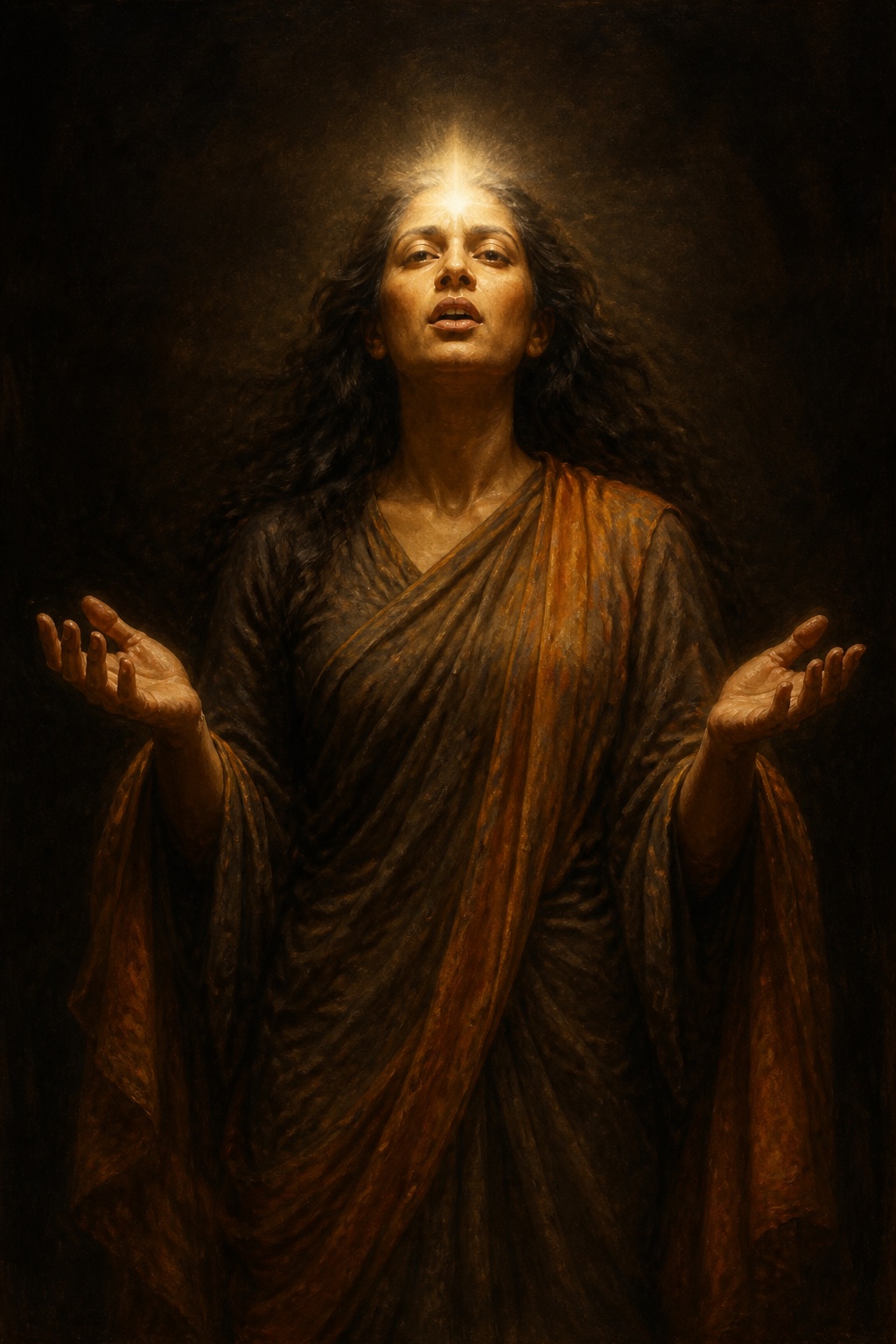
She who travels with the gods
The tenth book of the Rigveda holds a hymn spoken entirely in the first person by the goddess it describes — later tradition calls it the Devī Sūkta, though neither source page used in this entry prints that title. Vac (Vāc in scholarly transliteration, the Sanskrit word for speech) is not addressed by a poet here; she is the poet, and every claim in the hymn is her own.
अहं रुद्रेभिर्वसुभिश्चराम्यहमादित्यैरुत विश्वदेवैः । अहं मित्रावरुणोभा बिभर्म्यहमिन्द्राग्नी अहमश्विनोभा ॥१॥
“I TRAVEL with the Rudras and the Vasus, with the Adityas and All-Gods I wander. I hold aloft both Varuna and Mitra, Indra and Agni, and the Pair of Asvins.” — Rigveda 10.125.1, tr. Ralph T. H. Griffith
She opens by naming almost every rank the Rigveda gives its gods — the Rudras, the Vasus, the Adityas, the All-Gods — and says she travels and wanders among them all. Then the claim goes further: she does not merely accompany Varuna and Mitra, Indra and Agni, and the Asvin twins, she holds them aloft. Clause after clause in the verse opens with the same word, aham, “I” — the gods are named only as what she carries, never as the ones doing the carrying.
She who speaks, and makes the man she loves a sage
Later in the same hymn, Vac turns from the gods she carries to the word she herself utters, and to what that word does for the one man she chooses to love.
अहमेव स्वयमिदं वदामि जुष्टं देवेभिरुत मानुषेभिः । यं कामये तंतमुग्रं कृणोमि तं ब्रह्माणं तमृषिं तं सुमेधाम् ॥५॥
“I, verily, myself announce and utter the word that Gods and men alike shall welcome. I make the man I love exceeding mighty, make him a sage, a Rsi, and a Brahman.” — Rigveda 10.125.5, tr. Ralph T. H. Griffith
The word she utters here is the same word her own name is built from, and she says gods and men alike welcome it. What she gives whoever she loves is not a possession or a victory but a mind: he becomes exceeding mighty, then, in the same breath, a sage, a Rsi — a seer — and a Brahman, one who has mastered the sacred utterance. Nothing in this verse makes her patroness of writing or of music; what she is credited with here is turning an ordinary man into someone who can see truly and speak with authority.
Vac and Saraswati: a river and an utterance
Nowhere in her own hymn does Vac call herself a river, and nowhere does she name Saraswati. Saraswati’s own hymn is silent in exactly the same way about speech, eloquence, or the spoken word. The Rigveda keeps the two goddesses apart — one an utterance, the other a watercourse — and this wiki’s own entry on Saraswati says as much. Only in the Brahmanas and the Puranas that follow does Vac’s identity fold into Saraswati’s, and it is that later, merged goddess who is dressed in a vina, carried by a swan, and seated on a lotus. None of that iconography belongs to Vac’s own hymn: across its eight verses she is never given a robe, an ornament, or an object held in a hand, because the whole of it is delivered as her own first-person voice rather than a scene a poet describes from outside.