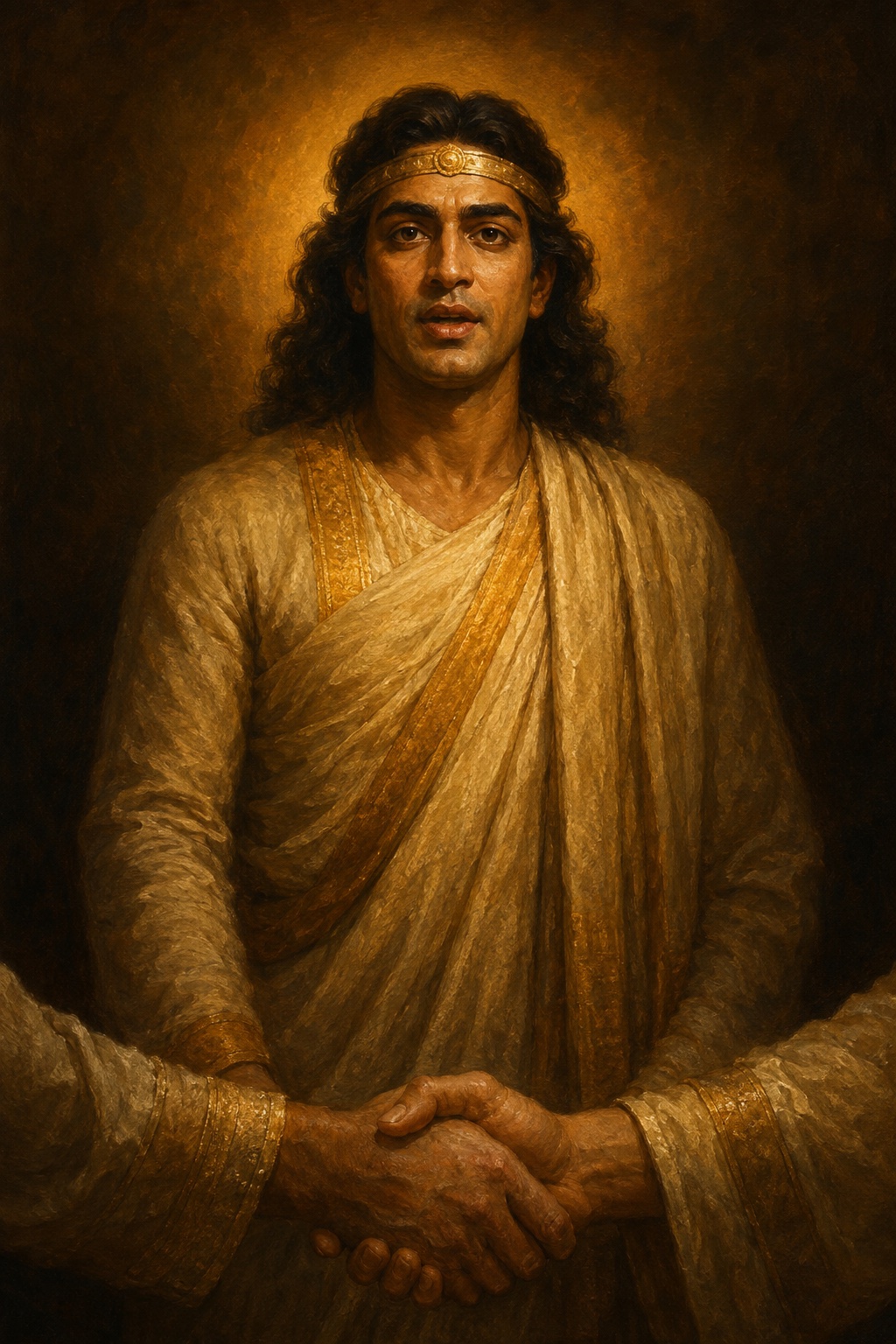
He who speaks, and thereby joins
The Rigveda addresses exactly one hymn to Mitra alone, 3.59, and it opens with what he does rather than what he owns.
मित्रो जनान्यातयति ब्रुवाणो मित्रो दाधार पृथिवीमुत द्याम् । मित्रः कृष्टीरनिमिषाभि चष्टे मित्राय हव्यं घृतवज्जुहोत ॥१॥
“MITRA, when speaking, stirreth men to labour: Mitra sustaineth both the earth and heaven. Mitra beholdeth men with eyes that close not. To Mitra bring, with holy oil, oblation.” — Rigveda 3.59.1, tr. R. T. H. Griffith
Mitra, in one case-form or another, opens all four clauses of the verse — मित्रो, मित्रो, मित्रः, मित्राय — a repetition Griffith’s own line keeps rather than smooths away. Speaking, ब्रुवाणः, is the first and only recorded act; the same breath sustains earth and heaven, दाधार, and watches the tribes, कृष्टीः, with an eye अनिमिषा, unwinking. No rod is named for the sustaining, no weapon for the watching — the verse gives him verbs, not equipment. Only the last clause turns from claim to instruction: bring Mitra his हव्यम्, the oblation, घृतवत्, mixed with ghee.
An eye of his own, next to a sun three gods borrow
This wiki’s Surya is addressed in a separate hymn, RV 1.115, where the rising sun is named the sight of Mitra, Varuna and Agni at once — three gods who are said to watch through him rather than through eyes of their own. RV 3.59 keeps Mitra’s own eye apart from that shared one: अनिमिषा अभि चष्टे, he himself watches the tribes, with no sun and no other god credited as the means. Vac’s own hymn, 10.125, draws the two names together a third way, naming Mitra beside Varuna among the gods she claims to carry, alongside Indra, Agni and the Asvin twins. RV 3.59 never once says Varuna’s name — the hymn belongs to Mitra alone — but the rest of this corpus keeps pairing them, and it is that older habit, not anything in his own hymn, that this entry’s counterpart relation records.
Aditya, and the ordinance that keeps its keeper
The second verse turns from what Mitra does to what he shields, and gives him, in the hymn’s own address, the name the rest of the tradition uses for his rank.
प्र स मित्र मर्तो अस्तु प्रयस्वान्यस्त आदित्य शिक्षति व्रतेन । न हन्यते न जीयते त्वोतो नैनमंहो अश्नोत्यन्तितो न दूरात् ॥२॥
“Foremost be he who brings thee food, O Mitra, who strives to keep thy sacred Law, Aditya. He whom thou helpest ne’er is slain or conquered, on him, from near or far, falls no affliction.” — Rigveda 3.59.2, tr. R. T. H. Griffith
आदित्य, Aditya, son of Aditi, is spoken here as a direct address to Mitra, not attached to him afterward by a commentator’s list. व्रतेन, by the ordinance, is what the mortal keeps, and the reward for keeping it is stated twice, in matching negatives: न हन्यते न जीयते, not slain, not overcome, and then न एनम् अंहः अश्नोति अन्तितो न दूरात्, no affliction reaches him, near or far. The hymn does not say what breaking the ordinance costs. Both verses stop at what keeping it is worth.