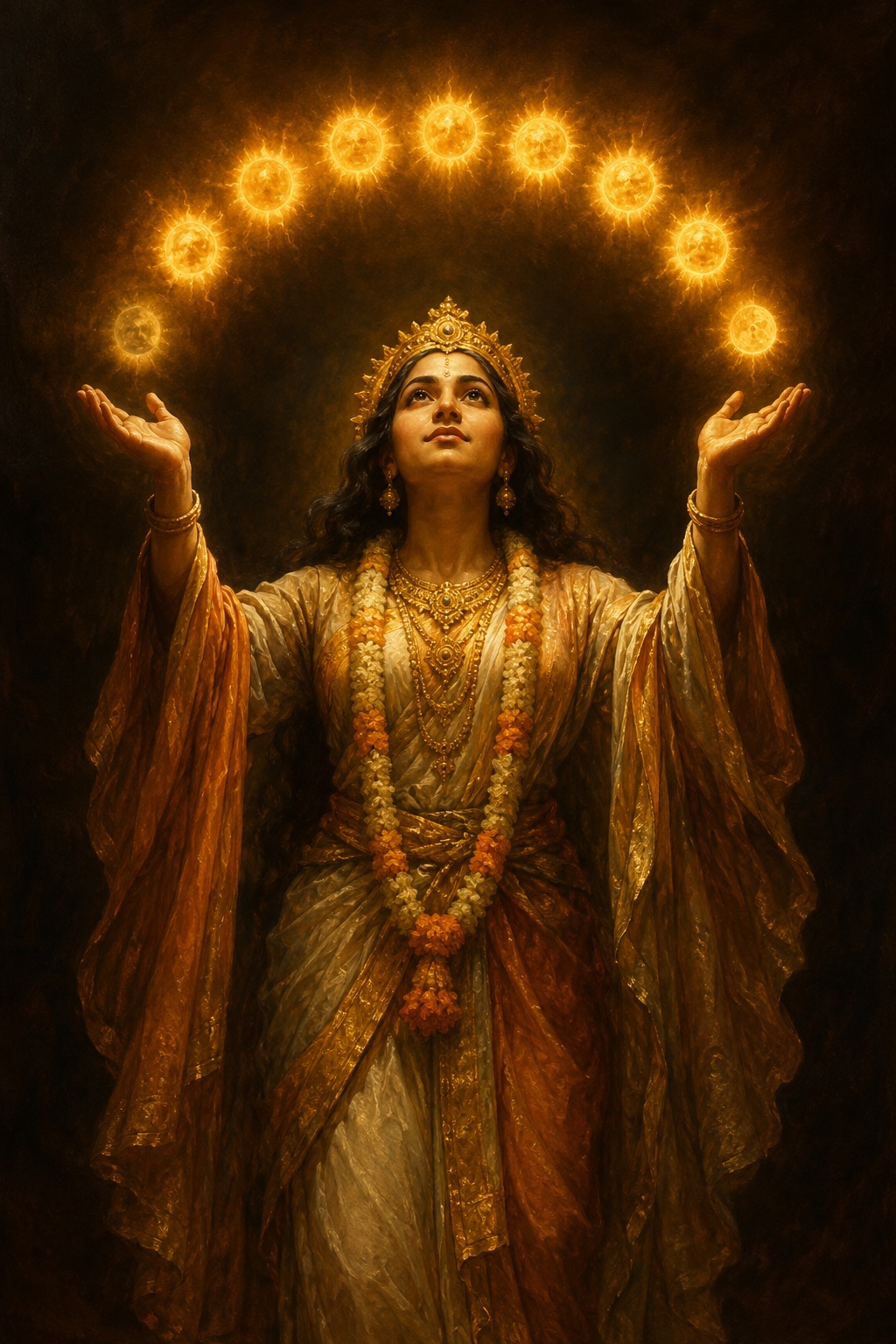
Eight sons, and seven kept
The hymn that tells her story is a creation hymn, and it is unusually blunt about arithmetic.
अष्टौ पुत्रासो अदितेर्ये जातास्तन्वस्परि । देवाँ उप प्रैत्सप्तभिः परा मार्ताण्डमास्यत् ॥८॥
“Eight are the Sons of Aditi who from her body sprang to life. With seven she went to meet the Gods she cast Martanda far away.” — Rigveda 10.72.8, tr. R. T. H. Griffith
Eight are born; seven are carried to the assembly of the gods; the eighth is thrown away. मार्ताण्ड, Martanda, is built from words for death and egg — the dead egg, the addled one — and the verse gives no reason for the discard beyond the name. The next verse brings him back: she fetches him “thitherward to spring to life and die again”, which is a description of a sun. What the hymn is explaining, in the flat voice of a genealogy, is why the thing in the sky is born every morning and dies every evening while the other seven immortals do not.
Nothing in the passage is a praise formula. She bears, she carries, she casts away, she brings back; four verbs, all hers, and the gods appear only as the party she is walking toward.
Born of her own son
The same hymn puts her at the point where a creation account gives up on sequence.
अदितेर्दक्षो अजायत दक्षाद्वदितिः परि ॥४॥
“Daksa was born of Aditi, and Aditi was Daksa’s Child.” — Rigveda 10.72.4, tr. R. T. H. Griffith
Daksha is skill, or ritual competence, personified. The verse says each produced the other, and the verse after it says it again from Daksha’s side — “For Aditi, O Daksa, she who is thy Daughter, was brought forth. After her were the blessed Gods born” — so this is not a slip that survived transmission. It is the hymn refusing to put a first term at the front of its own list. The wiki’s Brahma, Pangu and Nyx entries all begin from something; this one begins from a loop, and treats the loop as an answer rather than a problem.
Aditi is the heaven
The most quoted line about her is not from a story at all. It is a single verse closing a hymn to all the gods, and it enumerates what she is until the enumeration has swallowed everything.
अदितिर्द्यौरदितिरन्तरिक्षमदितिर्माता स पिता स पुत्रः । विश्वे देवा अदितिः पञ्च जना अदितिर्जातमदितिर्जनित्वम् ॥१०॥
“Aditi is the heaven, Aditi is mid-air, Aditi is the Mother and the Sire and Son. Aditi is all Gods, Aditi five-classed men, Aditi all that hath been born and shall be born.” — Rigveda 1.89.10, tr. R. T. H. Griffith
Her name means the unbound — diti is binding or limit, and the a- takes it away — and this verse is what that abstraction does when a poet uses it. She is not the goddess of boundlessness. She is the sky, then the air, then the three positions in a family at once, then the whole pantheon, then the five peoples, then everything already born and everything still to be. The Vedic gods are addressed as persons who receive offerings and act; this one is addressed as a category that has no outside.
Both halves are true of her simultaneously, which is why she is difficult to picture and easy to invoke. The corpus has other deities who are called mothers, and none of them is also the mid-air.
The mother this wiki already had
Aditi has been in these pages since the first batch without an entry: Indra’s entry names her as his mother and nothing else here linked to her. The Adityas are named for her — the sons of Aditi — and three of them already have entries of their own.
The hymn itself never lists the eight. Sayana’s commentary on it supplies a list from the Taittiriya Aranyaka: Mitra, Varuna, Dhatr, Aryaman, Amsha, Bhaga, Vivasvat and the Aditya. Varuna and Vivasvat are in this wiki, and so, through Martanda, is the sun. Indra is not on that list, and the claim that he is her son belongs to the wider tradition rather than to this hymn — but it is the claim this wiki’s own Indra entry makes, and it is recorded here as it stands rather than quietly corrected in either direction.