Pangu is the first thing that is not chaos — and he is a latecomer. No oracle bone names him, no Zhou classic, no Han philosopher. He surfaces in the third century AD, in a lost book by Xu Zheng called the Sanwu Liji, which survives only because Tang and Song encyclopedists copied pieces of it into their compendia. What they copied is an entire cosmogony in about ninety characters:
天地渾沌如雞子,盤古生其中,萬八千歲。天地開闢,陽清為天,陰濁為地,盤古在其中,一日九變,神於天,聖於地。天日高一丈,地日厚一丈,盤古日長一丈。
“Heaven and earth were a murky blend, like a hen’s egg, and Pangu was born inside it — eighteen thousand years. Heaven and earth broke open: the clear yang became the sky, the turbid yin became the earth. Pangu stood between them, nine times transformed in a day, godlike in heaven and sagelike on earth. Each day the sky rose ten feet higher, the earth grew ten feet thicker, and Pangu grew ten feet taller.” — Xu Zheng, Sanwu Liji, in Taiping Yulan 2; tr. Mythos Atlas
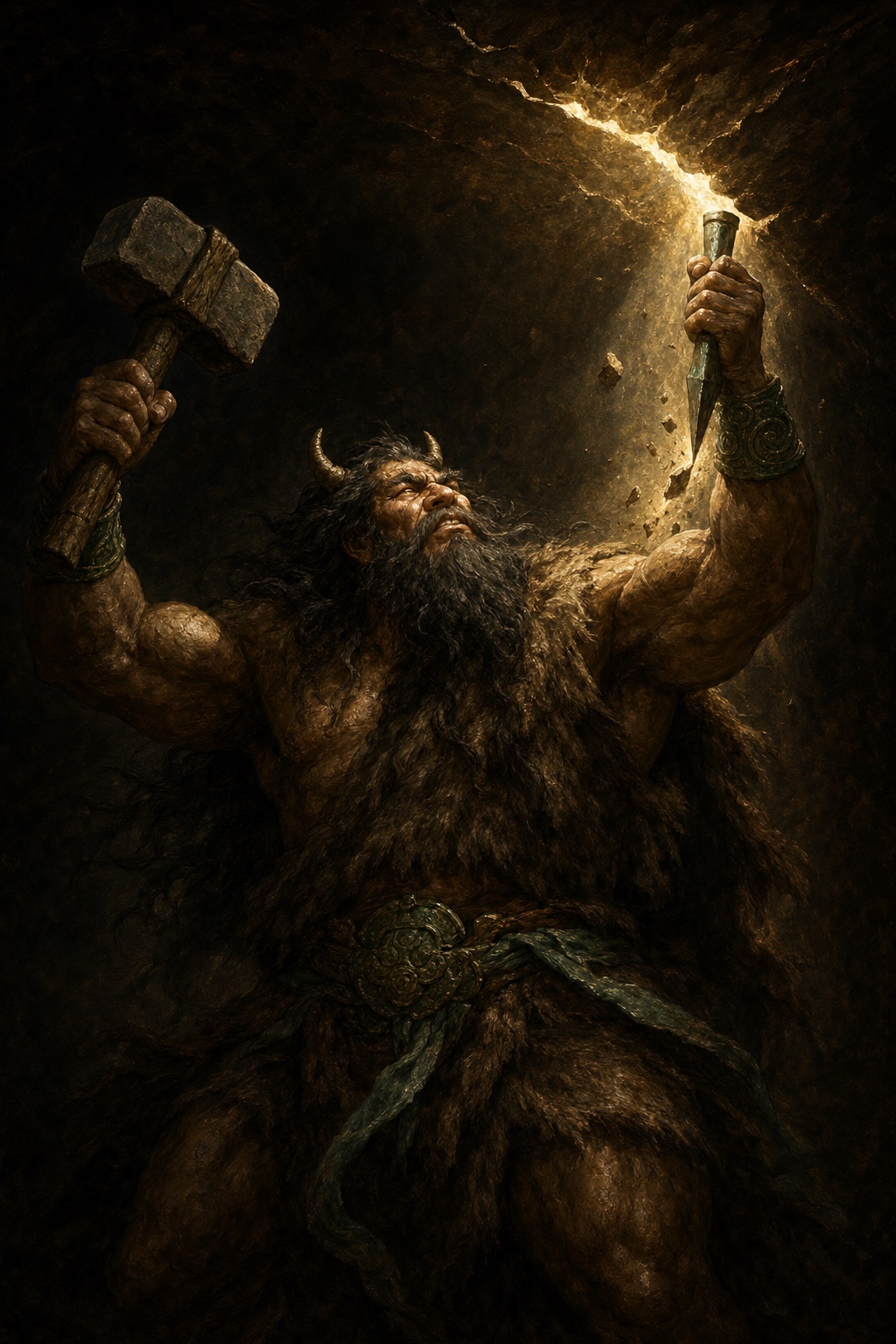
Notice what he does not do. He does not command the separation, or will it, or speak it. He grows, and the growing is the separation — the sky is high because for eighteen thousand years somebody stood underneath it getting taller. Creation here is not an act but a physiology.
Then the work kills him, and this is the part that matters: he does not rule what he has made, he becomes it. The transformation is preserved in a Daoist treatise on primordial breath, copied into the eleventh-century Yunji Qiqian.
首生盤古,垂死化身,氣成風雲,聲為雷霆,左眼為日,右眼為月,四肢五體為四極五岳,血液為江河,筋脈為地里,肌肉為田土,發髭為星辰,皮毛為草木,齒骨為金石,精髓為珠玉,汗流為雨澤。身之諸蟲,因風所感,化為黎甿。
“First was born Pangu, who at the point of death transformed his body. His breath became the wind and clouds, his voice the thunder. His left eye became the sun, his right eye the moon. His four limbs and five extremities became the four poles and the five sacred peaks; his blood the rivers, his sinews the lie of the land, his flesh the fields and soil, his hair and beard the stars, his skin and body-hair the grasses and trees, his teeth and bones the metals and stones, his marrow pearl and jade, his running sweat the rain. And the creatures crawling on his body, stirred by the wind, became the black-haired people.” — Yuanqi Lun, in Yunji Qiqian 56; tr. Mythos Atlas
The last clause is the sting. In a mythology that will spend the next several thousand years sorting gods into ranks and offices, humanity enters the world as vermin on a corpse — 黎甿, the black-haired commonfolk, condensed out of parasites by a passing breeze.
A rival account in the Wuyun Linian Ji refuses the whole shape of that story. There Pangu has a dragon’s head and a serpent’s body, and the world answers his moods rather than his remains: 「噓為風雨,吹為雷電,開目為晝,閉目為夜」 — he breathes out and it is wind and rain, he blows and it is thunder and lightning, he opens his eyes and it is day, he closes them and it is night. Not a corpse quarried into landscape but a living body the cosmos runs on.
The tradition never chose between them, and that is itself the evidence: Pangu was assembled late, out of whatever was to hand, to answer a question the older texts had simply never asked. Nothing in the Chinese pantheon inherits authority from him. He is spent entirely in the making, and the celestial bureaucracy that follows has to be built from nothing by other hands.