Quickened in the void
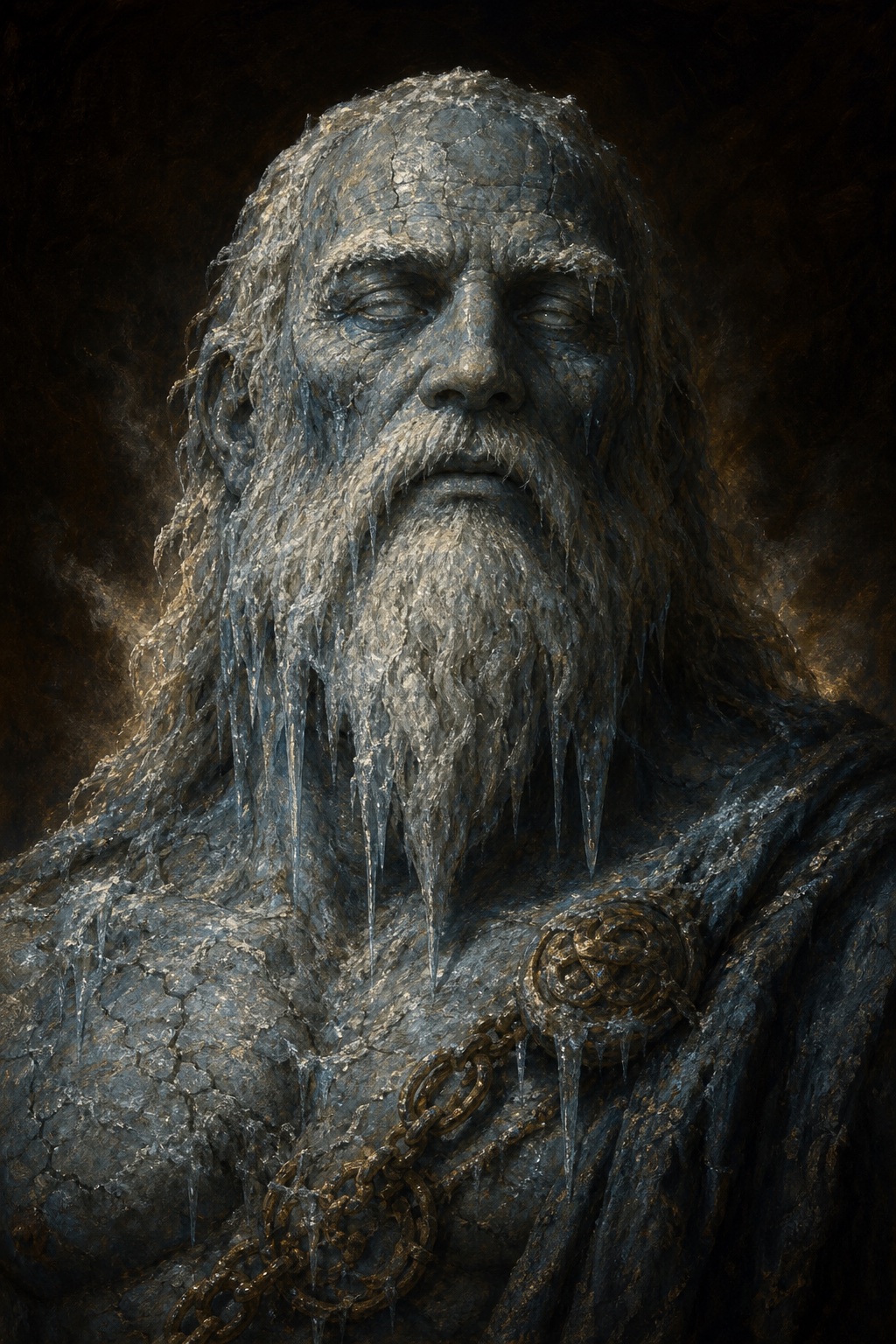
Before there are gods, or giants, or a world for either to stand on, there is only Ginnungagap, the yawning gap between two extremes. Niflheim’s cold and mist lie to one side; an answering heat presses in from the other. Where the two meet, the rime begins to melt and drip, and out of the falling drops — warmed by the very heat that is causing them to fall — life stirs and takes the shape of a man. That man is Ymir, first of all beings, older than the gods who will eventually kill him and older than the race of giants who will spring from his own body. He does nothing to bring himself into existence; he simply forms, the way frost forms overnight, and the rest of his short existence keeps the same character. Even his food is given rather than earned: the same melting rime licks itself into the shape of a cow, Auðumla, and four rivers of milk run from her udders to nurse the giant she has, in effect, come into being alongside.
Giants sprung unasked
Ymir is solitary and yet endlessly generative, and this is presented as plain physiology rather than as any act of his. While he sleeps, sweat gathers beneath one arm, and out of it grow a son and a daughter — the first pair of the jötnar, the frost-giants. One of his own legs, without any partner at all, begets a son on the other. None of it is willed, and none of it is even witnessed by the one it happens to; Ymir sleeps through the beginning of an entire people. It is this scene, more than any single deed, that makes him the root of the giants who go on to fill the rest of Norse myth as raiders, rivals, and in-laws of the Æsir themselves.
Slain by the sons of Borr
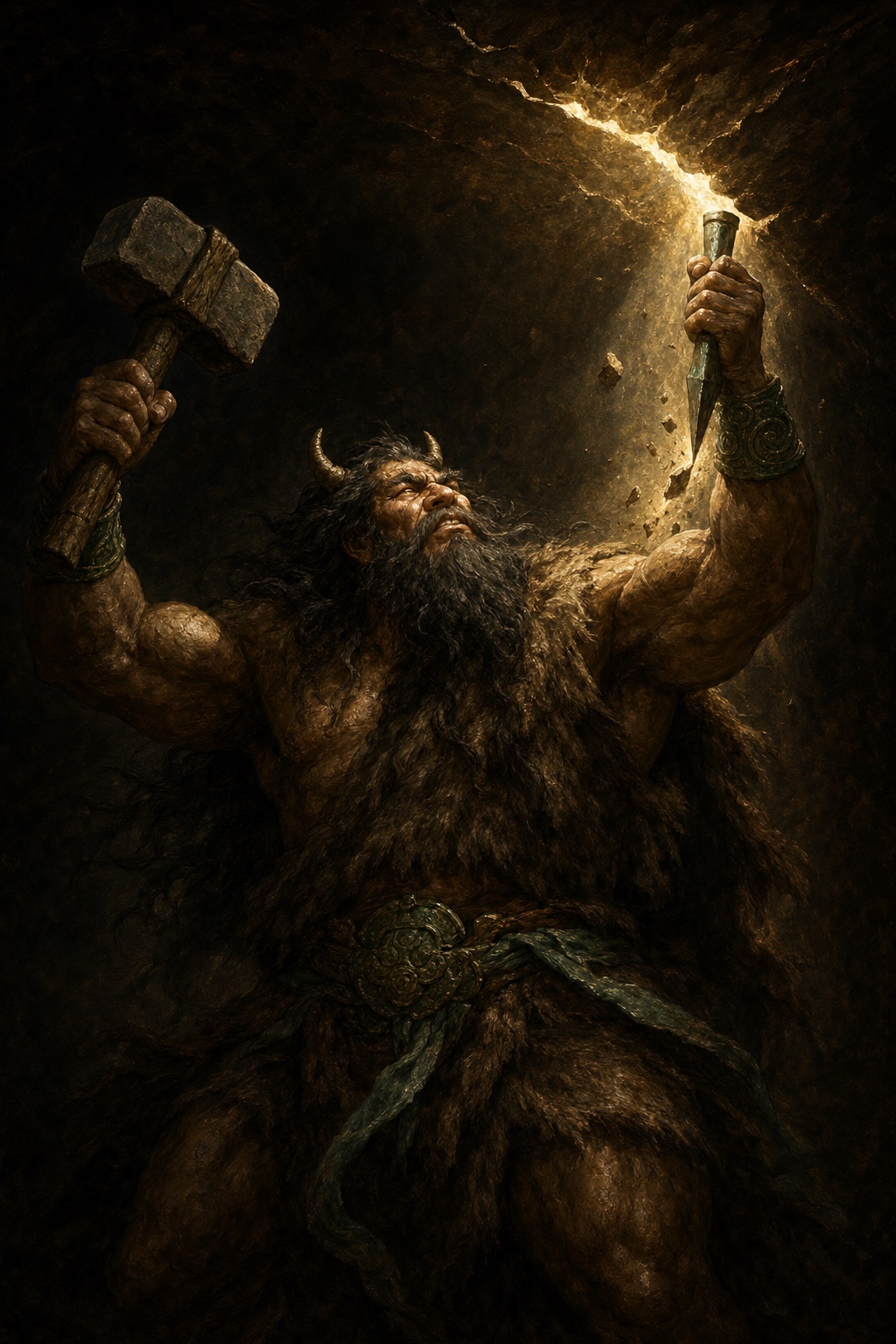
Bestla, the giantess who will bear Odin, Vili, and Vé to her husband Borr, is herself of giant stock — kin, at some remove, to the very sweat-born pair Ymir produced without meaning to. It is this generation that finally turns on him. Snorri gives the killing itself a single sentence and lets the aftermath carry the scale of it: where Ymir falls, blood pours from his wounds in a flood large enough to drown the entire race of frost-giants sprung from him. The sons of Borr do not stop at killing him. They drag the body to the middle of Ginnungagap and set about building a world out of it — which is the one passage in this entry actually quoted rather than retold.
The world built from his corpse
Grímnismál reaches its cosmogony in a single stanza, part of Odin’s own survey of the nine worlds, which names Ymir outright and runs through his body in order — flesh, blood, bones, hair, skull.
Ór Ymis holdi var jörð of sköpuð, en ór sveita sær, björg ór beinum, baðmr ór hári, en ór hausi himinn.
“Out of Ymir’s flesh was fashioned the earth, And the ocean out of his blood; Of his bones the hills, of his hair the trees, Of his skull the heavens high.” — Grímnismál 40, tr. Bellows
Snorri quotes this same stanza inside his own prose retelling of the world’s construction, and there the translator renders the same ambiguous word, sveiti, not as blood but as sweat for the sea — a difference between the two English versions, not a disagreement in the Norse, since the word carries both senses. What both agree on, clause for clause, is the method: nothing about Ymir is cleared away to make room for a world. The sons of Borr turn the body itself into the world, part answering to part — flesh into soil, bones into hills, hair into forest, skull into sky — without remainder. Chinese myth reaches the same shape from an entirely unrelated direction: Pangu’s corpse is quarried into landscape in almost the same order, flesh to soil and blood to rivers, bones to mountains, hair to trees. Ymir supplies his world exactly as he supplied everything else in his short existence — without ever willing it, purely by being taken apart.