Highest and eldest
In Snorri’s Gylfaginning, Odin is the highest and eldest of the Æsir, and he rules all things. The other gods are mighty too, but they all serve him the way children obey a father.
Óðinn er æðstr ok elztr ásanna. Hann ræðr öllum hlutum, ok svá sem önnur goðin eru máttug, þá þjóna honum öll svá sem börn föður
“Odin is highest and eldest of the Æsir: he rules all things, and mighty as are the other gods, they all serve him as children obey a father” — Snorri Sturluson, Gylfaginning 20, tr. A. G. Brodeur
Odin was one of three sons of Borr and Bestla, the daughter of the giant Bölthorn, and his brothers were Vili and Vé. His wife was Frigg, the daughter of Fjörgvinn. Earth was both his daughter and his wife, and on her he begot his first son, Thor. Snorri explains the name Allfather: Odin is father of all the gods and of men, and of everything that came about through him and his might. In the Old Norse of chapter 20 the name is Alföðr, and the chapter gives the reason in one clause: he is the father of all the gods.
He also has a seat to rule from. It is the high-seat called Hlidskjálf, and whenever Allfather sits in it he surveys all lands. Snorri describes it a second time as well. From that seat, he says, Allfather looked out over the whole world, saw every man’s acts, and knew everything he saw.
The pledged eye
Under the root that turns toward the Rime-Giants lies Mímir’s well, where wisdom and understanding are stored. Mímir, who keeps the well, is full of ancient lore because he drinks from it out of the Gjallar-Horn. Allfather came there and asked for a single drink, and he did not get it until he had laid his eye in pledge.
En undir þeiri rót, er til hrímþursa horfir, þar er Mímisbrunnr, er spekð ok mannvit er í fólgit, ok heitir sá Mímir, er á brunninn. Hann er fullr af vísendum, fyrir því at hann drekkr ór brunninum af horninu Gjallarhorni. Þar kom Alföðr ok beiddist eins drykkjar af brunninum, en hann fekk eigi, fyrr en hann lagði auga sitt at veði
“But under that root which turns toward the Rime-Giants is Mímir’s Well, wherein wisdom and understanding are stored; and he is called Mímir, who keeps the well. He is full of ancient lore, since he drinks of the well from the Gjallar-Horn. Thither came Allfather and craved one drink of the well; but he got it not until he had laid his eye in pledge” — Snorri Sturluson, Gylfaginning 15, tr. A. G. Brodeur
Snorri does not use the name Odin in this sentence. The visitor is Alföðr, the Allfather of chapter 20. The price is one drink for one eye: the Old Norse says he laid auga sitt at veði, his eye as a pledge.
Nine nights on the windy tree
In Hávamál, Odin tells of his own sacrifice in the first person. He hung on a windy tree for nine full nights, wounded with a spear. He was offered to Odin, himself to himself, on a tree whose roots no one knows.
Veit ek, at ek hekk vindga meiði á nætr allar níu, geiri undaðr ok gefinn Óðni, sjalfr sjalfum mér, á þeim meiði, er manngi veit hvers af rótum renn
“I ween that I hung on the windy tree, / Hung there for nights full nine; / With the spear I was wounded, and offered I was / To Othin, myself to myself, / On the tree that none may ever know / What root beneath it runs.” — Hávamál 139, tr. Bellows
The poem does not name the tree. Bellows’s note does: he identifies the windy tree as the ash Yggdrasil, and says that Odin hanged himself there as an offering to himself in order to win the magic runes, and wounded himself with his own spear. The Old Norse text numbers this stanza 138, one lower than Bellows. In the next stanza, Bellows’s 140, no one comforts him with loaf or horn. He looks down, takes up the runes, shrieking as he takes them, and falls back.
Snorri’s list of Odin’s names in Gylfaginning 20 includes Hangaguð, which Brodeur translates as God of the Hanged.
Ravens, wolves and the slain
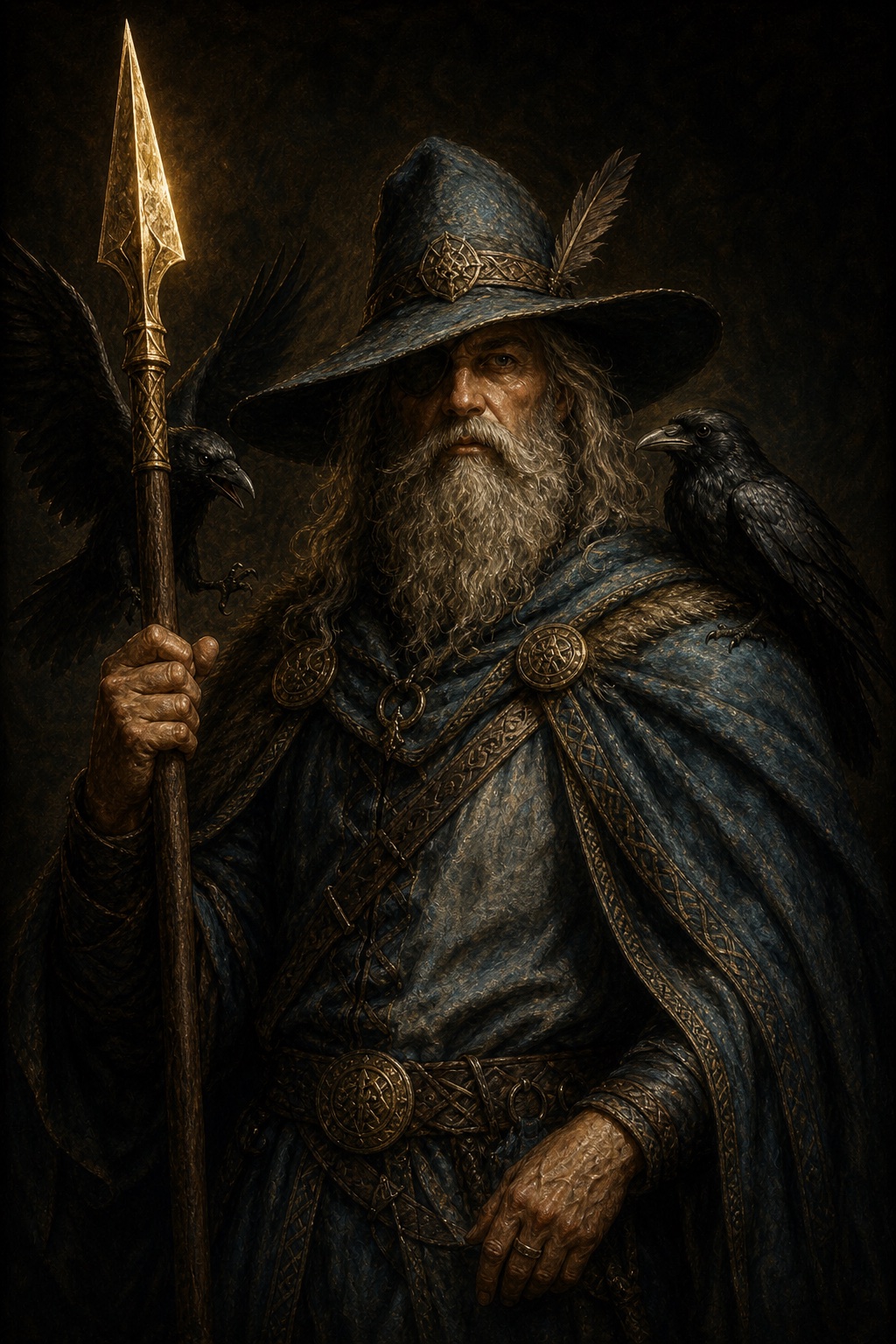
Two ravens sit on Odin’s shoulders and speak into his ear all the news they see or hear. Their names are Huginn and Muninn. He sends them out at daybreak to fly over all the world, and they come back at undern-meal, so he learns a great deal of news. For this reason men call him Hrafnaguð, the Raven-God.
Hrafnar tveir sitja á öxlum honum ok segja í eyru honum öll tíðendi, þau er þeir sjá eða heyra. Þeir heita svá, Huginn ok Muninn. Þá sendir hann í dagan at fljúga um heim allan, ok koma þeir aftr at dögurðarmáli. Þar af verðr hann margra tíðenda víss. Því kalla menn hann Hrafnaguð
“The ravens sit on his shoulders and say into his ear all the tidings which they see or hear; they are called thus: Huginn and Muninn. He sends them at day-break to fly about all the world, and they come back at undern-meal; thus he is acquainted with many tidings. Therefore men call him Raven-God” — Snorri Sturluson, Gylfaginning 38, tr. A. G. Brodeur
Snorri also tells how Odin feeds his wolves. He gives the food on his table to his two wolves, Geri and Freki. He needs no food himself, because wine is both food and drink to him. Sleipnir, the horse Odin has, is the best, Snorri says, and it has eight feet.
The dead of battle belong to him as well. He is called Valföðr, Father of the Slain, because everyone who falls in battle is his adopted son. He gives them Valhalla and Vingólf, and there they are called einherjar. The same list goes on with more names, which Brodeur gives as God of Gods and God of Cargoes.
The wolf
At Ragnarök the Æsir put on their war-gear, and all the einherjar with them, and they advance to the field. Odin rides first, with a gold helmet, a fair mail-coat and his spear, which is called Gungnir. He goes out against Fenrir. The prophecies had already said that Fenrir would be the slayer of Odin, and so it happens: the Wolf swallows Odin, and that is his death. The Old Norse sentence is three words long, Úlfrinn gleypir Óðin.
Þá kemr Hlínar harmr annarr fram, er Óðinn ferr við ulf vega, en bani Belja bjartr at Surti; þá mun Friggjar falla angan
“Now comes to Hlin yet another hurt, / When Othin fares to fight with the wolf, / And Beli’s fair slayer seeks out Surt, / For there must fall the joy of Frigg” — Völuspá 53, tr. H. A. Bellows
Völuspá tells the same end as a second grief. Odin’s fight with the wolf is another hurt that comes to Hlín, and the stanza ends with the fall of the joy of Frigg.
The revenge comes at once. In the next stanza Víðarr, whom the poem calls Sigfather’s mighty son, comes to fight the wolf. He drives his sword to its heart, and his father is avenged. Snorri’s prose says the same thing in its own way: straight after Odin’s death, Víðarr strides forward and sets one foot on the Wolf’s lower jaw.