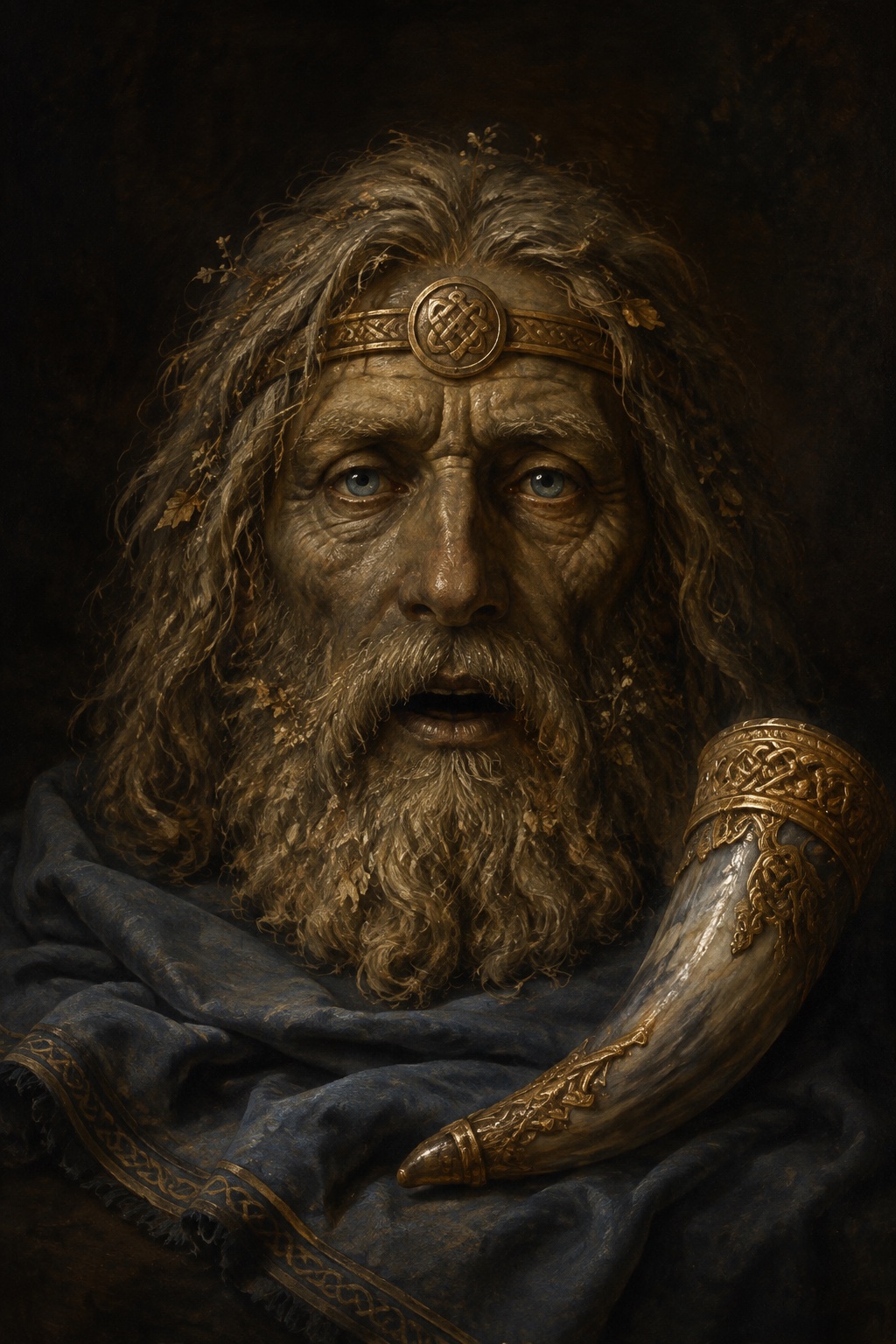
The wisest man they had
The Æsir and the Vanir ended their war by exchanging men. The Vanir handed over Njörðr and his son Freyr; the Æsir sent Hœnir the other way, a big man and the handsomest of them, whom the Vanir made a chief the day he arrived. One clause of the same sentence introduces the man sent with him, and it is the only description of Mímir anywhere in the saga.
Með honum sendu Æsir þann er Mímir hét, hann var hinn vitrasti maðr
“and with him they sent a man of great understanding called Mimir” — Snorri Sturluson, Ynglinga saga 4, tr. Samuel Laing
Hinn vitrasti maðr is a superlative — the wisest man — and Laing flattens it into a compliment. Take the register as it stands. Snorri is writing the gods as early kings of men, and Mímir is a man in that sense and in no other; no text quoted on this page calls him a giant, and none gives him a father, a hall, a wife or a byname. What he is given instead is a function, and the function belongs to somebody else’s office.
That office was Hœnir’s. Mímir kendi honum ráð öll, Mímir taught him all counsel, and Hœnir presided impressively for as long as Mímir stood beside him. When Mímir was not near, every hard question got the same answer: let others give their advice. The Vanir concluded they had been cheated in the exchange of men, and they did not send the pair back.
þá tóku þeir Mími ok hálshjoggu ok sendu höfuðit Ásum
“They took Mimir, therefore, and beheaded him, and sent his head to the Asaland people” — Snorri Sturluson, Ynglinga saga 4, tr. Samuel Laing
The Old Norse begins in lower case because the page’s semicolon leaves it there, and the clause is the whole of his death. There is no fight in it, no accusation against him, no defence, and no reason that has anything to do with anything he did. He is killed for a silence that was not his, and the head is posted back to the people who supplied it, the way a returned invoice is posted back.
The head that goes on answering
A head sent home as an insult is normally where a figure stops. Here it is where he becomes useful. The chapter does not end at the beheading; its next sentence is Odin’s work on the object, and both languages put that work in chapter 4, immediately after the killing, not in the later chapter where the head is already in service.
Óðinn tók höfuðit ok smurði urtum, þeim er eigi mátti fúna, ok kvað þar yfir galdra, ok magnaði svá, at þat mælti við hann ok sagði honum marga leynda hluti
“Odin took the head, smeared it with herbs so that it should not rot, and sang incantations over it. Thereby he gave it the power that it spoke to him, and discovered to him many secrets” — Snorri Sturluson, Ynglinga saga 4, tr. Samuel Laing
Two operations, in order, and only the second of them is magic. The herbs are a preservative, þeim er eigi mátti fúna, of the kind that could not rot, and they do an embalmer’s work on a piece of meat. The galdrar sung over it afterwards are what make it talk. Snorri keeps the two apart and this entry follows him: the head is one thing and the herbs that hold it are another.
What the head then delivers is precisely what Mímir delivered alive. Marga leynda hluti, many hidden things — counsel to Hœnir before, secrets to Odin now, and the only change in him is that he has become portable. Three chapters on, the saga says as much in a single sentence and never returns to it.
Óðinn hafði með sér höfuð Mímis, ok sagði þat honum mörg tíðindi or öðrum heimum
“Odin carried with him Mimir’s head, which told him all the news of other countries” — Snorri Sturluson, Ynglinga saga 7, tr. Samuel Laing
Or öðrum heimum is from other worlds. Laing gives “other countries”, which is the same euhemerising register that turned the wisest of the Æsir into a man of great understanding: in his Heimskringla the nine worlds are provinces and the gods are chieftains with good advisers. The page prints or where an edited text would print ór, and the quotation keeps what the page prints. Under either register the point is the same — the head goes where its owner cannot and comes back with the news.
The well under the root
A second body of text has a Mímir who was never a hostage and is never beheaded. He lives under the World Tree, and he owns the water.
En undir þeiri rót, er til hrímþursa horfir, þar er Mímisbrunnr, er spekð ok mannvit er í fólgit, ok heitir sá Mímir, er á brunninn. Hann er fullr af vísendum, fyrir því at hann drekkr ór brunninum af horninu Gjallarhorni. Þar kom Alföðr ok beiddist eins drykkjar af brunninum, en hann fekk eigi, fyrr en hann lagði auga sitt at veði
“But under that root which turns toward the Rime-Giants is Mímir’s Well, wherein wisdom and understanding are stored; and he is called Mímir, who keeps the well. He is full of ancient lore, since he drinks of the well from the Gjallar-Horn. Thither came Allfather and craved one drink of the well; but he got it not until he had laid his eye in pledge” — Snorri Sturluson, Gylfaginning 15, tr. A. G. Brodeur
The relation is ownership: heitir sá Mímir, er á brunninn, he is called Mímir, who has the well. Even here the wisdom is not innate but drawn — he is full of lore fyrir því at, because, he drinks. And the eye in the last clause is not his. Nothing in any source describes Mímir as one-eyed; the single eye in this story belongs to the visitor, who pays it over, and the well is what keeps it.
The horn is worth a pause, because one name covers two different objects inside the same book. Mímir’s drinking vessel here is horninu Gjallarhorni, Brodeur’s Gjallar-Horn. Later in the same work the trumpet whose blast is heard through all the worlds is also called Gjallarhorn, and that one is Heimdall’s. Snorri neither remarks on the collision nor merges the objects, and neither does this wiki: the symbol is filed where the trumpet is, and Mímir keeps the drink.
Allt veit ek, Óðinn, hvar þú auga falt, í inum mæra Mímisbrunni. Drekkr mjöð Mímir morgun hverjan af veði Valföðrs
“I know where Othin’s eye is hidden, / Deep in the wide-famed well of Mimir; / Mead from the pledge of Othin each morn / Does Mimir drink” — Völuspá 28 (Bellows numbers it 29), tr. H. A. Bellows
The seeress says this to Odin’s face, and it is a demonstration as much as a report: she knows the one thing he has hidden. Which settles what the eye is doing down there. It is not lost and it is not spent — it is on deposit, and it pays out every morning, af veði Valföðrs, out of the Father of the Slain’s pledge, in mead that Mímir drinks. Nothing in the stanza suggests a term or a redemption.
Two cautions attach to it. Heimskringla.no prints the stanza twice, once on its Völuspá page and once inside Gylfaginning where Snorri quotes it, and the readings differ: í inum mæra Mímisbrunni and morgun hverjan on the first, í þeim inum mæra Mímisbrunni and morgin hverjan on the second. Both are legitimate, neither is corrected against the other, and every quotation on this page keeps what its own page prints. The numbering diverges as well — what heimskringla packs into stanza 28 Bellows splits into two, so the Mímir lines above are his 29.
Two Mímirs, one chapter
Nothing in either strand states that the beheaded hostage and the keeper of the well are the same being, and this entry does not state it either. What can be shown is stronger than a silence: the two stand side by side, unreconciled, about fifteen hundred characters apart, inside a single chapter by a single author.
Ragnarök has begun. Heimdall has stood up and blown mightily in the horn — blæss ákafliga í Gjallarhorn — and the gods have gone into council.
Þá ríðr Óðinn til Mímisbrunns ok tekr ráð af Mími fyrir sér ok sínu liði
“Then Odin shall ride to Mímir’s Well and take counsel of Mímir for himself and his host” — Snorri Sturluson, Gylfaginning 51, tr. A. G. Brodeur
That is a Mímir at the well, present at the end of the world and alive enough to be asked. A page later the same chapter turns to verse, quoting Völuspá as its authority for the same scene.
Hátt blæss Heimdallr, horn er á lofti, mælir Óðinn við Míms höfuð
“High blows Heimdallr, the horn is aloft; Odin communes with Mimir’s head” — Snorri Sturluson, Gylfaginning 51, quoting Völuspá, tr. A. G. Brodeur
The prose sends Odin to a person. The poem cited to support it sends him to a head. Snorri sets the two within a page of each other and reconciles nothing, and no other text does the work for him: the Ynglinga saga knows nothing of the well, Gylfaginning 15 and Völuspá 28 know nothing of the head, and nowhere does a source join them.
What the sources do settle is that the two names are one name. The poem writes Míms höfuð and Míms synir; Snorri’s own prose, in the chapter that quotes it, writes tekr ráð af Mími; and where the skalds call Odin Míms vinr, Brodeur reads that as Friend of Mímir — an Odin kenning, not a byname for this figure, and useful here only as evidence that Mím and Mímir are one word. One name, then, and at least two stories underneath it, which is a different claim from one figure with two careers.
Read the verbs and there is no third possibility to find. He is sent, beheaded, embalmed, carried, consulted, and asked for a drink of his own water. The verbs that are his own are counsel and appetite: kendi, he taught; mælti, it spoke; drekkr, he drinks. He never fights, builds, rules or travels of his own will in any text on this page. He is a source that other people arrive at with questions, and the one thing worth saying about his death is that it did not close him.