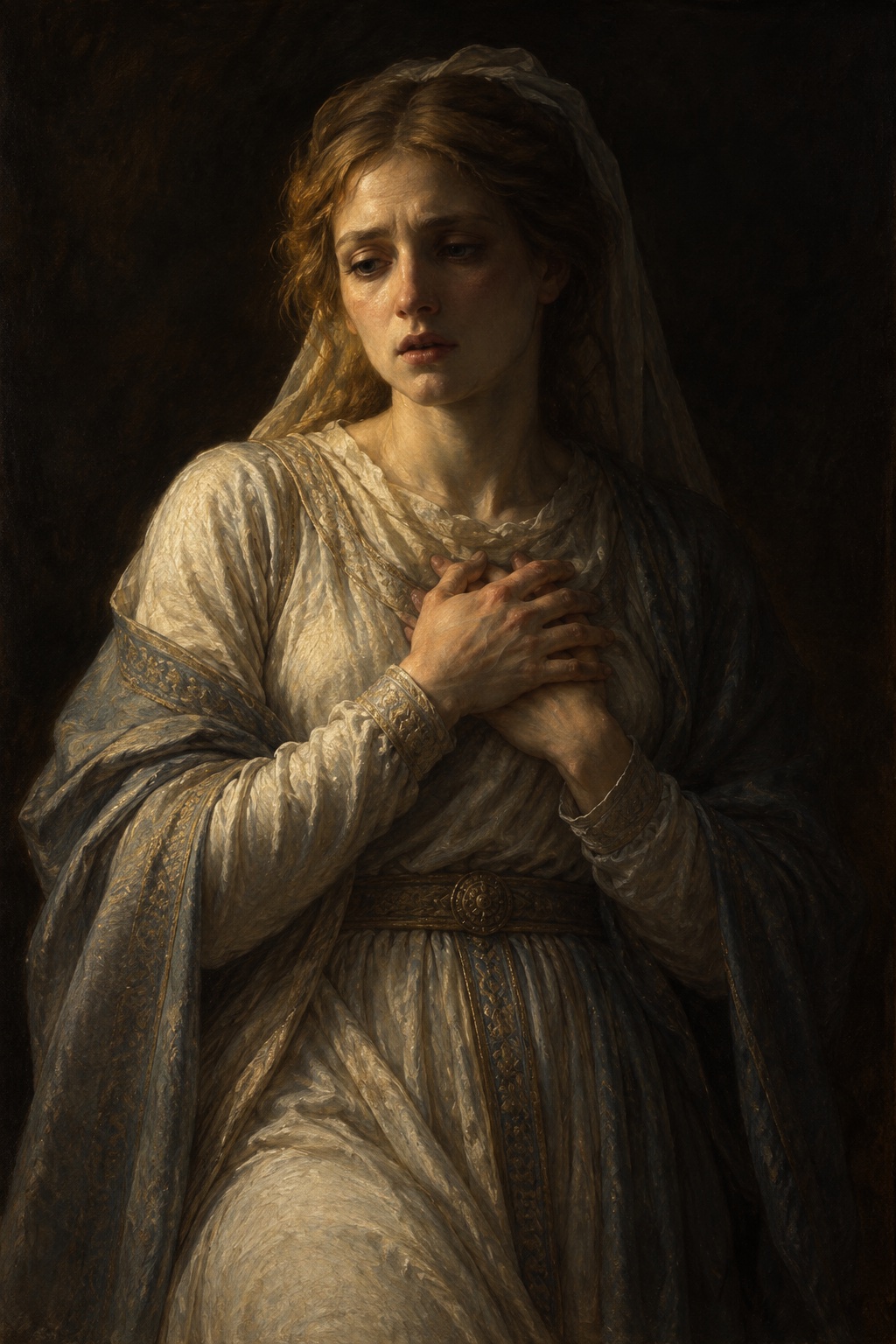
Her one act inside the funeral
The death and the burning belong to Baldr, and his own entry carries them. What belongs here is the sentence and a half Snorri spends on his wife, and the odd fact that the only thing it has her do is look.
Þá var borit út á skipit lík Baldrs, ok er þat sá kona hans, Nanna Nepsdóttir, þá sprakk hon af harmi ok dó. Var hon borin á bálit ok slegit í eldi.
“Then was the body of Baldr borne out on shipboard; and when his wife, Nanna the daughter of Nep, saw that, straightway her heart burst with grief, and she died; she was borne to the pyre, and fire was kindled.” — Snorri Sturluson, Gylfaginning 49, tr. A. G. Brodeur
The order of events is exact and usually gets remembered wrong. She dies at the ship, at the sight of the body being carried out to it, and she is already dead before anyone lights anything; she does not walk onto the pyre and she does not choose it. Snorri’s own grammar quietly makes the point. The body is borit, carried; one clause later she is borin, carried, the same verb with the ending changed to fit her — so that the sentence which kills her also files her with the cargo rather than with the mourners. The chapter around that clause is loud with people doing things: a giantess wrestles the ship off its rollers hard enough to shake the land, Thor hallows the fire and kicks a dwarf into it, and Snorri says a crowd of many kinds came to the burning. Nanna’s entire part is to see what is being carried past her.
Nothing in the text calls it a sacrifice, an oath kept, or a suicide. The words are sprakk hon af harmi — her heart burst with grief — and Snorri offers no more explanation of them than he does of the weather. She is not asked to die, and no one tries to stop her.
What she sends up out of Hel
The ride down to Hel is Hermóðr’s errand and belongs to his side of the story. What belongs here is the moment he turns to leave, because that is where Snorri does something he does for almost nobody else in the mythology: he lets a dead character act.
en Nanna sendi Frigg rifti ok enn fleiri gjafar. Fullu fingrgull.
“And Nanna sent Frigg a linen smock, and yet more gifts, and to Fulla a golden finger-ring.” — Snorri Sturluson, Gylfaginning 49, tr. A. G. Brodeur
This is the whole of it, and it is the only thing any Norse source has her do after she dies. Beside what happens in the same breath, it is also the sharper of the two gestures. Baldr hands Hermóðr the ring Draupnir to carry to his father — but Draupnir was Odin’s to begin with and had been laid on the pyre, so the ring is going home, a thing given back. Nanna’s gifts are not returns. The linen and the gold ring have never been mentioned before; they arrive out of nowhere, out of the one place in this cosmology from which nothing is supposed to come out. They also go to two women, and one of them is Frigg, who started the whole rescue by asking which of the Æsir would ride the road to Hel — while Baldr’s ring travels back up to the father who laid it on the pyre.
The Old Norse is blunter than the English. Snorri gives her sentence a verb once — sendi, sent — and then drops the verb entirely for the second gift: Fullu fingrgull, four syllables, a dative and a compound noun, the gold ring to Fulla. Brodeur carries the verb across so the line reads as English; Snorri does not bother. It is an inventory, not a scene.
Both objects leave her hands for good, which is the thing to hold on to. Her attributes in this wiki are a garment and a ring that she does not wear, does not keep, and never touches again. The one recipient the story has already introduced is Frigg, who is her husband’s mother; the other, Fulla, is a goddess she otherwise meets only in a list.
Nep’s daughter, Forseti’s mother
Outside the funeral chapter Gylfaginning names her exactly once more, and she is not the subject of that sentence either. She is half of a parentage, supplied so that somebody else can be introduced.
Forseti heitir sonr Baldrs ok Nönnu Nepsdóttur. Hann á þann sal á himni, er Glitnir heitir. En allir, er til hans koma með sakarvandræði, þá fara allir sáttir á braut. Sá er dómstaðr beztr með goðum ok mönnum.
“Forseti is the name of the son of Baldr and Nanna daughter of Nep: he has that hall in heaven which is called Glitnir. All that come to him with such quarrels as arise out of law-suits, all these return thence reconciled. That is the best seat of judgment among gods and men” — Snorri Sturluson, Gylfaginning 32, tr. A. G. Brodeur
Thin as that is, it is the only line in the sources that makes her a mother, and it is worth more than it looks. Baldr’s entry ends its catalogue of praise on a strange qualification — that none of his own judgements can be made to stand. The son he has by Nanna holds the best seat of judgement among gods and men, and everyone who walks into his hall walks out reconciled. Whatever the father could not do, the child does, and the sources never remark on it.
The rest of the line is her father, and her father is a problem. Both of the places that name her father build him into her name and neither lets him out of it: she is Nepsdóttir at the funeral and Nönnu Nepsdóttur here, both times a genitive locked inside a patronymic. Nepr has no sentence of his own in either Gylfaginning or Skáldskaparmál — no story, no kin, no hall, no epithet, not one line where the name stands alone as a subject. Gerðr’s father Gymir is a man Snorri describes, with a wife and a house and a daughter who lights up the sky when she opens the door. Nanna’s father is a syllable inside her name, and the relations field on this page is built out of that syllable and nothing else.
The name the roll ends on
Named as a wife, named as a mother, named as a body carried to a fire. One passage stands apart, because in it she is not defined by anybody she is attached to. At the feast in Ægir’s hall, Snorri counts out the goddesses present, and the counting stops at her.
Slíkt sama ásynjur: Frigg, Freyja, Gefjun, Iðunn, Gerðr, Sigyn, Fulla, Nanna.
“and in like manner the Ásynjur: Frigg, Freyja, Gefjun, Idunn, Gerdr, Sigyn, Fulla, Nanna.” — Snorri Sturluson, Skáldskaparmál 1, tr. A. G. Brodeur
Eight names, hers last, no qualifier on any of them. This is what her two scenes cannot supply by themselves. A woman who dies at her husband’s funeral could be a mortal queen; a woman who sends cloth and gold to her mother-in-law could be anybody’s widow. The list is the flat statement that she is none of those things — she is an ásynja, in the same breath as Frigg and Freyja, and Snorri takes no exception and adds no note.
What he never does is describe her. There is no hair, no dress, no stature, no face, and no epithet anywhere in the sources that this corpus can reach; Gerðr is fairest of all women, Sigyn at least gets one hedged word about her mood, and Nanna gets not a single adjective of her own. She also never speaks. In everything reachable — Gylfaginning, Skáldskaparmál, the Baldr poems of the Poetic Edda, the surviving stanzas of Húsdrápa — there is not one line of hers in direct speech, not one question, not one refusal. Her entire recorded interior is the word harmr, grief, and it is named only as the thing that killed her.