Casket, shoes and secret counsel
When Gylfaginning counts out the goddesses, the first four entries are quick. Frigg comes first, with an estate called Fensalir; the second has a dwelling of her own; the third is a physician; the fourth is Gefjun, a virgin, and those who die as maidens attend her. Then Snorri reaches the fifth name and, after the name itself, spends two full sentences on it.
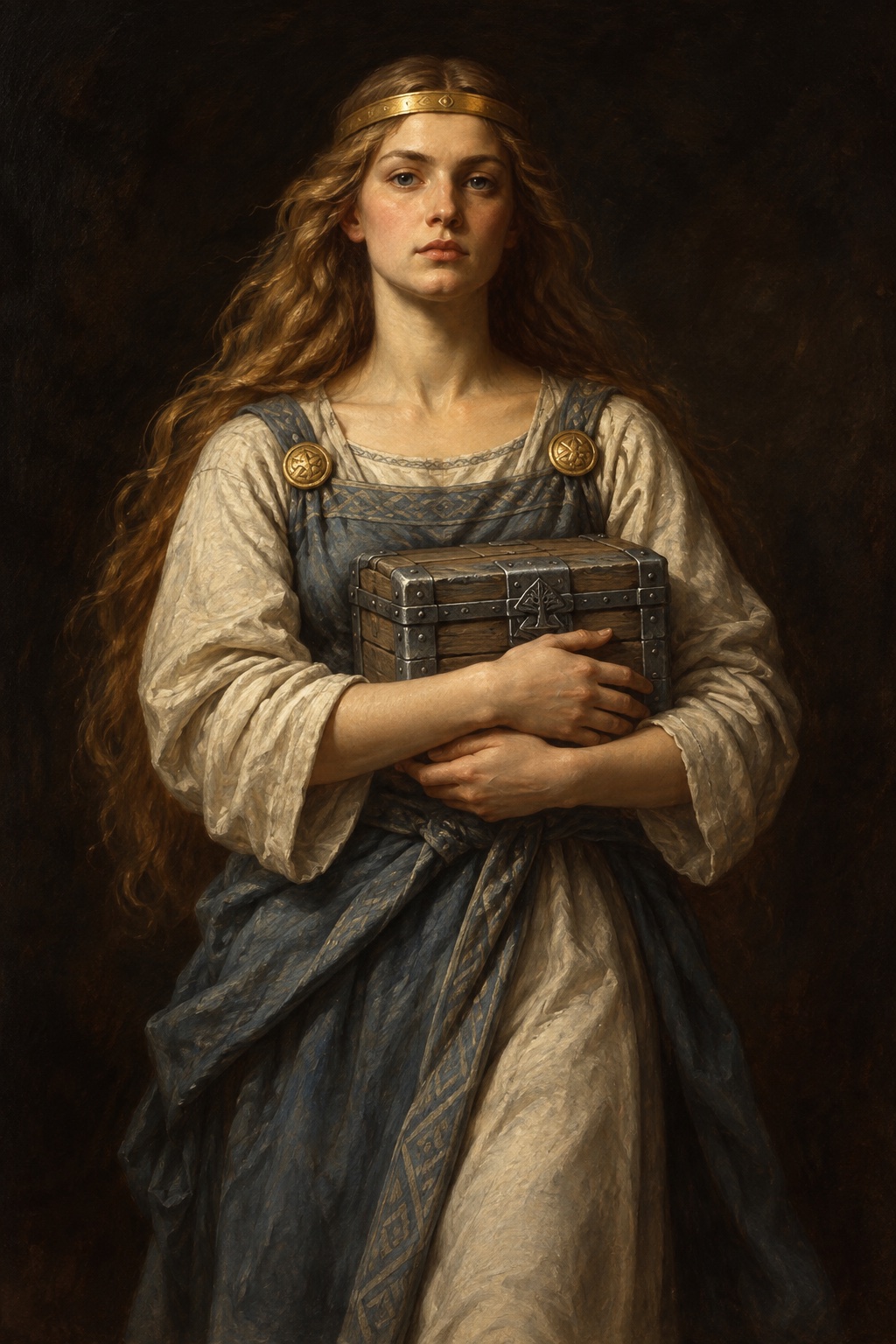
Fimmta er Fulla. Hon er enn mær ok ferr laushár ok gullband um höfuð. Hon berr eski Friggjar ok gætir skóklæða hennar ok veit launráð með henni.
“The fifth is Fulla: she also is a maid, and goes with loose tresses and a golden band about her head; she bears the ashen coffer of Frigg, and has charge over her footgear, and knows her secret counsel.” — Snorri Sturluson, Gylfaginning 35, tr. A. G. Brodeur
The two sentences do two different jobs. The first is the only one that is about her. She is a mær, a maid — Brodeur’s “also” reaches back to Gefjun, called a virgin one line before — and she goes laushár, with her hair loose, and with gullband um höfuð, a gold band about her head. Of the first five names in the list, hers is the only one Snorri lets the reader see. Frigg and the second goddess get houses, the third gets a skill, Gefjun gets a following of the dead; Fulla gets hair and gold.
The second sentence belongs to Frigg. It has three verbs and three objects, and every object is Frigg’s: berr eski Friggjar, she carries Frigg’s casket; gætir skóklæða hennar, she has charge of her shoes; veit launráð með henni, she knows her secret counsel. A thing in her hands, a thing in her keeping, a thing in her head. Not one possessive in the sentence points back at Fulla herself.
What the list does not give is as plain as what it gives. There is no father and no mother, no husband, no hall, and no kinship of any kind with the goddess she serves. Snorri makes her one of the ásynjur, counted in the same list as Frigg, and then defines her almost entirely by what she does for Frigg. The last of the three duties is the one that matters most. A maid who knows her mistress’s secret counsel is also the one who can be sent to carry it out — and in one text, she is.
The errand to the king
The prose that opens Grímnismál first tells how two brothers were fostered, and then comes to a quarrel between husband and wife. Odin and Frigg sit in Hliðskjálf and look over all the worlds, and each of them has fostered a boy. Odin points out that his fosterling is now a king who rules his land, while Frigg’s fosterling begets children with a giantess in a cave. Frigg answers that the king is so miserly he tortures his guests if he thinks too many have come. Odin calls that the greatest of lies, and the two of them make a wager on it. Frigg does not go herself.
Frigg sendi eskimey sína Fullu til Geirröðar. Hon bað konung varast, at eigi fyrirgerði honum fjölkunnigr maðr, sá er þar var kominn í land, ok sagði þat mark á, at engi hundr var svá ólmr, at á hann mundi hlaupa.
“Frigg sent her maid-servant, Fulla, to Geirröth. She bade the king beware lest a magician who was come thither to his land should bewitch him, and told this sign concerning him, that no dog was so fierce as to leap at him.” — Grímnismál, prose introduction, tr. H. A. Bellows
Bellows gives maid-servant for eskimey, and the first half of that word is eski, the same casket that Snorri puts in her hands. The poem’s prose and Snorri’s list are different texts, but both identify her by the same box. The king she visits is Odin’s fosterling and not the giant who has his own entry in this wiki and dies at Thor’s hand; they are two different figures who share a name.
Nothing in her message turns out to be false. There is a stranger in the land, and the dogs will not go for him. But the prose states outright that it was a very great slander to call the king inhospitable, and that he nevertheless had the man seized whom the dogs would not attack. The stranger wears a dark-blue mantle and calls himself Grímnir; the king has him set between two fires, and he sits there eight nights. In other words, the warning makes the king do the very thing Frigg had accused him of. The rest of the poem follows from that: the stranger speaks from between the fires, the closing prose names him as Odin, and the king, rising to take Odin from the fire, falls on his own sword.
Fulla’s part in all of this is one sentence of reported speech. She delivers the warning, the poem never names her again, and nothing tells whether she knew what her mistress’s message would cause. It is the knowledge Snorri credits her with, the secret counsel, put into practice — and the only scene in these sources where she does something rather than holds something.
A ring sent up from Hel
Hermóðr’s ride down to Hel belongs to his own entry, and Nanna’s entry tells this moment from the side of the sender. What belongs here is where the gifts arrive. When Hermóðr rises to leave, Baldr leads him out of the hall, takes the ring Draupnir and sends it to Odin for a remembrance. Nanna’s gifts follow in the same breath.
en Nanna sendi Frigg rifti ok enn fleiri gjafar. Fullu fingrgull.
“And Nanna sent Frigg a linen smock, and yet more gifts, and to Fulla a golden finger-ring.” — Snorri Sturluson, Gylfaginning 49, tr. A. G. Brodeur
Gifts come up out of Hel at that moment to three recipients. Draupnir goes to Odin, Baldr’s father. The linen and the other gifts go to Frigg, Baldr’s mother and Nanna’s mother-in-law. The ring goes to Fulla, and of the three she is the only one with no family tie to Baldr or to Nanna anywhere in these sources. Snorri gives no reason for the choice, and he records no answer: Fulla does not speak, does not thank anyone, and is not seen with the ring again.
What the sentence does show is the order. The gifts for Frigg come first and the gift for Fulla comes after, in one sentence, as if the dead woman were sending to a household rather than to a single person — the mistress, then the maid. It also puts more gold on her. Gylfaginning 35 has already set a gold band about her head; the word Snorri uses here, fingrgull, has gull, gold, inside it as well. In the sources Fulla keeps company with gold: on her head in the list of goddesses, in her hands from Hel, and in the poets’ language, where gold itself is named after her.
Gold named for her headband
Skáldskaparmál is Snorri’s handbook of poetic names, and one of its lists answers the question of how gold may be named. In Brodeur’s English the answers include Snood of Fulla, between Hair of Sif and Freyja’s Tears. Later in the same work Snorri gives the proof, a stanza by Eyvindr skáldaspillir, whom Brodeur calls Eyvindr Skald-Despoiler. The Old Norse prose that introduces it says that gold is named after höfuðbands Fullu, Fulla’s headband.
Fullu skein á fjöllum fallsól bráavallar. Ullar kjóls of allan aldr Hákunar skaldum.
“Fulla’s shining Fillet, The forehead’s sun at rising, Shone on the swelling shield-hill For skalds all Hakon’s life-days.” — Snorri Sturluson, Skáldskaparmál 44 (Brodeur numbers it XXXVI), tr. A. G. Brodeur
The stanza is not about Fulla at all. It praises a king called Hákon, under whom gold shone for poets as long as he lived, and Fulla is only one part of a name for that gold. The word band does not occur in the stanza itself: Brodeur’s English for it has a fillet and the forehead’s sun, and the headband is the name Snorri’s prose gives to what the stanza shows. The name matches the one detail of her looks that Gylfaginning 35 gives, the gullband um höfuð: there, gold on her brow; here, gold named after her brow.
The same handbook works the other way round as well. Among the names it lists for Frigg, Brodeur’s English gives Mistress of Fulla. So the maid is one of the ways to name her mistress, and the maid’s headband is one of the ways to name gold. That is how every source here treats her. Each time she is named, something is named with her: a box, a pair of shoes, a ring, a band of gold — and Frigg.