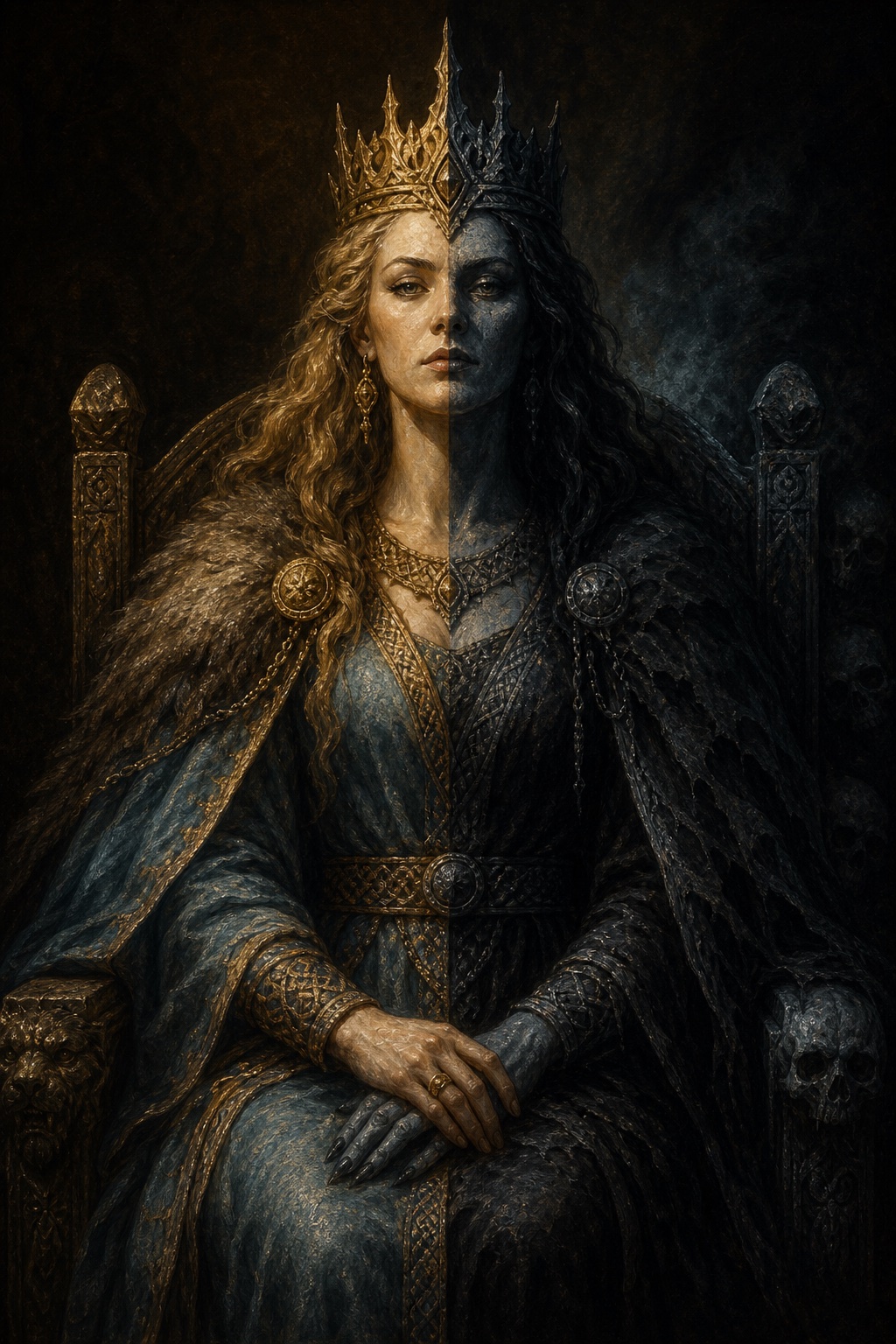
Hel is both a goddess and the name of the realm she rules, a cold and shadowed country given to her by Odin far off in Niflheim, below one of the roots of Yggdrasil. She is the daughter of Loki and the giantess Angrboða, and when Odin learned that she and her monstrous siblings, the wolf Fenrir and the serpent Jörmungandr, had been raised among the giants, he cast all three out — Hel he sent down into the underworld and gave her power over nine worlds, to house those who die of sickness or old age rather than in glorious battle.
Snorri furnishes her household the way an inventory would, and every item in it is named for a deprivation:
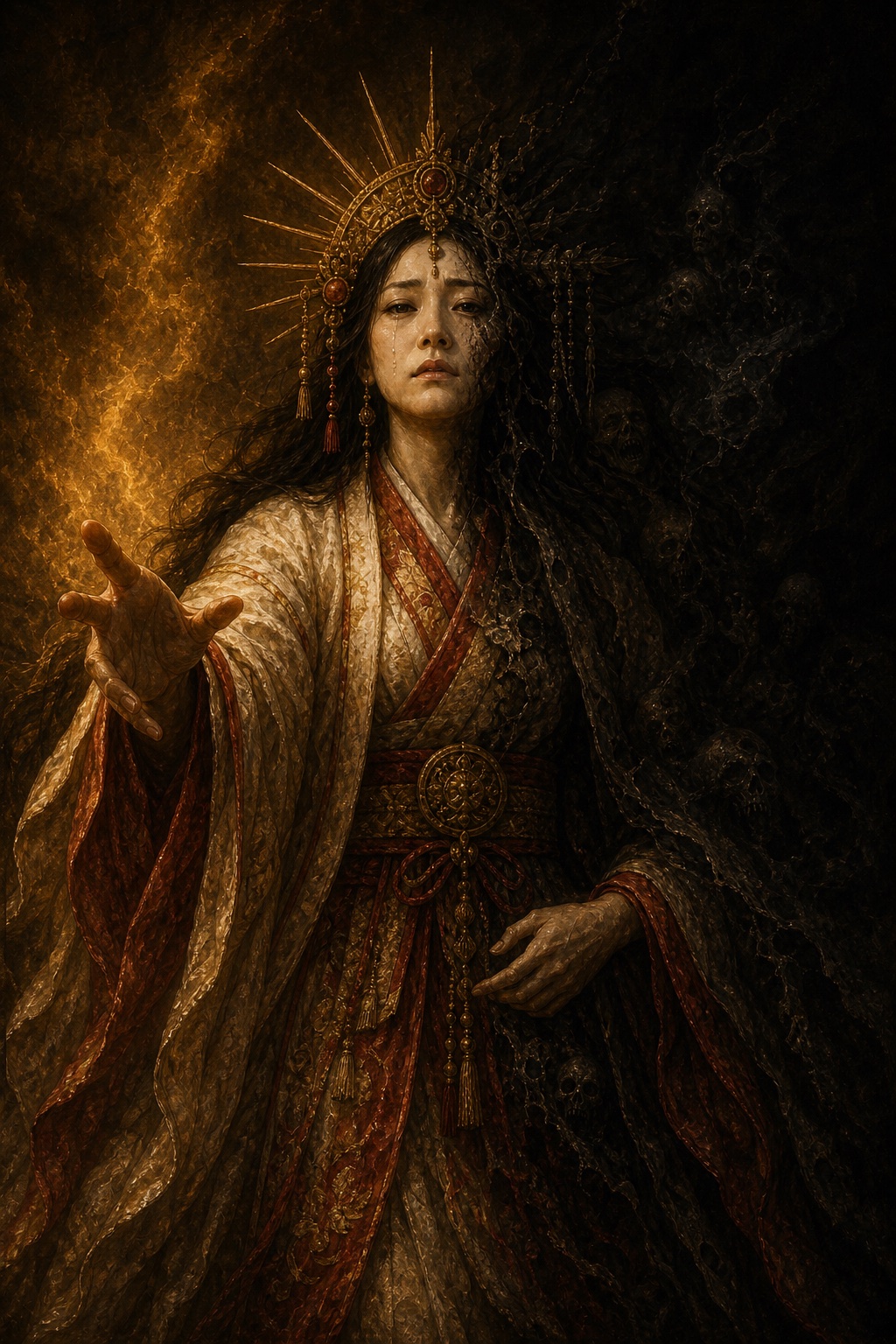
Éljúðnir heitir salr hennar, Hungr diskr hennar, Sultr knífr hennar, Ganglati þrællinn, Ganglöt ambátt, Fallandaforað þresköldr hennar, er inn gengr, Kör sæing, Blíkjandaböl ársali hennar. Hon er blá hálf, en hálf með hörundarlit. Því er hon auðkennd ok heldr gnúpleit ok grimmlig
“Hel he cast into Niflheim, and gave to her power over nine worlds, to apportion all abodes among those that were sent to her: that is, men dead of sickness or of old age. … Her hall is called Sleet-Cold; her dish, Hunger; Famine is her knife; Idler, her thrall; Sloven, her maidservant; Pit of Stumbling, her threshold, by which one enters; Disease, her bed; Gleaming Bale, her bed-hangings. She is half blue-black and half flesh-color (by which she is easily recognized), and very lowering and fierce.” — Gylfaginning 34, tr. Brodeur
Note that Brodeur anglicises the hall — Sleet-Cold, for the Old Norse Éljúðnir — rather than keeping the name, as later translators do.
To her hall came even Baldr, best-loved of the gods, after Loki engineered his death; Hel agreed to release him only if every thing in creation would weep for him, and when one giantess refused, Baldr stayed. Unlike her father and brothers, Hel takes no active part in Ragnarök in the surviving sources — she simply presides, patient and unmoved, over the dead who never leave.