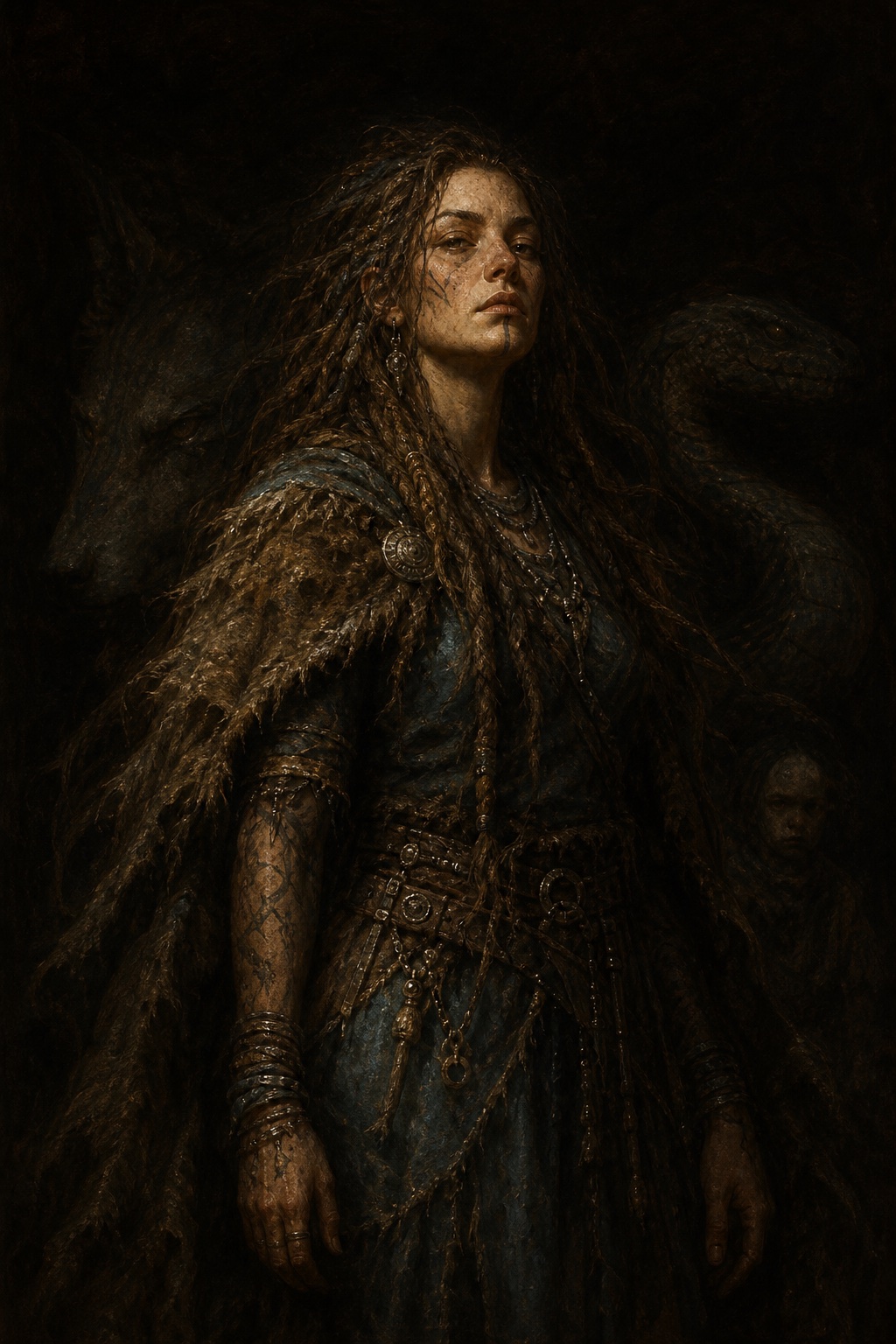
Angrboða appears in the Prose Edda for exactly one sentence, and it is enough to make her the mother of the end of the world. Snorri has just finished listing Loki’s household by his wife Sigyn when he adds that there were other children too.
Enn átti Loki fleiri börn. Angrboða hét gýgr í Jötunheimum. Við henni gat Loki þrjú börn. Eitt var Fenrisúlfr, annat Jörmungandr, þat er Miðgarðsormr, þriðja er Hel
“Yet more children had Loki. Angrboda was the name of a certain giantess in Jotunheim, with whom Loki gat three children: one was Fenris-Wolf, the second Jormungandr — that is the Midgard Serpent — the third is Hel.” — Snorri Sturluson, Gylfaginning 34, tr. Brodeur
Her name reads as “grief-bringer” or “she who offers sorrow”, and Snorri’s word for her is gýgr, an ogress or troll-wife, not a goddess. The three children are raised in Jötunheim until the gods learn of them and trace the prophecies attached to them; what the Æsir conclude, in Snorri’s account, is that great harm was to be looked for from all three, “first from the mother’s side and yet worse from the father’s”. Odin has them fetched. He throws the serpent into the encircling sea, sends Hel down to Niflheim and gives her authority over the dead, and keeps the wolf at home until it grows too dangerous to keep.
That is the whole of her attested biography — she does nothing further, and the sources never bring her back on stage. A giantess called the Old One in Járnviðr, the iron wood east of Midgard, is said in the Völuspá to breed the brood of Fenrir there, and readers since at least the nineteenth century have wanted her to be Angrboða; the poem does not say so. Almost everything else told about her, including the elaborate romances of recent fiction, is later invention resting on those two lines of Snorri.