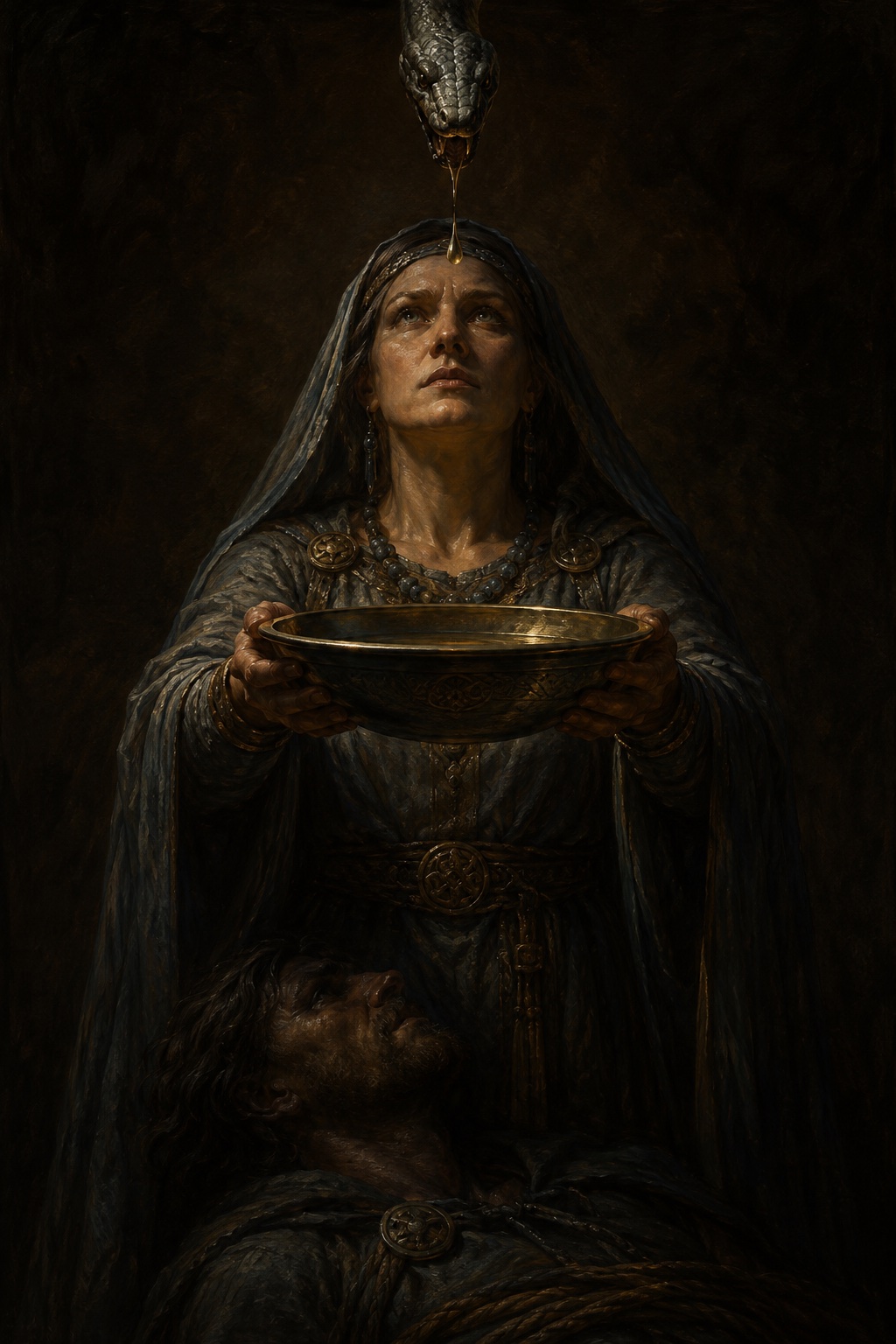
The basin under the venom
Loki’s own entry tells the binding from his side; this is her part in it, the one scene in the whole corpus where she acts rather than merely appears. The gods lash Loki to three stones with the entrails of one of his own sons, and Skaði hangs a venomous serpent above his face. Sigyn takes her place beside him and holds a basin under the drip.
Sigyn, kona hans, stendr hjá honum ok heldr mundlaug undir eitrdropa. En þá er full er mundlaugin, þá gengr hon ok slær út eitrinu, en meðan drýpr eitrit í andlit honum. Þá kippist hann svá hart við, at jörð öll skelfr. Þat kallið þér landskjálfta
“Sigyn, his wife, stands near him and holds a basin under the venom-drops; and when the basin is full, she goes and pours out the venom, but in the meantime the venom drips into his face. Then he writhes against it with such force that all the earth trembles: ye call that ‘earthquakes’” — Snorri Sturluson, Gylfaginning 50, tr. A. G. Brodeur
Snorri’s own sentence runs on past the word this entry has to cut it at, but the shape of the scene is already complete by then. She is named twice in four short sentences, first as kona hans, his wife, and nothing grander; the vessel is a mundlaug, a hand-basin, not a gift of the gods or an implement made for the purpose, just a bowl put to a use no bowl is meant for. Nowhere in the corpus is she called a giant or given any other kin-word at all, the way Angrboða is; the sources have exactly one thing to say about what she is, and this scene is it.
The same chapter goes on to say that Loki lies bound there until Ragnarök, and nothing in the text ever calls a stop to the arrangement before then — no rescue, no relief, no one else ever named to spell her. What the myth commits to is not a single rescue but a repetition: full basin, walk, pour, return, and the venom finds his face again in exactly the time it takes her to do it.
Sitting by him, unhappy
Snorri is not the only witness. Völuspá’s seeress, reciting what she has seen on her way toward the world’s end, gives Sigyn a stanza of her own — an independent source, a different genre, the same two figures.
Haft sá hon liggja und Hveralundi, lægjarns líki Loka áþekkjan; þar sitr Sigyn þeygi of sínum ver vel glýjuð
“One did I see in the wet woods bound, A lover of ill, and to Loki like; By his side does Sigyn sit, nor is glad To see her mate” — Völuspá 35, tr. H. A. Bellows
Glýjuð is the word Bellows renders “glad,” and the line does not deny it outright so much as hedge it down to nothing: þeygi… vel glýjuð, not very glad at all, a litotes doing quietly what an outright “wretched” would have done bluntly. It is also the only word anywhere in the corpus that describes how she feels, and the only line anywhere that describes what she looks like doing it — she sitr, sits, where Gylfaginning has her stendr, stands. The two sources cannot even agree on her posture, only on the fact of the vigil and the fact that it brings her no joy. No source calls her young or fair or gives her any epithet worth quoting at all; Gerðr, elsewhere in this corpus, is “fairest of all women,” and Sigyn is not given so much as an adjective for her own face.
Counted among the ásynjur
Every other appearance of her name in the record is a list, not a scene. At the feast in Ægir’s hall — the same feast Gerðr’s own entry describes — Snorri names the goddesses in attendance one by one, and hers falls between Gerðr’s and Fulla’s.
Slíkt sama ásynjur: Frigg, Freyja, Gefjun, Iðunn, Gerðr, Sigyn, Fulla, Nanna.
“and in like manner the Ásynjur: Frigg, Freyja, Gefjun, Idunn, Gerdr, Sigyn, Fulla, Nanna.” — Snorri Sturluson, Skáldskaparmál 1, tr. A. G. Brodeur
A basin held under venom is not, on its own, proof of godhood; it could as easily describe a servant. This line is what the basin cannot supply by itself — Snorri counts her flatly among the Ásynjur, in the same breath as Frigg and Freyja, no qualifier attached and no exception taken. Between the two kinds of evidence, the corpus gives Sigyn everything it gives any of them except a story of her own invention: a place in the roll of goddesses, and one long, wordless duty that the roll does not explain.