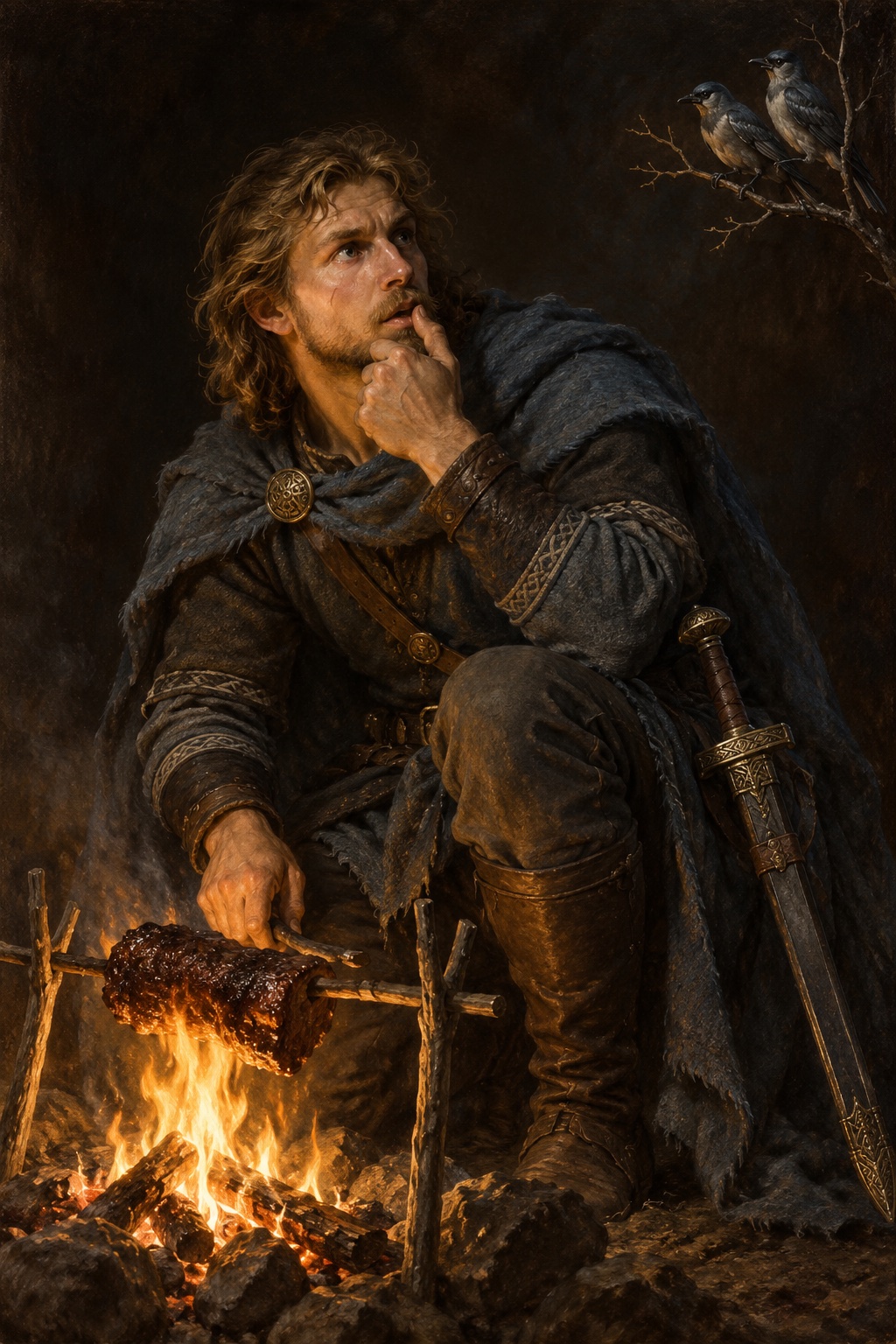
The pit on Gnitaheiðr
Sigurd is the man who killed Fáfnir. His name in Old Norse is Sigurðr, and Bellows writes it Sigurth. His part of the story is told in two poems of the Poetic Edda, Fáfnismál and Sigrdrífumál, and Snorri tells the killing again in Skáldskaparmál. When Fáfnismál begins, Sigurd has come to Fáfnir with Reginn, his foster-father, and Reginn is Fáfnir’s brother.
The poem opens in prose. Sigurd and Reginn go up to Gnitaheiðr and find the track that Fáfnir made when he crawled to water. Sigurd digs a great pit across the path, which Bellows calls a trench, and gets down into it.
En er Fáfnir skreið af gullinu, blés hann eitri, ok hraut þat fyrir ofan höfuð Sigurði. En er Fáfnir skreið yfir gröfina, þá lagði Sigurðr hann með sverði til hjarta. Fáfnir hristi sik ok barði höfði ok sporði
“When Fafnir crawled from his gold, he blew out venom, and it ran down from above on Sigurth’s head. But when Fafnir crawled over the trench, then Sigurth thrust his sword into his body to the heart. Fafnir writhed and struck out with his head and tail” — Fáfnismál, prose before st. 1, tr. H. A. Bellows
The prose keeps the events in order. First the venom runs down fyrir ofan höfuð Sigurði, from above on his head, while he lies in the pit. Sigurd strikes only when Fáfnir is over the pit, and the blow goes til hjarta, to the heart. He fights from underneath the serpent, and the prose gives him one stroke. Fáfnir’s first stanza ends on that stroke: Stöndumk til hjarta hjörr, the sword stands in my heart.
Fáfnir speaks as he dies, and at first Sigurd will not tell him his name. The prose gives the reason: “it was believed in olden times that the word of a dying man might have great power if he cursed his foe by his name.” So Sigurd calls himself “The Noble Hart” and says that he has no father and no mother. When Fáfnir sees through the lie, Sigurd names himself in the fourth stanza: “Sigurth my name, and Sigmund’s son”. The rest of that conversation, with Fáfnir’s warning þér verða þeir baugar at bana, that the rings will be his bane, is told on Fáfnir’s page.
Reginn had gone some distance away while Sigurd fought, and he comes back while Sigurd is wiping the blood from his sword. In Bellows’s stanza 25 he finds him cleaning it, “As Gram with grass thou cleansest”, and so the sword has its name. Reginn hails the victory and then reminds Sigurd whose blood it is: bróður minn hefr þú benjaðan, you have slain my brother. He also claims a share, “And somewhat I did myself”. Sigurd answers him.
Fjarri þú gekkt, meðan ek á Fáfni rauðk minn inn hvassa hjör; afli mínu atta ek við orms megin, meðan þú í lyngvi látt
“Afar didst thou go while Fafnir reddened With his blood my blade so keen; With the might of the dragon my strength I matched, While thou in the heather didst hide” — Fáfnismál 28 (Bellows 26), tr. H. A. Bellows
This is Sigurd’s own account of the fight, and it is short. He reddened his sharp sword on Fáfnir, rauðk minn inn hvassa hjör, and he matched his own strength, afli mínu, against the serpent’s might, orms megin. Bellows puts “dragon” for orms, but the word is ormr, serpent or worm. The last line is aimed at Reginn: meðan þú í lyngvi látt, while you lay in the heather. Reginn answers with the sword. Sigurd would have let “Yon hoary giant” lie long in the heather, he says, “Had the weapon availed not that once I forged”. His words for his dead brother are þann inn aldna jötun, that old giant. The Old Norse edition numbers these two stanzas 28 and 29, and Bellows numbers them 26 and 27.
The heart’s blood
Reginn cuts the heart out of Fáfnir with a sword called Riðill, and he drinks blood from the wound. Then he asks Sigurd to roast the heart: “Sit now, Sigurth, for sleep will I, Hold Fafnir’s heart to the fire”. Sigurd takes the heart and roasts it on a spit, steikði á teini. When he thinks that it is done, and the blood is foaming out of it, he tests it with his finger. (Bellows puts this prose and Reginn’s request after the exchange about the heather, as his stanza 31; the Old Norse edition puts them before it, as stanza 27.)
Hann brann ok brá fingrinum í munn sér. En er hjartablóð Fáfnis kom á tungu hánum, ok skilði hann fugls rödd.
“He burned his finger, and put it in his mouth. But when Fafnir’s heart’s-blood came on his tongue, he understood the speech of birds.” — Fáfnismál, prose after st. 31, tr. H. A. Bellows
Nothing in the prose says that Sigurd meant to taste the heart. He burns himself and puts the finger in his mouth. The gift comes with the hjartablóð, the heart’s blood, on his tongue, and what he understands is fugls rödd, the voice of a bird. Then he hears igður chattering in the thicket. Bellows calls them nut-hatches, and Brodeur, who translates Snorri, calls them nuthatches.
Seven birds speak in turn, and they speak about Sigurd, not to him. The first sees him sveita stokkinn, “sprinkled with blood”, roasting the heart at the fire, and says that spillir bauga, “the breaker of rings”, would be wise to eat it himself. The second turns to Reginn, who lies there plotting to betray the youth who trusts him: vill bölvasmiðr bróður hefna, “Till his brother the maker of mischief avenges”. The others give advice. The third begins Höfði skemmra, shorter by a head: let the grey-haired chatterer go from here to hell, and then Sigurd alone would rule the gold that lay under Fáfnir. The fifth says that a man is not wise if he lets one brother go when he has killed the other. The seventh begins with the same two words and calls Reginn inn hrímkalda jötun, “the frost-cold giant”. Bellows notes that Reginn was certainly not a frost-giant, and that the stanza looks like a copyist’s version of stanza 34. But over Fáfnir’s body Reginn called his own brother a giant, and now a bird calls Reginn one.
Then Sigurd speaks his one stanza in the passage.
Verða-t svá rík sköp, at Reginn skyli mitt banorð bera; því at þeir báðir bræðr skulu bráðliga fara til heljar heðan.
“Not so rich a fate shall Regin have As the tale of my death to tell; For soon the brothers both shall die, And hence to hell shall go.” — Fáfnismál 39, tr. H. A. Bellows
The word that Bellows translates as “fate” is sköp. Sigurd does not deny that Reginn plans his death. He denies that Reginn has a fate so rich as mitt banorð bera, to carry the story of his killing. His last line takes the third bird’s own words, fara til heljar heðan, to go from here to hell, and gives them to both brothers. Then the prose makes it true. Sigurðr hjó höfuð af Regin: he cuts off Reginn’s head. Then he eats Fáfnir’s heart and drinks the blood of both, Regins ok Fáfnis. He was roasting the heart for Reginn, and he eats it himself, as the first bird said he should.
Fáfnir’s gold
At the end of Fáfnismál, Sigurd rides along Fáfnir’s track to his lair. Bellows’s prose says that he found it open, with gate-posts, gates and every beam of iron, in a house dug down into the earth.
Þar fann Sigurðr stórmikit gull ok fylldi þar tvær kistur. Þar tók hann ægishjálm ok gullbrynju ok sverðit Hrotta ok marga dýrgripi ok klyfjaði þar með Grana, en hestrinn vildi eigi fram ganga, fyrr en Sigurðr steig á bak hánum
“There Sigurth found a mighty store of gold, and he filled two chests full thereof; he took the fear-helm and a golden mail-coat and the sword Hrotti, and many other precious things, and loaded Grani with them, but the horse would not go forward until Sigurth mounted on his back” — Fáfnismál, closing prose, tr. H. A. Bellows
The list is short and exact: two chests of gold; ægishjálm, the fear-helm; gullbrynju, a golden mail-coat; and a second sword, sverðit Hrotta, which Bellows calls Hrotti. The helm is the one that Fáfnir said he wore of alda sonum, against the sons of men, while he lay on the treasure. Now it belongs to the man who killed him. The prose says that Sigurd took it. It does not say that he wore it.
Then the horse. Grani will not move under the load fyrr en Sigurðr steig á bak hánum, until Sigurd is on his back. The poem ends there, with the gold packed and the rider in the saddle. Fáfnir told him that the rings would be his bane, and Sigurd takes them all the same. Fáfnismál does not say what the gold does to him, and this page does not follow him that far.
The sleeper on Hindarfjall
Sigrdrífumál opens with Sigurd on the road again: Sigurðr reið upp á Hindarfjall ok stefndi suðr til Frakklands, he rode up onto Hindarfjall and turned south toward the land of the Franks. (Bellows spells the mountain Hindarfjoll.) On the mountain he saw a great light, as if a fire were burning, and the glow reached up to the sky. When he came to it, there stood a skjaldborg, “a tower of shields” in Bellows’s words, with a banner above it. Inside, a man lay asleep með öllum hervápnum, with all his war-weapons.
Sigurd took the helm off the sleeper’s head first, and then he saw þat var kona, that it was a woman. The mail-coat was as tight sem hon væri holdgróin, as if it had grown to the flesh. He cut it með Gram, with Gram, from the head-opening downward and out through both sleeves; Bellows’s English leaves out the sword’s name here. Then he took the mail-coat off her, and she woke, sat up and saw him. Her first words are three questions: Hvat beit brynju?, “What bit through the byrnie?”, what broke her sleep, and who took the pale fetters off her? Sigurd answers in the third person.
Sigmundar burr, - sleit fyr skömmu hrafn hrælundir, - hjörr Sigurðar!
“Sigmund’s son, with Sigurth’s sword, That late with flesh hath fed the ravens.” — Sigrdrífumál 1, tr. H. A. Bellows
He names his father first, Sigmundar burr, Sigmund’s son, and names himself only as the owner of the sword, hjörr Sigurðar, Sigurd’s sword. The sword, he says, has lately fed the ravens; the passage does not say on whose flesh. On Gnitaheiðr he hid his name from a dying enemy. Here he gives it, and his father’s, as the answer to the first thing that a stranger says to him.
She answers that she has slept long, Lengi ek svaf, and that Óðinn því veldr: Odin is the cause, and she could not throw off her sleep. Bellows prints this as his fourth stanza, after her two greetings, where the Old Norse edition has it second. Sigurd sits down and asks her name. She takes a horn full of mead and gives him minnisveig, “a memory-draught”. Then she greets the day and the sons of day, the night and her daughter, the gods and the goddesses and the earth, and she asks for victory, for wisdom and speech, and for healing hands for the two of them while they live. Only then does the prose give her name: Hon nefndist Sigrdrífa, she was called Sigrdrífa.
The prose just after the passage quoted here adds that she was a valkyrie. It goes on to say that she had killed a king in battle to whom Odin had promised the victory, and that Odin pricked her with a sleep-thorn to punish her. That is why Odin is the cause of her sleep. Nothing in the passages on this page gives her any other name.
This wiki files Sigurd as a hero. War is for his sword and his two killings, and monsters is for Fáfnir. Fate is for the stanza in which Sigurd denies Reginn the banorð, and for the gold that Fáfnir told him would be his bane. Where the gold leads him, the passages on this page do not say.