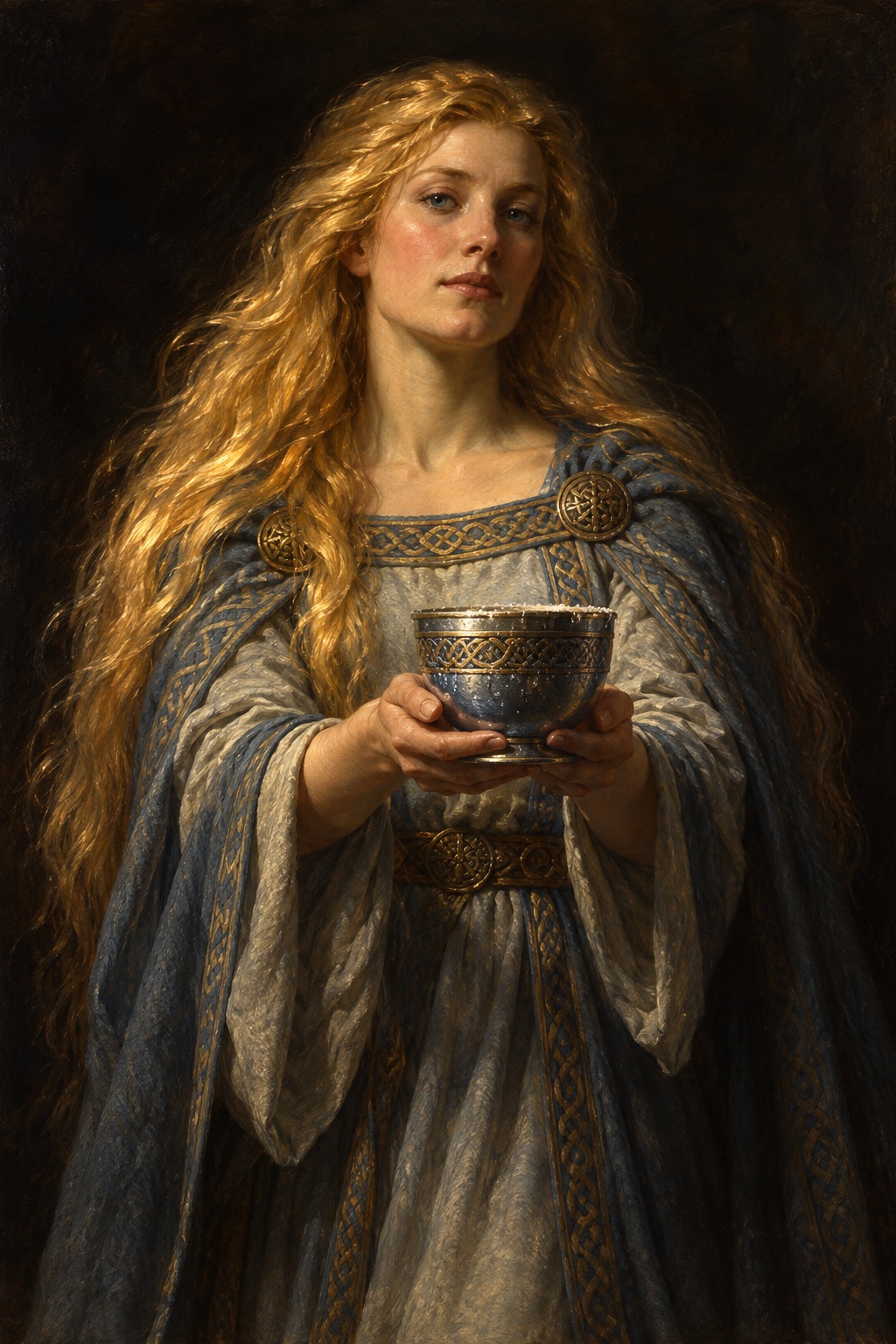
The hair cut off, and the hair made
Snorri does not introduce her. He asks a technical question about poetry — why gold is called haddr Sifjar, Sif’s hair — and the answer is a story about an assault on Thor’s wife and the compensation her husband extorted for it.
Hví er gull kallat haddr Sifjar? Loki Laufeyjarson hafði þat gert til lævísi at klippa hár allt af Sif. En er Þórr varð þess varr, tók hann Loka ok myndi lemja hvert bein í honum, áðr hann svarði þess, at hann skal fá af Svartálfum, at þeir skulu gera af gulli Sifju hadd þann, er svá skal vaxa sem annat hár. Eftir þat fór Loki til þeira dverga, er heita Ívaldasynir, ok gerðu þeir haddinn ok Skíðblaðni ok geirinn, er Óðinn átti, er Gungnir heitir.
“Why is gold called Sif’s Hair? Loki Laufeyarson, for mischief’s sake, cut off all Sif’s hair. But when Thor learned of this, he seized Loki, and would have broken every bone in him, had he not sworn to get the Black Elves to make Sif hair of gold, such that it would grow like other hair. After that, Loki went to those dwarves who are called Ívaldi’s Sons; and they made the hair, and Skídbladnir also, and the spear which became Odin’s possession, and was called Gungnir.” — Snorri Sturluson, Skáldskaparmál 43 (Brodeur numbers it XXXV), tr. A. G. Brodeur
Everything in the episode happens to her and nothing is said by her. Loki cuts the hair til lævísi, out of malice; Thor finds out; Thor takes hold of Loki and would have broken every bone in him. The price Loki swears to is not an apology to Sif but a replacement, and the replacement is better than the original, because it is gold and because it will grow. The detail Snorri will not let go of is that last one — svá skal vaxa sem annat hár, it shall grow as other hair grows. The dwarves are not making an ornament. They are making living hair out of metal, and that impossibility is the point of the kenning the chapter exists to explain: after this, a poet can say gold by saying Sif’s hair.
Two things in this passage are routinely told wrong, and the text itself is unambiguous about both. The first is who made what. Ívaldi’s Sons make three things and only three: the hair, the ship Skíðblaðnir, and the spear Gungnir that Odin carries. The second is the hammer. Mjölnir is not made on this commission at all. In the very next sentence Loki wagers his own head against the dwarf Brokkr that Brokkr’s brother — Snorri calls him Sindri — cannot forge three treasures as good, and that wager is what produces the hammer. Thor’s entry here names the smiths as Brokkr and Eitri; the second brother’s name varies with the edition, but the division of labour does not. Sif’s hair belongs to the first commission, the hammer to the second, and the two are separate transactions that happen to run back to back on the same page.
Snorri’s list of Loki-kennings, earlier in the same book, keeps the account open: among the ways to periphrase Loki is “Harmer of Sif’s Hair”. The injury is filed under the name of the man who did it, and it stays there as a permanent term of art.
What the kenning chapter settles
Sif gets a chapter of her own in Snorri’s handbook — Sifjarkenningar, how to periphrase Sif — and it is one sentence long. That sentence is the densest piece of evidence anyone has about her, and it answers questions the narrative sources never raise.
Hvernig skal kenna Sif? Svá, at kalla hana konu Þórs, móður Ullar, it hárfagra goð, elja Járnsöxu, móður Þrúðar.
“How should Sif be periphrased? By calling her Wife of Thor, Mother of Ullr, Fair-Haired Goddess, Co-Wife of Járnsaxa, Mother of Thrúdr.” — Snorri Sturluson, Skáldskaparmál 29 (Brodeur numbers it XXI), tr. A. G. Brodeur
Five terms, and four of them are relationships. She is defined by whose wife she is, whose mother she is, and whose co-wife she is; the only term that describes her in herself is it hárfagra goð, the fair-haired goddess, which is the hair episode turned into a standing epithet. This entry takes its list of her children from this sentence and from nothing else: Ullr and Þrúðr, both stated outright, neither inferred.
That matters because Thor has three children and Sif is not the mother of all of them. Snorri’s Thor-kennings chapter calls him “Father of Magni and Módi and Thrúdr, Husband of Sif, Stepfather of Ullr” in a single breath — which is a claim about Thor, not about Sif, and Thor’s own entry in this wiki records it as such. Sif’s chapter then supplies what his does not. She is elja Járnsöxu, Járnsaxa’s co-wife: the word for two women who bear children to the same man, and the tell that at least one of his three is somebody else’s. The Hrungnir episode, earlier in the same book, names which one — Þá kom til Magni, sonr Þórs ok Járnsöxu, “Then Magni came up, son of Thor and Járnsaxa,” a three-night-old boy who lifts the dead giant’s foot off his father when every one of the Æsir has failed to. Magni is therefore Thor’s and not hers. Móði is the open case: he appears only alongside Magni as a son of Thor, no mother is named for him anywhere, and this entry does not guess one.
Ullr runs the other way. He is Sif’s son and not Thor’s — Gylfaginning calls him “son of Sif, step-son of Thor”, the bowman and skier no one can match, and the Thor chapter agrees by calling Thor his stepfather rather than his father. Who Ullr’s father was is a question no surviving source answers. So the marriage the sources describe is a second one on both sides: she brought a son into it, he had at least one child outside it, and the kenning chapter records both facts without a word of comment.
One thing that sentence does not contain is a job. Nothing Sif does in any source is an office — she is not given a domain, a rite, a season or a power, and neither Snorri nor the poems assign her one. This wiki’s schema requires at least one domain, and fertility is the choice scholarship has settled on, so it is the one used here. It should be read as a modern convention and not as a source fact. The reasoning behind it — gold hair that grows and is cut is a field of ripe grain, and the goddess who wears it is a harvest goddess — is nineteenth-century comparative mythology, Jacob Grimm and the scholars who followed him. It appears nowhere in Snorri, nowhere in the Poetic Edda, and nowhere in Brodeur’s or Bellows’ own notes on any of the passages quoted on this page.
The cup at Ægir’s feast
Ægir’s entry tells what his hall was and what Loki did in it: a sanctuary where no blood may be shed, a killing at the door, and then Loki working down the benches insulting every god and goddess in the room in turn. Sif does not try to shout him down and does not threaten him. She comes forward with a drink and asks to be left out of it.
Heill ver þú nú, Loki, ok tak við hrímkálki fullum forns mjaðar, heldr þú hana eina látir með ása sonum vammalausa vera.
“Hail to thee, Loki, and take thou here / The crystal cup of old mead; / For me at least, alone of the gods, / Blameless thou knowest to be.” — Lokasenna 53, tr. H. A. Bellows
The word the stanza uses for the cup is hrímkálki, a rime-cup or frost-cup, which Bellows renders as crystal; what is in it is old mead. The Old Norse has her ask in the third person — heldr þú hana eina látir, rather let her alone be left without blemish — and the word eina, alone, is not a boast about being the only one to serve him. It is the whole of her request. She is offering hospitality in exchange for silence, in a hall where hospitality has already stopped working. He takes the horn and drinks from it before he answers.
Ein þú værir, ef þú svá værir, vör ok gröm at veri; einn ek veit, svá at ek vita þykkjumk, hór ok af Hlórriða, ok var þat sá inn lævísi Loki.
“Alone thou wert if truly thou wouldst / All men so shyly shun; / But one do I know full well, methinks, / Who had thee from Hlorrithi’s arms,— / (Loki the crafty in lies.)” — Lokasenna 54, tr. H. A. Bellows
He drinks her mead and turns her own word back on her: alone, yes, you would be, if you really shunned all men the way you say. Then he names the man who had her from Hlórriði’s arms, and the man is himself. Hlórriði is Thor — in the next stanza Beyla says Hlórriði is coming from his home, and two stanzas after that Thor comes forth.
This is the only place in any source where the affair is stated rather than alleged, and the speaker is Loki, in a poem whose entire method is saying the worst available thing about whoever has just spoken, under a roof where nobody can hit him for it. The line is a claim, not a confession, and this entry records it as one.
The same charge, from the far bank
The charge does not stay inside Lokasenna. In Hárbarðsljóð, Thor is coming home from a journey in the east and reaches a sound with a ferryman and a boat on the other side. The ferryman, who gives his name as Hárbarðr, will not take him across, and spends the poem answering Thor’s boasts with better ones and Thor’s demands with insults. Thor finally threatens him with the hammer, and this is what the ferryman says back.
Sif á hó heima, hans muntu fund vilja, þann muntu þrek drýgja, þat er þér skyldara.
“Sif has a lover at home, and him shouldst thou meet; / More fitting it were on him to put forth thy strength.” — Hárbarðsljóð 48, tr. H. A. Bellows
It is the same accusation, and it is aimed at Thor rather than at Sif — the cruellest thing available to a man who has run out of boasts, with Sif as the instrument. Thor answers it in the next stanza: the ferryman says whatever seems worst to him, and “Thou liest, I ween.” The ferryman’s reply in the stanza after that is “Truth do I speak,” and there the subject drops. Bellows’ own editorial note sends the reader across to Lokasenna 54 and supposes the unnamed lover to be Loki, which is an editor joining two passages, not a third source. The poem itself names nobody.
Neither poem lets Sif answer the charge. In Lokasenna she is accused to her face and the next voice is Beyla’s, not hers; in Hárbarðsljóð she is not present at all, and the only denial anyone enters is her husband’s, shouted across water. That is the shape of nearly everything the sources record about her. Her hair is cut and the chapter that tells it gives her not one word, her compensation is settled between her husband and the man who wounded her, her children are established in a list of poetic formulas, and the one charge ever made against her is made twice, to her husband and to her face, by people with a reason to say it. The one time she speaks for herself, she asks to be left out.