Three nights old
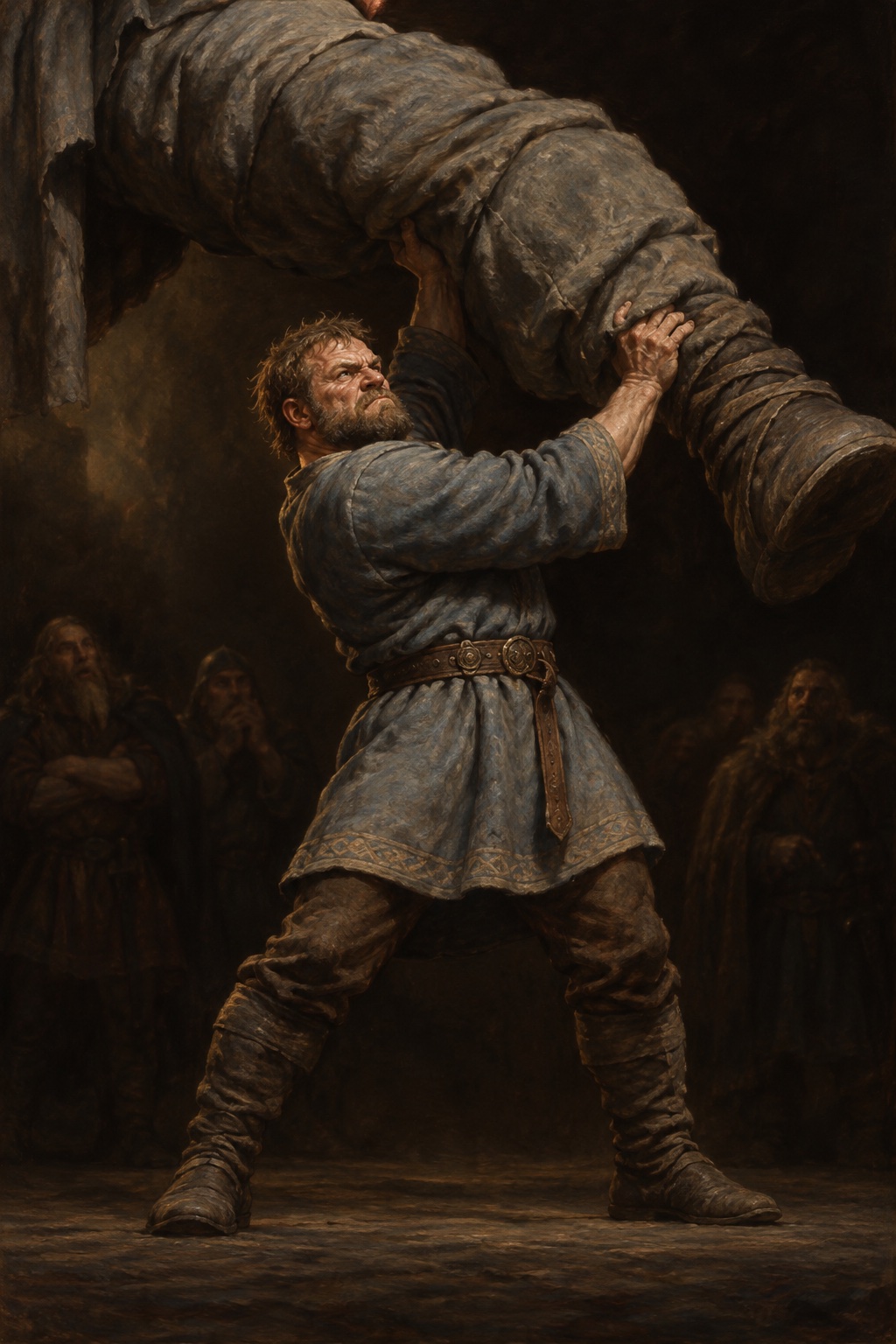
Magni enters the mythology at the end of somebody else’s fight. Snorri tells the story of Thor and the giant Hrungnir to explain a set of poetic kennings, and it is a long chapter. It starts with a wager about horses: Odin rides Sleipnir into giant country, and Hrungnir answers that his own horse, Gullfaxi, is better. The race that follows carries Hrungnir through the gates of Asgard, where he drinks, boasts, and leaves with a challenge to Thor to meet him at Grjótúnagarðr. The hammer smashes the giant’s stone skull. A piece of the giant’s whetstone strikes Thor’s head, and Thor falls forward. Hrungnir falls forward on top of him, so that the dead giant’s foot lies across Thor’s neck. Thor’s servant Þjálfi tries to lift it and cannot. Then all the Æsir come, try to lift it, and can do nothing.
Þá kom til Magni, sonr Þórs ok Járnsöxu. Hann var þá þrínættr. Hann kastaði fæti Hrungnis af Þór ok mælti: “Sé þar ljótan harm, faðir, er ek kom svá síð. Ek hygg, at jötun þenna myndak hafa lostit í hel með hnefa mínum, ef ek hefða fundit hann.” Þá stóð Þórr upp ok fagnaði vel syni sínum ok sagði, at hann myndi verða mikill fyrir sér, - “ok vil ek,” sagði hann, “gefa þér hestinn Gullfaxa, er Hrungnir hefir átt.” Þá mælti Óðinn ok sagði, at Þórr gerði rangt, er hann gaf þann inn góða hest gýgjarsyni, en eigi föður sínum.
“Then Magni came up, son of Thor and Járnsaxa: he was then three nights old; he cast the foot of Hrungnir off Thor, and spake: ‘See how ill it is, father, that I came so late: I had struck this giant dead with my fist, methinks, if I had met with him.’ Thor arose and welcomed his son, saying that he should surely become great; ‘And I will give thee,’ he said, ‘the horse Gold-Mane, which Hrungnir possessed.’ Then Odin spake and said that Thor did wrong to give the good horse to the son of a giantess, and not to his father.” — Snorri Sturluson, Skáldskaparmál 24 (Brodeur numbers it XVII), tr. A. G. Brodeur
Nobody has mentioned him before this sentence, and Snorri introduces him by his parents first. The second fact is his age. The word is þrínættr, three nights old. It is the same kind of word that Völuspá uses for Váli, who fights to avenge Baldr einnættr, one night old. Two sons of gods are known for what they did in their first nights of life, and both of them survive the end of the world.
The lift itself takes one clause. Snorri spends more words on what the boy says afterwards, and it is not a boast about the foot. It is a regret: it is a pity that he came so late. Then he says what he would have done if he had been there. Thor needed the hammer to kill Hrungnir. His son says that he would have struck the giant í hel with his fist, which Brodeur renders simply as dead. The only one who can move the giant’s foot is also the only one who says that he did not need a weapon.
Thor stands up, welcomes him, and says that he will be great. Then he gives him Gullfaxi, which Brodeur calls Gold-Mane. This is Hrungnir’s horse, the same horse whose boast started the chapter. That is why Odin objects. He had raced that horse, and in his view it should have gone to Thor’s father, which means to Odin himself. The word he uses for Magni is gýgjarsyni, the son of a giantess. The episode says nothing else about Járnsaxa, and that one word is enough to make her a giantess. The boy who lifts the giant off Thor is half giant himself, and Odin names him by his mother’s side. Snorri gives the complaint no answer. The next sentence sends Thor home to Þrúðvangar with the whetstone still in his head, and the story turns to the seeress Gróa, who sings her spells over it.
Father of Magni
Outside the Hrungnir chapter, Snorri’s handbook uses Magni mostly as a way to name somebody else. Early in Skáldskaparmál, in the list of ways a poet may refer to Thor without saying Thor, the son comes directly after Thor’s own parents.
Hvernig skal kenna Þór? Svá, at kalla hann son Óðins ok Jarðar, faðir Magna ok Móða ok Þrúðar, verr Sifjar, stjúpfaðir Ullar, stýrandi ok eigandi Mjöllnis ok megingjarða, Bilskirrnis, verjandi Ásgarðs, Miðgarðs, dólgr ok bani jötna ok trollkvinna, vegandi Hrungnis, Geirröðar, Þrívalda, dróttinn Þjálfa ok Rösku, dólgr Miðgarðsorms, fóstri Vingnis ok Hlóru.
“What figures should be employed to periphrase the name of Thor? Thus: one should call him Son of Odin and of Jörd, Father of Magni and Módi and Thrúdr, Husband of Sif, Stepfather of Ullr, Wielder and Possessor of Mjöllnir and of the Girdle of Strength, and of Bilskirnir; Defender of Ásgard and of Midgard, Adversary and Slayer of Giants and Troll-Women, Smiter of Hrungnir, of Geirrödr and of Thrívaldi, Master of Thjálfi and Röskva, Foe of the Midgard Serpent. Foster-father of Vingnir and Hlóra.” — Snorri Sturluson, Skáldskaparmál 11 (Brodeur numbers it IV), tr. A. G. Brodeur
The sentence is about Thor, and Magni is in it only in the genitive, Magna, as the son a poet can name to mean the father. But the list around him holds the whole of his story. The same sentence that makes Thor the father of Magni also makes him the owner of the hammer, the killer of Hrungnir, and the enemy of the Midgard Serpent. Magni’s two scenes in the sources are about exactly those three things. He lifts Hrungnir’s foot off his father, and he receives the hammer after the serpent has killed his father. Snorri then gives verse examples of the kennings, and two of them use Thor’s children. In Eilífr’s stanza Thor is Magni’s sire, and in Eysteinn Valdason’s he is Þrúðr’s father. Thor uses the title himself, too. In Hárbarðsljóð, when the ferryman demands his name, Thor gives it as Odin’s son, Meili’s brother and Magni’s father, and near the end of the poem he calls himself Magni’s father again when he demands the boat.
The sentence names three children and says nothing about their mothers. The mothers come from other chapters. Magni’s mother is Járnsaxa, from the Hrungnir chapter above. Þrúðr’s mother is Sif: Sif’s own kenning chapter calls her the mother of Þrúðr and also Járnsaxa’s co-wife, and Sif’s entry sets out that evidence. Sif is therefore not Magni’s mother, and Þrúðr is his half-sister through Thor. Móði is the open case. In every passage quoted on this page he stands beside Magni as a son of Thor, but no source names his mother, and this entry does not guess one.
The sources do not explain either brother’s name. Bellows, in his note on the Vafþrúðnismál stanza quoted below, translates Magni as Might and Móði as Wrath. Magni’s one scene bears his name out. Strength is the only quality the sources show in him, and it is also the quality his father is known for.
The hammer after Ragnarök
Thor’s death belongs to his own entry. At Ragnarök he strikes the serpent, walks nine paces, and falls. The hammer does not fall with him. In Vafþrúðnismál, Odin tests the all-wise giant Vafþrúðnir with questions, and one of them is who will rule the gods’ possessions when Surtr’s fire has died down. The first half of the answer gives the gods’ sanctuaries to Víðarr and Váli. The second half is about Thor’s sons.
Móði ok Magni skulu Mjöllni hafa Vingnis at vígþroti.
“Mothi and Magni shall Mjollnir have / When Vingnir falls in fight.” — Vafþrúðnismál 51, tr. H. A. Bellows
Vingnir is Thor. Bellows’s note says so, and Brodeur, translating the same stanza where Snorri quotes it, puts Thor’s name where the Old Norse has Vingnir. The inheritance is timed by the father’s death: the sons have the hammer at the end of Thor’s fighting. The half-stanza says nothing about where they are during the battle, or whether they fight in it, and Snorri’s own account of the battle does not name them. They simply have the hammer afterwards.
Snorri tells the same thing in his own prose, a few lines before he quotes the stanza.
Víðarr ok Váli lifa, svá at eigi hefir særinn ok Surtalogi grandat þeim, ok byggja þeir á Iðavelli, þar sem fyrr var Ásgarðr, ok þar koma þá synir Þórs, Móði ok Magni, ok hafa þar Mjöllni.
“Vídarr and Váli shall be living, inasmuch as neither sea nor the fire of Surtr shall have harmed them; and they shall dwell at Ida-Plain, where Ásgard was before. And then the sons of Thor, Módi and Magni, shall come there, and they shall have Mjöllnir there.” — Snorri Sturluson, Gylfaginning 53, tr. A. G. Brodeur
Because Snorri quotes the stanza a few lines later, his prose is a reading of it and not a second, independent witness. But he adds two things that the stanza does not have. The first is a place: Iðavöllr, where Asgard had stood. The second is a movement. Víðarr and Váli live on and settle there, and Thor’s sons come there. Snorri does not say where they come from.
The rest of the chapter shows who holds the new world. After Thor’s sons, Baldr and Höðr come back from the dead. Then they all sit down together and talk over what happened before, the Midgard Serpent and Fenrir among it, and they find in the grass the golden gaming pieces that the Æsir once owned. Every one of the gods in that scene is a son. Víðarr, Váli, Baldr and Höðr are sons of Odin and brothers of Thor, and Móði and Magni are sons of Thor. The fathers do not come back. In the last scene the sources give him, Magni has the hammer, sits on the old ground of Asgard with his father’s brothers, and talks about Jörmungandr, the serpent that killed his father.
That scene is Snorri’s, and most of it is not new. Völuspá has its own account of the renewal: the earth rises green out of the sea, the Æsir meet again on Iðavöllr, the golden pieces lie in the grass, and Baldr and Höðr return. Snorri’s setting matches that poem closely, but Völuspá never names Móði or Magni. Their place in the renewed world rests on the one half-stanza of Vafþrúðnismál and on Snorri, who quotes it. The whole record of Magni is small: one scene at three nights old, his name in the genitive whenever a poet names his father, and a half-stanza about a hammer. Nothing in these sources gives him a hall, a cult, or anything to do with the hammer once he has it. The domains on this page, war and rebirth, stand for the hammer and for the new world he receives it in. They are not an office that any source gives him.