At the land’s-end
No source that names Surtr gives him a father, a mother, or a birth. Fenrir and Jörmungandr both come from Loki and Angrboða; Surtr has no parents named anywhere in the mythology, and no source calls him a jötunn, a gýgr, or a þurs either — the ordinary words this corpus uses for other monstrous figures. What survives instead is a name, a station, a sword, and an errand. Snorri places him in the far south, in the burning country called Múspell, closed to anyone who does not already belong there.
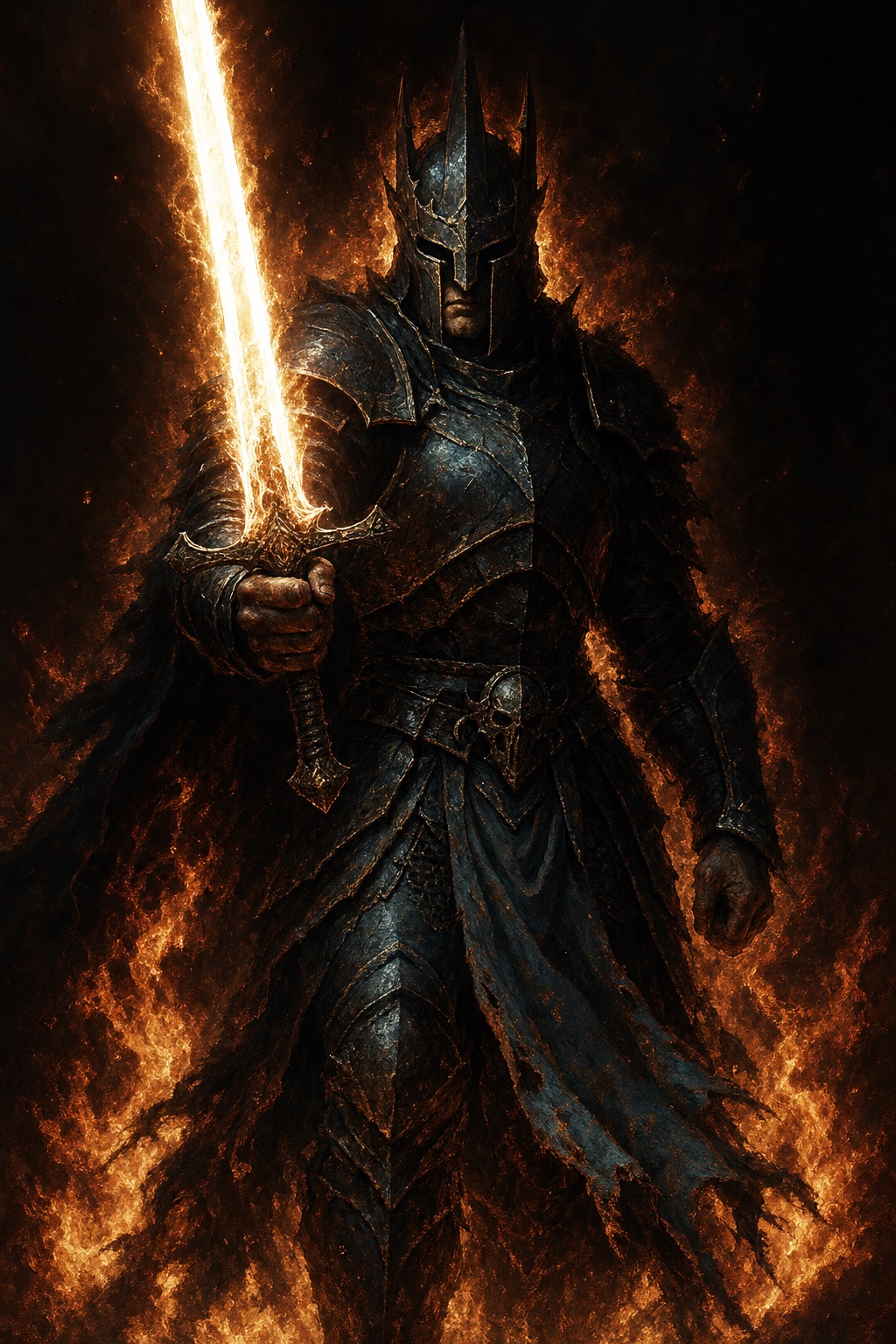
Sá er Surtr nefndr, er þar sitr á landsenda til landvarnar. Hann hefir loganda sverð, ok í enda veraldar mun hann fara ok herja ok sigra öll goðin ok brenna allan heim með eldi
“He who sits there at the land’s-end, to defend the land, is called Surtr; he brandishes a flaming sword, and at the end of the world he shall go forth and harry, and overcome all the gods, and burn all the world with fire” — Gylfaginning 4, tr. Brodeur
Before Ragnarök he is a guardian, seated to defend Múspell rather than to attack anything beyond it. That watchfulness ends the moment the world does: the same sentence that introduces him already promises the harrying, the defeat of the gods, and the fire.
Fares from the south
Völuspá reaches him at the poem’s own climax, in the stanza that gives the seeress her last clear image of the world ending.
Surtr ferr sunnan með sviga lævi, skínn af sverði sól valtíva; grjótbjörg gnata, en gífr rata, troða halir helveg, en himinn klofnar
“Surt fares from the south with the scourge of branches, The sun of the battle-gods shone from his sword; The crags are sundered, the giant-women sink, The dead throng Hel-way, and heaven is cloven” — Völuspá 52, tr. Bellows
Bellows spells him “Surt” here, without the final -r, inside his own translation of the verse — the same figure, an older form of the name. “The scourge of branches” is a kenning for fire, named for what it does to wood rather than by the word for fire itself, and the sword outshining the sun is the poem’s own image, independent of anything Snorri says about it later. What the stanza does not do is use a word for burning. Its ending is heaven splitting open, rock shattering, the dead crowding the road to Hel — cataclysm, but not combustion in so many words. The explicit fire belongs to the prose account that follows.
Riding with the Sons of Múspell
Snorri’s own telling of this same moment fills in what the poem compresses into half a line.
Í þessum gný klofnar himinninn, ok ríða þaðan Múspellssynir. Surtr ríðr fyrst ok fyrir honum ok eftir eldr brennandi. Sverð hans er gott mjök. Af því skínn bjartara en af sólu
“In this din shall the heaven be cloven, and the Sons of Múspell ride thence: Surtr shall ride first, and both before him and after him burning fire; his sword is exceeding good: from it radiance shines brighter than from the sun” — Gylfaginning 51, tr. Brodeur
Fire is not only the weapon he swings; it travels with his whole body, going before him and coming after, so that the army riding out of the cloven sky is wreathed in it before a single blow lands. The sword gets a second, brighter description here than at his introduction — no longer merely flaming, but outshining the sun outright, the same comparison Völuspá already made independently.
Freyr’s death
Somewhere in that advance, Surtr meets Freyr, and Snorri is explicit about why the encounter goes the way it does.
Freyr berst móti Surti, ok verðr harðr samgangr, áðr Freyr fellr. Þat verðr hans bani, er hann missir þess ins góða sverðs, er hann gaf Skírni
“Freyr shall contend with Surtr, and a hard encounter shall there be between them before Freyr falls: it is to be his death that he lacks that good sword of his, which he gave to Skírnir” — Gylfaginning 51, tr. Brodeur
Freyr had given his own sword — the one that fought by itself — to his servant Skírnir, sent to win the giantess Gerðr on his behalf. He is remembered as facing Surtr with an antler instead, and losing. Surtr needs no title beyond his own name for this: no source dresses him in anything further, monstrous or otherwise, for the killing. He simply still has the sword Freyr no longer does.
The burning of the world
The last thing Surtr does, once the individual duels of Ragnarök are finished — Freyr fallen, Loki and Heimdall dead by each other’s hand — is the act every source that names him has been pointing toward.
Því næst slyngr Surtr eldi yfir jörðina ok brennir allan heim
“Then straightway shall Surtr cast fire over the earth and burn all the world” — Gylfaginning 51, tr. Brodeur
This is the one place any fetched source actually uses a word for burning. Völuspá’s account of the same moment stops at heaven cloven; it is Snorri’s prose, not the poem, that spells out what the fire finally does to the earth. Between the flaming sword at the land’s-end, the fire that rides with him, and this last sentence, Surtr is given exactly one continuous action across every source that mentions him — and this is where it ends.