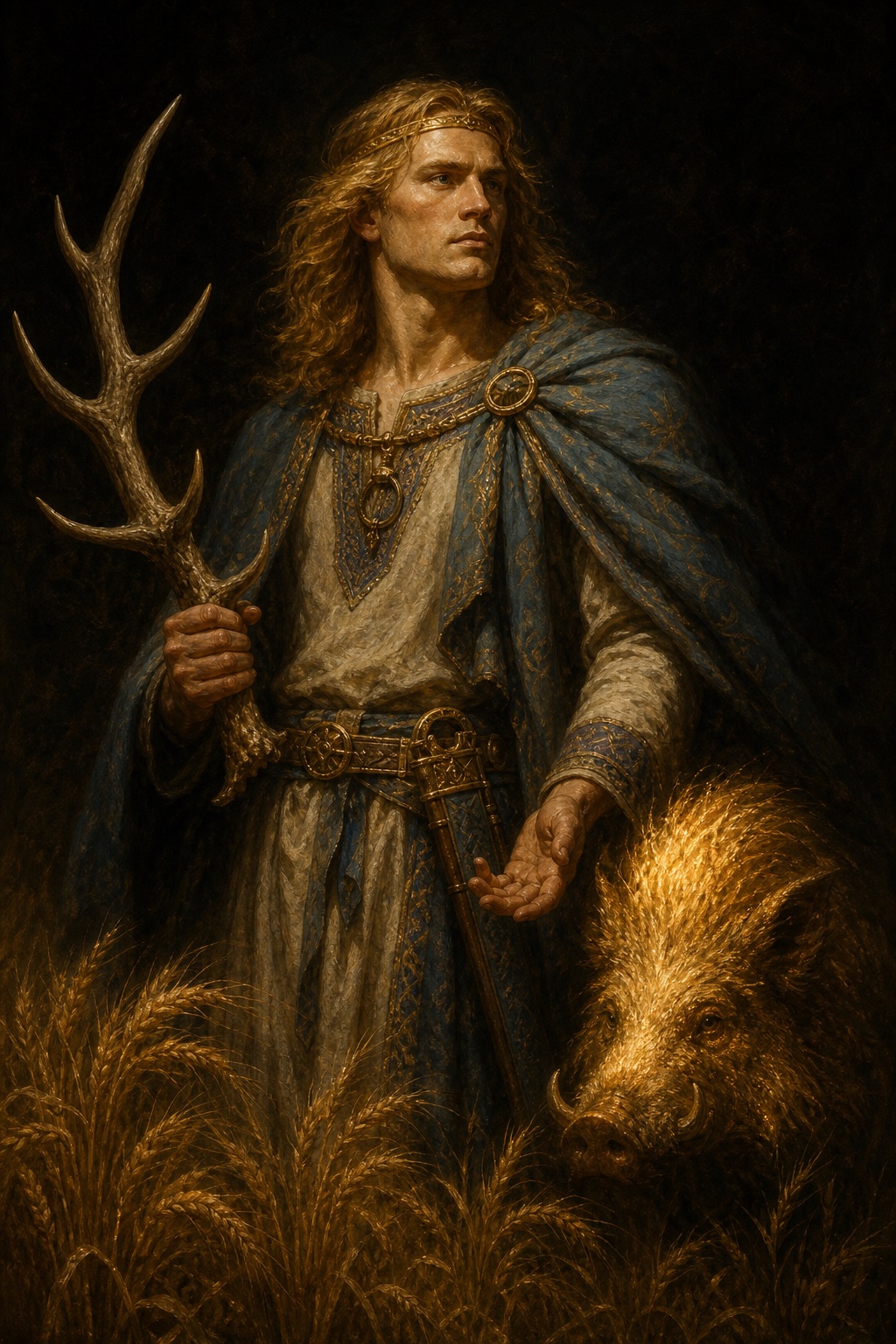
Freyr is a Vanir god, given to the Æsir as a hostage in the settlement that ended their war, along with his father Njörðr and his sister Freyja. Snorri puts him at the head of the list.
Freyr er inn ágætasti af ásum. Hann ræðr fyrir regni ok skini sólar ok þar með ávexti jarðar, ok á hann er gott at heita til árs ok friðar. Hann ræðr ok fésælu manna
“Freyr is the most renowned of the Æsir; he rules over the rain and the shining of the sun, and therewithal the fruit of the earth; and it is good to call on him for fruitful seasons and peace. He governs also the prosperity of men.” — Gylfaginning 24, tr. Brodeur
Ár ok friðr — good harvests and peace — is his whole portfolio, and it is a larger one than it sounds. Odin gets the aristocracy’s attention and Thor the farmer’s, but Freyr is the god of whether there is anything to eat and whether anyone is fighting, which for most people most of the time is the entire question. Adam of Bremen, describing the temple at Uppsala in the eleventh century, reports three images: Thor in the middle, Odin beside him, and Freyr, whom he says was invoked at weddings and depicted with an enormous phallus. The Swedish kings traced their line to him.
His central story is a courtship that costs him everything. Sitting in Hlidskjálf, Odin’s high seat, from which all worlds are visible, Freyr looks out and sees Gerðr, a giant’s daughter, raising her arms so that the air and the sea shine from them, and goes home sick with longing. He sends his servant Skírnir to woo her, and to make him go, gives him the horse that crosses fire and his own sword — the one that fights by itself. Skírnir tries gifts, then threats, then a curse of appalling detail, and Gerðr consents to meet Freyr in nine nights. Freyr replies that one night is long, that two are longer, and asks how he shall bear three. He gets the marriage. He does not get the sword back.
That transaction is the point of him. The antler belongs to an earlier fight: Snorri has him kill the giant Beli with a hart’s horn, and has his own narrator add that the encounter hardly counted — Freyr could have killed him bare-handed — but that the missing sword would tell when the sons of Múspell marched. It tells at Ragnarök, when Surtr comes from the south with the fire that ends the world. Freyr falls to him, and Gylfaginning names the cause outright: the good sword he gave to Skírnir. He is a god of peace and plenty who disarmed himself for love, and the world’s last battle is worse for it. Of all the Norse gods it is Freyr whose doom is most clearly the consequence of his own choice rather than of prophecy.