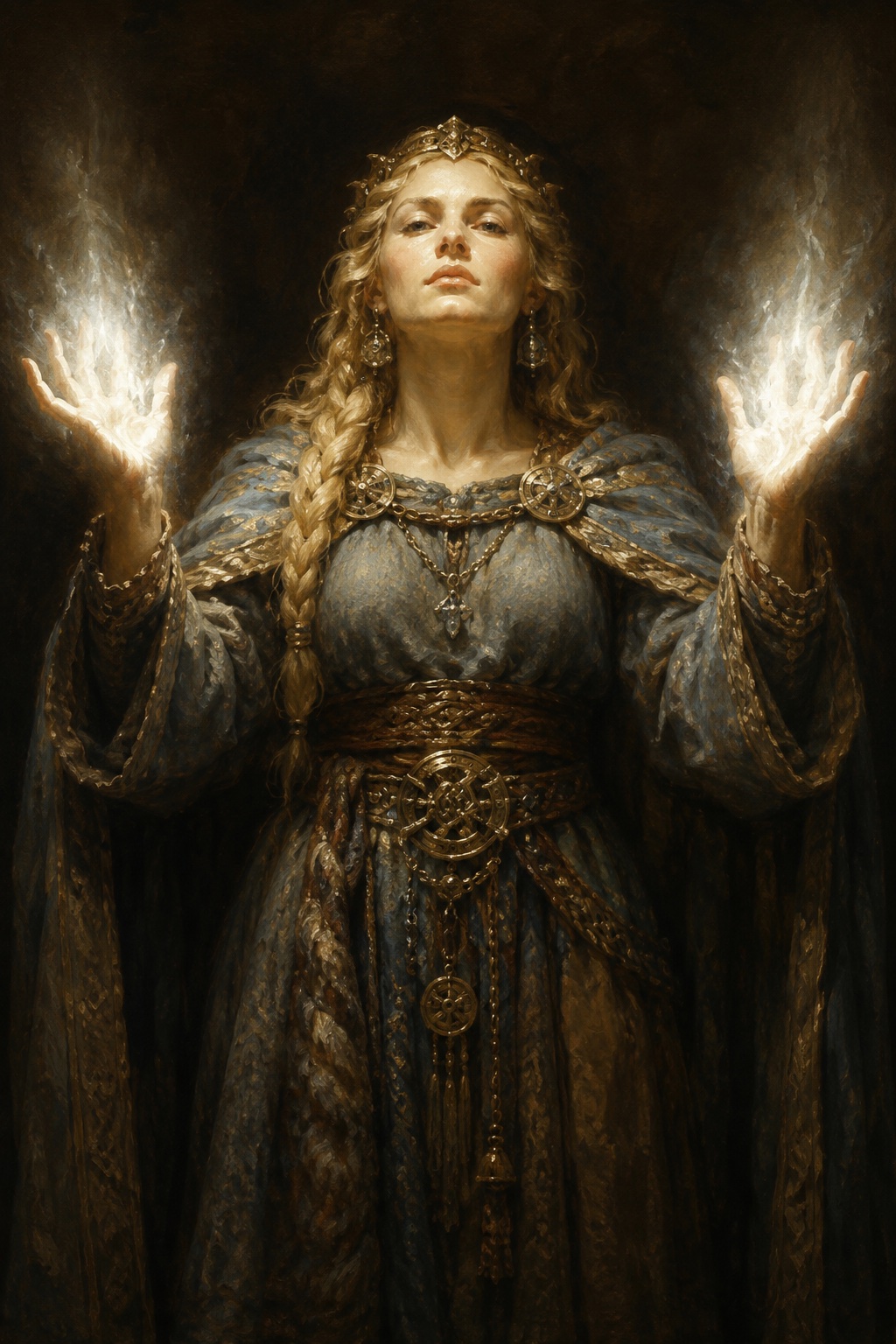
What Skírnir could not buy
Freyr’s entry already tells how he sent Skírnir north to woo her, and what it cost him to send him. What belongs here is her side of that meeting — three offers, three answers, all in her own words.
Epli ellifu ek þigg aldregi at mannskis munum, né vit Freyr, meðan okkart fjör lifir, byggjum bæði saman.
“I will not take at any man’s wish These eleven apples ever; Nor shall Freyr and I one dwelling find So long as we two live.” — Skírnismál 20, tr. H. A. Bellows
Eleven apples of gold buy nothing. Skírnir tries a ring next, the one burned on the pyre with Óðinn’s son, which drips eight more like it every ninth night — Bellows’ note identifies it as Draupnir, though the verse itself never gives it a name. Gerðr turns that down too: her father’s own hoard, she says, already lacks nothing. Then Skírnir draws his sword.
Ánauð þola ek vil aldregi at mannskis munum; þó ek hins get, ef it Gymir finnizk, vígs ótrauðir, at ykkr vega tíði.
“For no man’s sake will I ever suffer To be thus moved by might; But gladly, methinks, will Gymir seek To fight if he finds thee here.” — Skírnismál 24, tr. H. A. Bellows
Gold, a ring out of legend, a blade at her throat: three different arguments, and she answers all three the same way. Even facing the sword her only reply is a threat handed back — that her father will come looking for the man who tried it.
Barri, and nine nights of her own naming
Neither gift nor steel moves her. What finally does is a curse, stanza after stanza of it, promising her monstrous isolation if she keeps refusing — and only then does she yield, on terms she sets herself.
Barri heitir, er vit bæði vitum, lundr lognfara; en eft nætr níu þar mun Njarðar syni Gerðr unna gamans.
“Barri there is, which we both know well, A forest fair and still; And nine nights hence to the son of Njorth Will Gerth there grant delight.” — Skírnismál 39 (Bellows prints it as 40), tr. H. A. Bellows
She names the grove herself, and the number of nights herself; nothing about the line is Skírnir’s offer accepted, it is her own sentence passed. Bellows’ own note records that in the Codex Regius manuscript the speaker heading is missing for this stanza — the printed editions themselves supply it. What it costs on the other side is not hers to pay: Freyr had already given up the horse that crosses fire and the sword that fights by itself to make Skírnir go, and Surtr’s own entry tells what that sword’s absence costs him at the end of the world.
Gymir’s daughter, and the light from her hands
Her own lines never describe her. What she looks like, and whose daughter she is, comes only from Snorri.
Gymir hét maðr, en kona hans Aurboða. Hon var bergrisa ættar. Dóttir þeira er Gerðr, er allra kvinna var fegrst. Þat var einn dag, at Freyr hafði gengit í Hliðskjálf ok sá of heima alla. En er hann leit í norðrætt, þá sá hann á einum bæ mikit hús ok fagrt, ok til þess húss gekk kona, ok er hon tók upp höndum ok lauk hurð fyrir sér, þá lýsti af höndum hennar bæði í loft ok á lög, ok allir heimar birtust af henni.
“A certain man was called Gýmir, and his wife Aurboda: she was of the stock of the Hill-Giants; their daughter was Gerdr, who was fairest of all women. It chanced one day that Freyr had gone to Hlidskjálf, and gazed over all the world; but when he looked over into the northern region, he saw on an estate a house great and fair. And toward this house went a woman; when she raised her hands and opened the door before her, brightness gleamed from her hands, both over sky and sea, and all the worlds were illumined of her.” — Gylfaginning 37, tr. A. G. Brodeur
Her father is Gymir, a mountain-giant — not the Ægir of the Lokasenna prologue, who is given the same byname; this wiki’s entry on Ægir follows Bellows in treating that identification as the compiler’s own mistake, and Gerðr’s father is a different giant altogether. Her mother, Aurboða, is named nowhere else in this corpus, only here, of the stock of the Hill-Giants. And the one image any source gives her is this: raising her hands, and light pouring from them over sky and sea.
Counted among the ásynjur
Freyr’s and Surtr’s entries both call her a giant’s daughter — the second names her outright “the giantess Gerðr” — and neither is wrong to. But lineage is not the only measure Snorri uses. At the feast in Ægir’s own hall, described in his entry, he lists the goddesses in attendance by name.
Slíkt sama ásynjur: Frigg, Freyja, Gefjun, Iðunn, Gerðr, Sigyn, Fulla, Nanna.
“and in like manner the Ásynjur: Frigg, Freyja, Gefjun, Idunn, Gerdr, Sigyn, Fulla, Nanna.” — Snorri Sturluson, Skáldskaparmál 1, tr. A. G. Brodeur
She sits in that list beside Frigg and Freyja, named as one of the Ásynjur outright, not set apart from them. A giant’s daughter and a goddess are not, in Snorri’s own accounting, mutually exclusive — Skaði is the same case, jötunn-born and counted among the goddesses regardless, and this entry follows the same rule hers does: what settles the standing is not the blood but where the sources finally put her.
Freyr’s, Surtr’s and Ægir’s entries have already named her again and again between them, and every one of those mentions belongs to someone else’s story. Here, for once, the words are her own: three times no, and once, on her own terms, yes.