The bird at the window
Geirröðr’s story is in Snorri’s Skáldskaparmál, and it comes straight after the story of Hrungnir. In Snorri’s frame it is one of the tales that Bragi tells Ægir. Ægir says that Hrungnir seems to him to have been very mighty, and he asks whether Thor did any greater deeds against the trolls. Bragi answers with the journey to Geirröðr. At that time, he says, Thor did not have the hammer Mjöllnir with him, or his Girdle of Might, or the iron gauntlets, and that was the fault of Loki.
So the story starts with Loki, not with the giant. Once, for sport, Loki flew in Frigg’s hawk-plumage, as Brodeur translates it, and out of curiosity he flew into Geirröðr’s court. He saw a great hall, landed, and looked in through the window. Geirröðr looked up, saw him, and gave orders to catch the bird and bring it to him. The wall was so high that the man he sent could hardly climb it. Loki enjoyed the man’s struggle, and he did not fly until the man had almost reached him. When at last he spread his wings, his feet were stuck fast. So Loki was caught and brought before Geirröðr.
Geirröðr looked at the bird’s eyes and suspected that it was a man. He told it to answer, but Loki said nothing.
Þá læsti Geirröðr Loka í kistu ok svelti hann þar þrjá mánuðr. En þá er Geirröðr tók hann upp ok beiddi hann orða, þá sagði Loki, hverr hann var, ok til fjörlausnar vann hann Geirröði þess eiða, at hann skyldi koma Þór í Geirröðargarða, svá at hann hefði hvárki hamarinn né megingjarðar.
“Then Geirrödr shut Loki into a chest and starved him there three months. And now when Geirrödr took him out and commanded him to speak, Loki told who he was; and by way of ransom for his life he swore to Geirrödr with oaths that he would get Thor to come into Geirrödr’s dwelling in such a fashion that he should have neither hammer nor Girdle of Might with him.” — Snorri Sturluson, Skáldskaparmál 26 (Brodeur numbers it XVIII), tr. A. G. Brodeur
Geirröðr does not kill the bird, and he does not let it go. He shuts it í kistu, in a chest, and he starves it there for three months, þrjá mánuðr. Only then does he take Loki out and ask again. Loki names himself, and he buys his life, til fjörlausnar, with an oath. He will bring Thor to Geirröðargarða, which Brodeur translates as Geirrödr’s dwelling, and Thor will come hvárki hamarinn né megingjarðar, with neither the hammer nor the Girdle of Might. The oath names only those two things. Snorri does not say what Geirröðr wants with Thor, and the giant never explains himself. The text gives him only his terms: the god must come, and he must come without his weapons.
The river and the chair
On the way Thor stays the night with a giantess called Gríðr, whom Snorri names as the mother of Víðarr the Silent. She tells Thor the truth about Geirröðr: he is jötunn hundvíss ok illr viðreignar, which Brodeur translates as “a crafty giant and ill to deal with”. Brodeur’s “crafty” stands for hundvíss. Thor uses the same word himself in the Hrungnir chapter, in the plural, when he finds Hrungnir drinking in Valhöll and asks who allowed jötnar hundvísir to drink there. There Brodeur translates the words as “these dogs of giants”.
Gríðr does more than warn him. She lends him the Girdle of Might and the iron gloves that she has, and her staff, which Brodeur calls Grídr’s Rod. Loki’s oath kept Thor’s own hammer and girdle away from Geirröðr’s house. A giantess now arms him with her own.
Then Thor comes to the river Vimur, “greatest of all rivers” in Brodeur’s words. He puts on the girdle and braces himself against the current with Gríðr’s staff, and Loki holds on behind him by the girdle. In the middle of the stream the river rises until it breaks over Thor’s shoulders. Thor sings a verse to the river: if it rises, the strength of the god in him will rise as high as heaven.
Then Thor sees why the river is rising. Gjálp, Geirröðr’s daughter, stands in the ravines with one leg in each, across the river, and she is causing the flood. Thor takes a great stone out of the river and throws it at her, with the words “At its source should a river be stemmed.” Snorri says that he did not miss. Thor reaches the bank, takes hold of a rowan-clump and climbs out. From this, Snorri says, comes the saying that rowan is Thor’s deliverance.
At Geirröðr’s house the guests go first into the goat-fold, not into the hall. There is one chair there, and Thor sits on it. Then the chair rises under him toward the roof. Thor pushes Gríðr’s staff up against the rafters and presses back down against the chair. There is a great crash, and then screaming.
Þar höfðu verit undir stólinum dætr Geirröðar, Gjálp ok Greip, ok hafði hann brotit hrygginn í báðum.
“Under the chair had been Geirrödr’s daughters, Gjálp and Greip; and he had broken both their backs.” — Snorri Sturluson, Skáldskaparmál 26 (Brodeur numbers it XVIII), tr. A. G. Brodeur
Only here does Snorri name both daughters, dætr Geirröðar, Gjálp ok Greip. Gjálp, whom Thor’s stone hit at the river, is under the chair with her sister Greip. They were undir stólinum, under the chair, and they lifted it toward the roof with Thor on it. Thor did not strike them. He braced the borrowed staff against the rafters and pushed down, and that broke the backs of both, brotit hrygginn í báðum. Snorri does not say whether their father sent them. They are the only children that the chapter gives him, and this page records them as his children.
The glowing bolt
Now Geirröðr has Thor called into the hall til leika, to games. Great fires, eldar stórir, burn down the whole length of the hall.
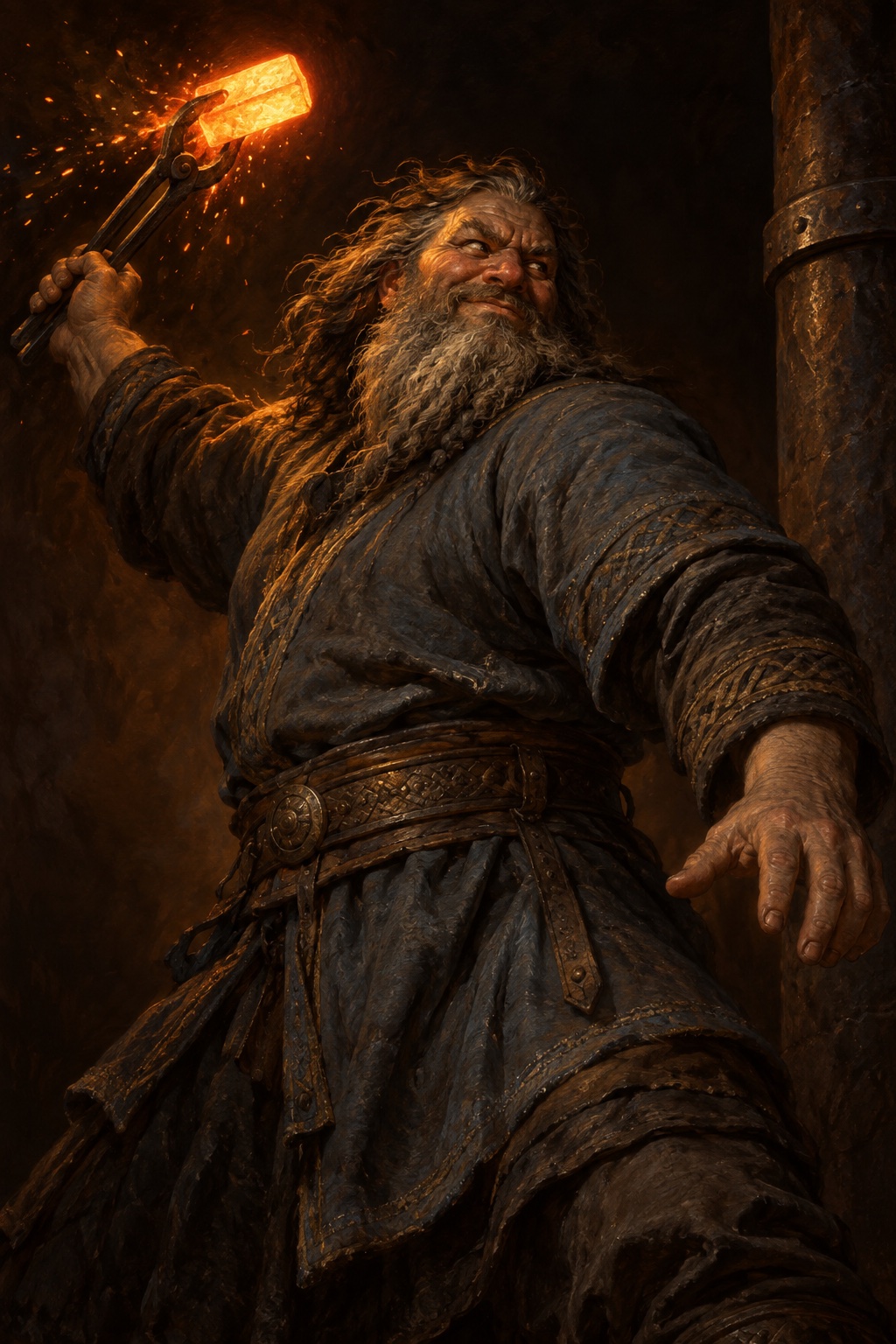
Þá lét Geirröðr kalla Þór í höllina til leika. Þar váru eldar stórir eftir endilangri höll. En er Þórr kom gagnvart Geirröði, þá tók Geirröðr með töng járnsíu glóandi ok kastar at Þór, en Þórr tók í móti með járngreipum ok færir á loft síuna, en Geirröðr hljóp undir járnsúlu at forða sér. Þórr kastaði síunni ok laust gegnum súluna ok gegnum Geirröð ok gegnum vegginn ok svá fyrir útan í jörðina.
“Then Geirrödr had Thor called into the hall to play games. There were great fires the whole length of the hall. When Thor came up over against Geirrödr, then Geirrödr took up a glowing bar of iron with the tongs and cast it at Thor. Thor caught it with his iron gloves and raised the bar in the air, but Geirrödr leapt behind an iron pillar to save himself. Thor lifted up the bar and threw it, and it passed through the pillar and through Geirrödr and through the wall, and so on out, even into the earth.” — Snorri Sturluson, Skáldskaparmál 26 (Brodeur numbers it XVIII), tr. A. G. Brodeur
The game is a throw, and the weapon is the giant’s. Geirröðr takes up með töng járnsíu glóandi, which Brodeur translates as “a glowing bar of iron with the tongs”, and throws it at Thor. This page calls it the bolt. Thor catches it járngreipum, with the iron gloves, and those are the gloves that Gríðr lent him on the way. Geirröðr runs behind an iron pillar, járnsúlu, to save himself. Thor raises the bolt and throws it back.
The last sentence says one word three times: gegnum súluna ok gegnum Geirröð ok gegnum vegginn, through the pillar and through Geirröðr and through the wall. Then the bolt goes on out of the house and into the earth, í jörðina. The pillar does not save him. Snorri’s prose ends on that sentence. It does not describe the body, and it says nothing more about the giant.
Thor wins without Mjöllnir. Loki’s oath kept the hammer away, and Thor kills the giant with the giant’s own weapon, caught in gloves that a giantess lent him. This page records Thor as the one who killed him, with the bolt thrown back through the pillar.
In the poets’ words
Snorri’s lists of kennings keep the story in small pieces. In Skáldskaparmál 11, among the ways to name Thor, he gives vegandi Hrungnis, Geirröðar, Þrívalda, which Brodeur translates as “Smiter of Hrungnir, of Geirrödr and of Thrívaldi”. Among the verses that Snorri gives after the list, a verse by Úlfr Uggason calls Thor “Vimur’s ford’s Wide-Grappler”, and Snorri explains the name: “There is a river called Vimur, which Thor waded when he journeyed to the garth of Geirrödr.” In the next verse the poet Vetrliði speaks to Thor, and one of the deeds he names is “Didst stand on lifeless Gjálp”.
Loki’s part of the story became a name too. In Skáldskaparmál 23, which Brodeur numbers XVI, Snorri’s list of ways to name Loki calls him “Visitor and Chest-Trapping of Geirrödr”. The three months in the chest became one of Loki’s names.
A second Geirröðr, the king who has Odin tortured in Grímnismál, is a different figure, and nothing on this page comes from that poem.
This wiki files Geirröðr with the monsters, as it files the other giants; Snorri’s own word for him is jötunn. Fire is for the great fires down the length of his hall and for the glowing bolt, the only weapon that the text puts in his hands. Snorri gives him a house, two daughters and one throw, and the throw comes back and kills him.