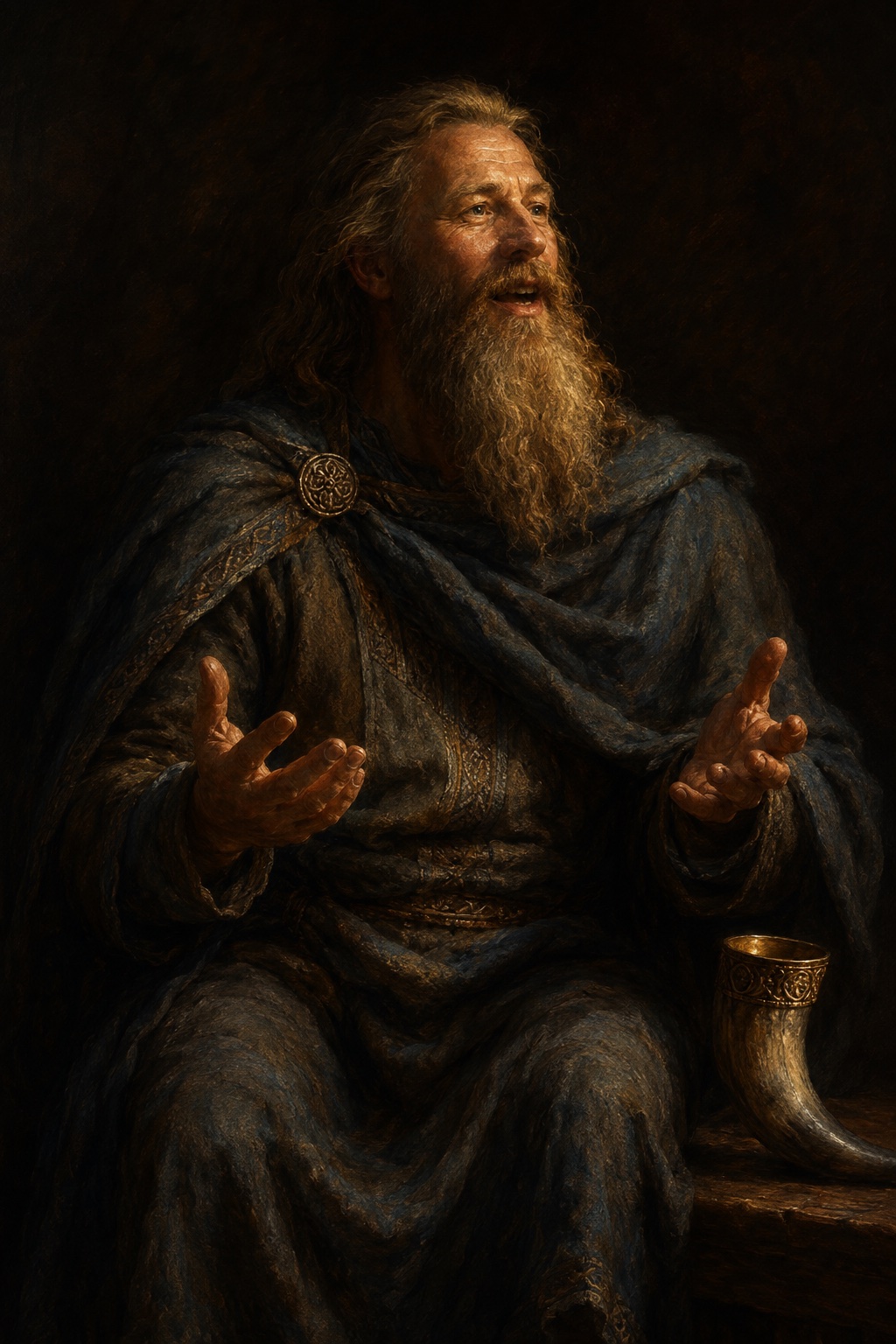
The god the word is named after
Snorri introduces him in a single paragraph, immediately after Týr and immediately before Iðunn, and gives him no parentage, no hall and no episode. What he gives him is a vocabulary.
Bragi heitir einn. Hann er ágætr at speki ok mest at málsnilld ok orðfimi. Hann kann mest af skáldskap, ok af honum er bragr kallaðr skáldskapr, ok af hans nafni er sá kallaðr bragr karla eða bragr kvinna, er orðsnilld hefir framar en aðrir, kona eða karlmaðr
“One is called Bragi: he is renowned for wisdom, and most of all for fluency of speech and skill with words. He knows most of skaldship, and after him skaldship is called bragr, and from his name that one is called bragr-man or -woman, who possesses eloquence surpassing others, of women or of men.” — Snorri Sturluson, Gylfaginning 26, tr. A. G. Brodeur
The claim is etymological and it runs the wrong way round, which is worth saying plainly: bragr is an ordinary Old Norse noun for poetry and for the foremost of a kind, and a god named Bragi looks very much like the word given a person to belong to. Snorri asserts the reverse — the art is named after the god — and then extends it, so that any outstandingly eloquent human, woman or man, is called a bragr of their sex. Nothing here is a story. It is a definition with a face on it.
The very next sentence in the chapter is Kona hans er Iðunn, his wife is Iðunn, and everything the corpus records about the apples of youth hangs off that clause. Snorri had nowhere else to put her.
The offer
The one poem that lets him speak is Lokasenna, and it does not go well. Loki has forced his way into Ægir’s hall, greeted every god and goddess present, and pointedly excluded one: all hail, he says, except the god who sits there on the bench, Bragi. Bragi’s answer is to try to buy the peace.
Mar ok mæki gef ek þér míns féar, ok bætir þér svá baugi Bragi, síðr þú ásum öfund of gjaldir, grem þú eigi goð at þér
“A horse and a sword from my hoard will I give, / And a ring gives Bragi to boot, / That hatred thou makst not among the gods; / So rouse not the great ones to wrath.” — Lokasenna 12, tr. H. A. Bellows
A horse, a sword and a ring is the standard shape of a settlement gift in the sagas — the price of a killing, offered here for an insult that has not happened yet. He also speaks of himself in the third person while offering it, which reads less like grandeur than like a man reciting a formula.
Loki takes the offer as an admission and answers it with the one accusation a bench-poet cannot disprove: of the gods and elves in the hall, Bragi is the least brave in battle and the shyest of shooting.
The threat, and who has to stop it
Bragi’s reply is the only aggressive line he has anywhere in the corpus, and it is conditional.
Veit ek, ef fyr útan værak, svá sem fyr innan emk, Ægis höll of kominn, höfuð þitt bæra ek í hendi mér; lykak þér þat fyr lygi
“Now were I without as I am within, / And here in Ægir’s hall, / Thine head would I bear in mine hands away, / And pay thee the price of thy lies.” — Lokasenna 14, tr. H. A. Bellows
If I were outside as I am inside. The hall is under a truce and blood may not be shed in it, so the threat is legally sound and practically empty, and Loki says so at once — bold in your seat, he answers, calling him bekkskrautuðr, bench-ornament, and telling him to go outside and fight if he is actually angry. It is the cruellest single word anyone throws in the poem, and it lands because the god of eloquence has just proved that eloquence is what he has instead.
What ends the exchange is Iðunn. She asks Loki’s kinship to be weighed and begs her husband not to speak to him with words of spite — and Loki turns on her instead, which is how she ends up in the poem at all. The god who is renowned for skill with words is talked over, defended by his wife, and does not speak again for the remaining forty stanzas. Snorri’s later Skáldskaparmál restores him to his proper element at the same feast, sitting beside the same host and telling the tales of the gods, including the one about Þjazi carrying his wife off. That is where he is most himself: not a participant, but the voice the stories arrive in.